Technological Advancements: such as LCD and OLED screens used in smartphones, televisions, and computers.
Environmental Benefit: reduced GHG emission
Medical Applications: phototherapy for neonatal jaundice.
Displays and Screens
Drones
National Drone Policy 2021
E.g. TAPAS - DRDO
Technology used during Covid 19
Contact tracing - GPS, Bluetooth, QR Code
Telemedicine
Work from home
Virtual learning
Supply chain management
Bose-Einstein statistics and revolution in the field of physics
New State of Matter: Bose-Einstein Condensates that is super cool and super unexcited
Development of Quantum Mechanics
Help in explaining superfluidity and superconductivity
MRI machines and maglev trains
Development of quantum computing
Quantum bits (qubits) based on bosonic system
Astrophysics: study of black holes, neutron stars, and the early universe
Laser Technology
Particle Physics
Educational and research
4th Industrial Revolution
Cyber Physical Systems
Growing interconnectedness, smart automation and blurring line between physical, digital and biological world.
Rapid change in technology, industry and society in 21st century.
Technologies
AI, Robotics, Internet of Things (IoT), Blockchain, 3D printing
Augmented and Virtual Reality (AR/VR)
Advanced Materials
Clean Energy Technologies
Edge Computing
Autonomous Vehicles
Drones
Significance
societal order, changing world order, emergence of new leaders as seen from past, who would exercise more hegemonic power, authority and rising inequality, basically Darwinism.
Medicine
Application of medical science in daily life
Health Monitoring Devices - wearable devices - tracks heart rate, blood pressure, and activity levels.
Assistive Devices - prosthetics, mobility aids
Disease Prevention and Management
Diagnostic Technologies - X-rays, CT scans, and MRI, blood, urine, and genetic analysis.
Telemedicine
Medical Treatments
Mental Health Support - psychotherapies, medication
Expand boundaries of human knowledge and understanding of universe
Interdisciplinary technological innovation - astronomy, material science, robotics, AI, Nanotech
Inspiration future generations of scientists and engineers.
Potential for discovery of extra-terrestrial life
Philosophical insights: addresses fundamental questions about our place in the universe.
Gaganyaan Mission
First manned mission proposed to be launched soon.
Technology constraints (*life cycle approach)
Life support system
Space suit and crew support system
Crew ejection module
Astronaut training
launch vehicle reliability
Logistical constraints
Capacity
Astronaut training facilities
Lack of sophisticated equipment’s
Way forward
Integrated Air Drop Test (IADT), Pad Abort Test (PAT) and Test Vehicle (TV) flights
Space station
plans to build a space station by 2030, following the success of its Gaganyaan mission
modular, 20-tonne structure capable of hosting astronauts for 15-20 days and can be extended
Objectives and benefits
Scientific Research: platform for conducting microgravity experiments
Technological Advancement: life support systems, space habitats, and orbital modules
Educational advancement in fields such as astronomy, materials science, biology, and medicine
Commercial Opportunities: satellite servicing, space tourism
Human Spaceflight Experience: help Indian astronaut in future inter-planetary missions
Joint missions and collaborative research with global space agencies
National Prestige
Inspiration for careers in STEM
Artemis Accords
Non-binding guidelines regarding the return of humans to the moon permanently under Artemis program.
Features
Plans for a base on the lunar surface,
multiple spacecraft to ferry humans and cargo
an orbiting space station
constellation of satellites to help with navigation and communication.
Peaceful use of space, registration, and liability.
Extract and utilise space resources.
Chandrayaan
Why south pole?
Unexplored Territory
Permanent Shadowed Regions
Temperature as low as -230°C. -> preserve ancient volatiles, such as water ice and organic molecules.
Mission objectives
Soft Landing on Lunar Surface
Lunar Surface Analysis
Technological Demonstration
Deployment of Rover: harsh lunar environment and difficult terrain
Demonstration of Communication Capabilities:
Conduct in-situ scientific experiments
Systems in the Spacecraft Launched
Launch vehicle - LVM3
Vikram Lander
Landing Gear System
Navigation Sensor
Onboard Computer
Communication System
Solar Panels
Pragyaan Rover
Scientific Instruments:
India’s Space station (Bharatiya Antariksha Station)
Current Plan
First module to be launched by 2028 and completion by 2035.
Capable of accommodating 3 astronauts up to 20 days
It will weigh around 20 tonnes
IT
Web 3.0
Decentralized online ecosystem based on blockchain technology and multiverse.
5G
Introduction
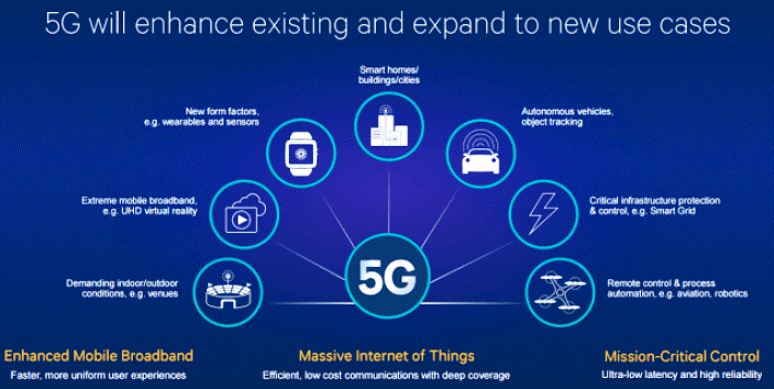
According to McKinsey, 5G is expected to create a cumulative economic impact of $1 trillion in India by 2035.
It is the next generation cellular technology that will provide faster and more reliable communication with ultra-low latency.
5G is expected to form the backbone of emerging technologies such as the Internet of Things (IoT) and machine to machine communications.
Sensor-embedded network - allow real time relay of information across diverse fields.
3 factors - coverage, speed, latency
Has ultra-reliable low latency (ranging between10 milliseconds and 1 millisecond)
Mainly works in 3 bands, namely low, mid and high-frequency spectrum
Low Frequency - large coverage, limited speed(100 MBPS)
High frequency - extremely limited coverage, very high speed (2-20 GBPS)
Applications | Impact in everyday life
Connectivity - video calls, smart homes, mobile computing etc.
Governance
Social welfare - health - remote surgery and prescription, education and skill training
Agriculture - smart and data-driven farming
Industrial automation
Challenges
Rural inclusion - concerns of inequality in society
Security and right to privacy
Infrastructure intensive
Regulatory restrictions
Network investment
Way forward
Judicious use of spectrum (Idle spectrum must be freed up)
Develop internal capacities
5G start-ups in design and manufacturing
Conclusion
5G will act as the catalyst for Digital India—a watershed moment in digital transformation.
Blockchain technology
Computers
Artificial Intelligence
A McKinsey study reviewing the impact of AI on the Sustainable Development Goals (SDGs) finds that AI may act as an enabler on 79% of all SDG targets.
AI can add $1 Trillion to GDP and 20 million jobs by 2030- NASSCOM.
AI refers to the ability of machines to perform cognitive tasks like thinking, perceiving, learning, problem solving and decision making that normally requires human intelligence.
Chat GPT
ChatGPT is an advanced language model designed to generate human-like text response. It is based on the GPT-3.5 architecture, which stands for “Generative Pre-trained Transformer 3.5.
Generative Pre-trained Transformer 3 (GPT-3) is an NLP Model that uses deep learning to produce human-like text.
Applications | Effects in everyday life
Business application (sales, marketing etc.)
Improving productivity
Automation of workflows like reports, summaries, drafts documents
Automation
Creative content generation
Open AI’s DALL-E
innovation and scientific advancements
artistic exploration by enhancing creative process
Decentralised internet through web 3.0
Healthcare advancements: AlphaFold by Google DeepMind.
Clinical Diagnosis
Early detection and diagnosis: of disease like cancer, cardiac issues
Better accuracy in analyzing medical images like X-rays, MRI scans, CT scans
Faster analysis of patient’s data and medical records
Personalized medication as per patients lifestyle, genetics, medical history
Drug discovery and effective development of new treatments
Issues
Economic
Job Displacement
85 million jobs may be lost to AI by 2025 [WEF Report]
Digital have nots
Ethical
privacy, bias, data security, IPR Violations
New York Times sued OpenAI
Generative AI - plagiarism, fake news, propaganda.
Inappropriate/Offensive content
Artificial hallucination
Environmental
High energy consumption
Security
Cybersecurity
Privacy; data security
Algorithmic biases which can reinforce societal biases
Social
Digital divide
Between peoples, businesses, nations
Stereotyping and prejudice
Manipulated media; misinformation, fake news
Deep fakes
Regulation and Governance:
Superintelligent AI: existential risks
Lack of AI research in India
Threat to Privacy of the Individual
Data breach and cyberattacks
Unauthorized access can lead to leak of sensitive information
Data misuse for other purposes
Informed consent issue
Regulatory challenges
Measures
Ethical AI
“AI ombudsman”
REAIM 2023 - Responsible AI in military
Regulatory guardrails
EU AI Act
DEEP FAKES Accountability Act in the U.S.
Job Transition economic policies
Reskilling and Upskilling Programs
E.g., ‘FutureSkills PRIME’ by MeitY & IT and NASSCOM
Responsible AI for Youth
Social Safety Nets:
UBI
RAISE: Responsible AI for Social Empowerment
Education and public awareness
Integrating AI awareness into school courses
Transparency and accountability
Development of regulatory algorithms
Technical debt and regulatory audits of code/algorithms
E.g. COBIT ERM Frameworks.
Inclusive and Representative Datasets:
Public-Private Partnerships
IndiaAI Mission
Rs 10,300 crore
AI Projects
BHASHINI-[BHASHa INterface for India]
National Supercomputing Mission
MeitY Quantum Computing Applications Lab
Centre of Excellence for Artificial Intelligence
National Centre on AI (NCAI)
International
Global Partnership on Artificial Intelligence (GPAI) - OCED (India - founding member)
Responsible AI for Social Empowerment (RAISE)
US - proposed AI Bill of Rights Blueprint
Bletchley Declaration - UK Summit on AI Safety
Regulation of AI - Complex Adaptive System
Establishing expert regulatory body [Bibek Debroy]
Open licensing of core algorithms for external audits (transparency)
Incident reporting protocols for failures (AI accountability)
Manual controls and authorization checkpoints
Empowers humans to intervene
Guardrails: implementing limits on AI behaviours
By law enforcement agencies
Way forward
Meity launched IndiaAI in 2023, covering all AI-related research.
Whole of society and whole of world approach
strike the right balance between AI promotion and AI governance
Conclusion
Need for multi-stakeholder efforts on global cooperation so AI is used in a manner that is “trustworthy, human rights-based, safe and sustainable, and promotes peace”.
Quantum Computing
Quantum computing is a field of computing that utilizes principles from quantum mechanics to solve complex problems. Unlike classical computers that use bits (0s and 1s), quantum computers use qubits.
Features
Superimposition
Entanglement: is a unique quantum phenomenon where two or more qubits become linked, sharing the same fate.
Use quantum gates
Application
Efficiently solve complex problems
Encryption of private keys
Identifying and Treating diseases
Materials Science
Machine Learning
Weather Forecasting
Space Research
Effects in everyday life
*SPECIALTY
Issues
Scalability
High Resource Requirements
Security Concerns:
Can be used for hacking and compromising systems of adversary’s critical infrastructure
Ethical and Societal Implications
Access and Affordability
Government initiatives
National Mission on Quantum Technology and Application, 2020
Quantum Computing Applications Lab (QCAL):
Quantum-enabled Science and Technologies (QuEST) funding
Way forward
Indigenization of quantum technology
Promote developers, students and scientists.
V Kamakoti Committee for financing research and development
Metaverse
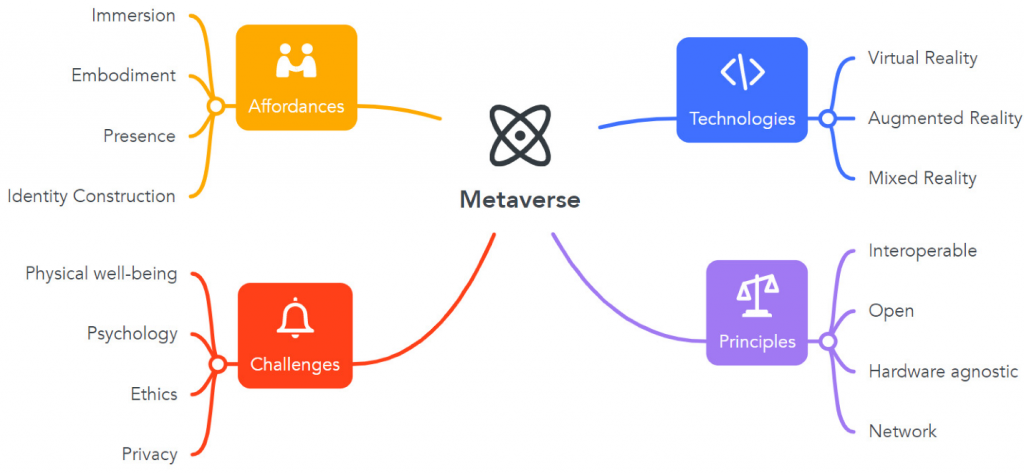
The Metaverse is defined as a spatial computing platform that offers digital experiences as an alternative to or replica of the real world.
Built on the foundation of blockchain technology.
Cloud computing
It is the on-demand delivery of IT resources (computing power, storage, and databases) over the Internet with pay-as-you-go pricing.
Types
Infrastructure as a Service (IaaS)
Platform as a Service (PaaS)
Software as a Service (SaaS)
Security implication
Data privacy
Data jurisdiction
Dependence on a third party
Government initiative
“GI Cloud” – ‘Meghraj’, by the Government of India to harness the benefits of cloud computing.
Blockchain technology
sophisticated database system
Information is stored in blocks - linked together in a chain
across a network of computers in a peer-to-peer network.
using cryptographic hashing
Neurocomputing is a field of computer science that draws inspiration from the structure and function of the human brain to create new computing paradigms. It aims to develop artificial neural networks (ANNs) that can mimic the brain’s ability to learn, adapt, and perform complex tasks, such as pattern recognition, decision-making, and natural language processing.
Argument for using digital technology
Increased access to vast amount of data on diverse topics
E.g. ChatGPT
Objective and data-driven decision-making
E.g. Big data analysis for soil health
Real time analysis
E.g. Gati Shakti Portal
Transparency and accountability
E.g. SWIFT Portal
Virtual simulation can help predicting potential outcomes
E.g. Disaster drills in Metaverse
Arguments against using digital technology
Filter bubbles: can create echo chambers
Social media profiling based on likes
Algorithmic bias - may reinforce existing bias
Credit score based on socio-economic profiling exacerbate inequality
irrational decisions based on misinformation and fake news
E.g. Deepfakes to influence public opinion during elections
errors and misinterpretations
Artificial hallucination
Privacy
E.g. Pegasus
Robotics
the branch of technology that deals with the design, construction, operation, and application of robots
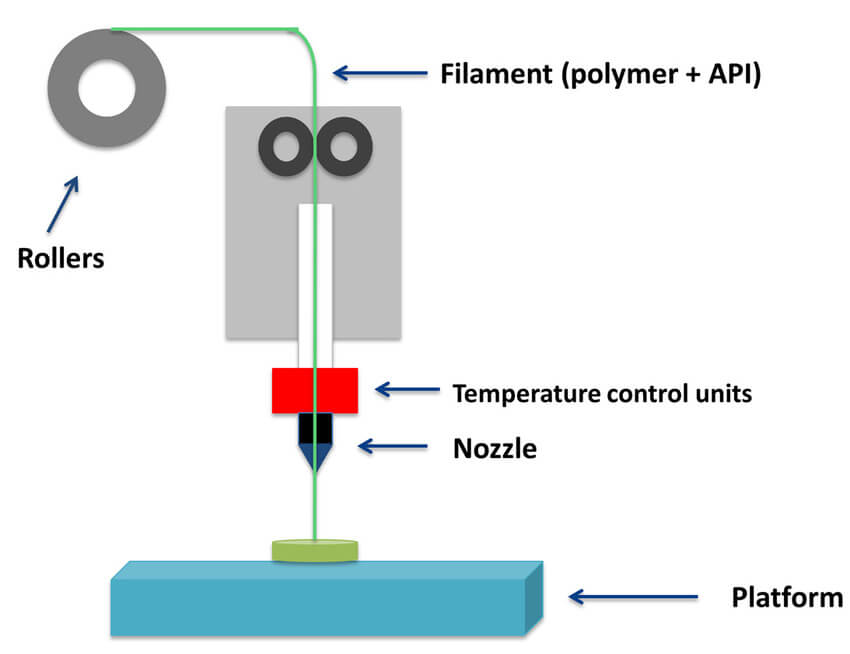
3D printing - additive manufacturing
Manufacturing technique that creates three-dimensional objects by adding material layer by layer.
Applications
Medical
Producing custom implants and prosthetics
organ and tissue replacements through bioprinting
Prototyping and Product Development
create miniature building models
Consumer Goods
smartphone cases, décor items
Space Exploration
NASA has used 3D printing on the International Space Station
Environmental Sustainability
3D printing to reduce construction waste
The 4 Ds Of Robotization: Dull, Dirty, Dangerous And Dear
Optimus - humanoid robot - SpaceX
Issac Asimov’s Three Laws of Robotics:
First Law: A robot may not injure a human being or, through inaction, allow a human being to come to harm.
Second Law: A robot must obey the orders given it by human beings, except where such orders would conflict with the First Law.
Third Law: A robot must protect its own existence as long as such protection does not conflict with the First or Second Law.
Nano-technology
Introduction
Nanotechnology involves manipulating matter on an atomic, molecular, and supramolecular scale, typically below 100 nanometers.
Significance
Interdisciplinary Applications
Enhanced Properties
Biocompatibility: interact with living tissues without causing harm.
Implants, prosthetics, drug delivery system
Corrosion Resistance
Design Flexibility
Applications - HEDC
Healthcare
Targeted drug delivery systems-
Liposomal nanoparticles used to deliver chemotherapy drugs directly to cancer cells
Enhance Diagnostics tools -
Quantum dots used in medical imaging
E.g. cardiac disease - nanochips to check plague in artilleries.
E.g. cancer - nano flares
Regenerative Medicine
Nanofibers used in wound dressings
Antimicrobial Treatment
Silver nanoparticles used in medical devices to prevent bacterial infections
Cancer Treatment
Gold nanoparticles used to deliver heat to tumor cells selectively destroying them
Stem cell technology - e.g. magnetic nano particles to isolate group of stem cells
Energy - e.g. perovskite nanoparticles used in PV cells
Environment e.g. nano filters, pollution monitoring, and remediation techniques.
Electronics and Computing:
Carbon nanotubes are used in transistors to create powerful microprocessors
Materials Science: Graphene is incredibly strong and conductive
Defence
Nano-composite materials
Automotive Industry
Nano-coatings on car bodies make them scratch-resistant
Space
Lightweight spacecraft
Consumers
Nano-filters
Glass screens
Electronic devices
Bio-materials
Nano-capsules, DNA nano-chips
Agriculture
Nanopesticides and Nanofertilizers
E.g. Silver nanoparticles
Nanosensors
monitor soil conditions, nutrient levels, and plant health
E.g. Carbon nanotubes
Nanocarriers
targeted delivery of growth regulators to specific plant tissues
Nanostructured seed coatings
Silicon dioxide nanoparticles
Nanoparticles of Titanium Dioxide (TiO2)
Carbon nanotubes (CNT)
Tube made up of carbon atoms rolled up in form of hexagonal lattice to form a hollow cylinder.
Properties (Uses)
Electrical Conductivity
Energy storage
Electricity transmission
Strength And Elasticity
Wearable technology
automotive parts
Thermal Conductivity And Expansion
thin-film electronics
Electron Emission
Non bio toxic
Biomedical devices
Biomedical implants
Issues
Health and Safety
Environmental Impact:
Can enter food chain and cause bio-magnification
Environmental pollution
Ethical Considerations
Can be used in biological weapons
Regulatory Challenges
Societal Implications:
Public Perception and Awareness:
Way forward
Nano Mission - by DST
Centre for Nano and Soft Matter Sciences (CeNS) in Bengaluru
iCAT - US
INSPIRE (Innovation in Science Pursuit for Inspired Research) Scholarships
V Kamakoti committee - Spending on R&D 0.67% -> 2% of GDP
National nanoscience and technology mission
International collaborations
Polymers
Bio-technology
Introduction
UNCBD defines biotechnology as any technological application that uses biological systems or living organisms to make or modify products or processes for specific use.
Applied biotechnology refers to the use of biological systems and organisms to develop products and technologies for human welfare
Achievements | Application
Agriculture
HYV Crops - GM Crops
e.g. BT Cotton, GM Mustard
Biofortification
Golden Rice, enriched with Vitamin A
Agriculture Inputs - Bio fertilizers, pesticides etc.
E.g. Nano Urea
Health
Molecular Diagnosis
RTPCR tests during COVID-19
Recombinant DNA (rDNA) - Genetically engineered Insulin
Vaccine development - (mRNA) - Pfizer, Moderna
Stem cells therapy - organs and tissues regeneration
Advantage - self renewal, less invasive, incurable disease, low side effects, high success rate
Gene therapy - to cure rare genetic disease
CRISPER-Cas9 - HIV and AIDS therapy
Genome Sequencing
Biopharmaceuticals - Inventing new drugs using recombinant DNA technology.
Environment
Bioremediation: Using microorganisms to clean up environmental pollutants
Oil-eating bacteria
Treatment of waste - phytoremediation
Biodegradable plastics
Biofuels
Bio filters
Biosensors
Effects in everyday life
Economic development
Social (SDG)
Poverty reduction
Food security
Health
Issues
Potential Health Risks - genetically modified organisms (GMOs)
Access and Equity - ‘health divide’
Privacy of genetic data
Environmental Impact - e.g. GM Crops
Ethical issues - genetic engineering or cloning
Way forward
Comprehensive strategy: National Biotechnology Development Strategy
Government Support
Biotechnology Industry Research Assistance Council (BIRAC)
Skill development: scientists, researchers, and professionals in biotechnology and related fields.
Strong emphasis on R&D
Increasing investments from both public and private sectors, VC and FDI
Biotechnology infrastructure development
Public-Private Partnerships:
V. Kamakoti Committee
Promote FDI
*Life cycle approach
Industry-academia linkage
IPR policy
Regulation
IP Rights
Introduction
Intellectual Property Rights (IPRs) are legal rights that grant creators protection for their inventions, designs, artistic works, and brands.
IP is intangible property that is product of human intellect, creativity and innovation.
India has been ranked 40th out of 53 countries on the Global Intellectual Property Index.
Global innovation index 2022 - India at 40/132.
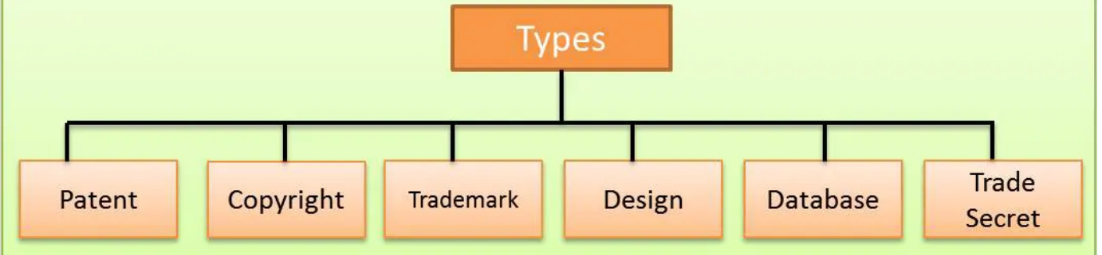
Types of IPR
Patents -
Exclusive right, can be granted for product or industrial process having economic significance.
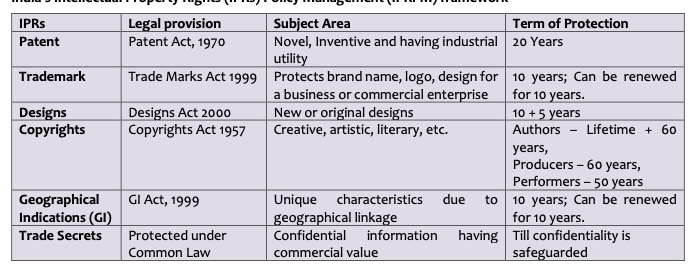
limited period - e.g. 20 years
Criteria - novelty, non-obviousness, and utility.
E.g. Novartis (failed on novelty)
Granted under Indian patent Act 1970
Invention
A new process or product with significant difference from the existing one
Requirement - Novelty, Non-obviousness, Utility
Trademark
Graphical representation to establish distinctively
E.g.- logo
Trademark Act, 1999
Trade Secret
A device or technique used in manufacturing process having commercial value, competitive advantage.
Copyrights
Excusive right for artistic material for producing, publishing etc.
Copyrights are automatic upon creation and do not require registration.
Geographical Indicators
Significance of IPR
Encourages Innovation and Creativity
Patent to population ratio- USA- 1:6000, China- 1:25000, India - 1:600000
Creating a culture of research and development
Attracting Foreign Direct Investment (FDI): Pharma Companies
Promoting R&D and Higher Education: IITs, NITs, increasingly filing patents
Challenges
Balancing IP rights with accessibility and affordability
E.g. essential medicines, educational resources
Enforcement challenge
E.g. Piracy, plagiarism, counterfeiting
Adjudication delays
no special IP courts set up to deal with cases
Evergreening of patents
Patenting of traditional knowledge(TK)
Issues
Pharmaceutical and Software Patents
Section 3(k) bars patentability of computer programs per se or algorithms.
Compulsory licensing
Section 3d of Patents Act, 2007 and power to issue compulsory licenses.
Section 84 provides for Exception to IP rules - legally pay fee and use a patented product
Grounds?
Reasonable need
Patent outside india
Essential and Not affordable
Issues - Export of medicines manufactured using compulsory licensing
E.g. Bayer Corporation case
R&D Problems
Infrastructure
India spends only around 0.65% of its GDP on R&D. China- 2.1%, USA 2.8%
brain drain - lack of attractive opportunities.
Lack of private participation
Global R&D is 65-70%, for India it is 35%
IPR Regime in India
The Copyright Act, 1957
The Patents Act, 1970
process patent regime, But due to obligations arising out of the TRIPS Agreement, India had to amend the Patents Act in 2005, and switch to a product patents regime across the pharma, chemicals, and biotech sectors.
The Trademarks Act, 1999
The Geographical Indications of Goods (Registration and Protection) Act, 1999
The Designs Act, 2000
The Intellectual Property Appellate Board (IPAB)
Patents (Amendment) Rules, 2024
International Agreements Related to IPRs
TRIPS Agreement under WTO
Patent Cooperation Treaty (PCT) - WIPO
Berne Convention - governs copyright
Paris Convention - for the Protection of Industrial Property
Madrid Protocol - trademarks
Nagoya protocol - Prior Informed Consent (PIC) and Access and Benefit-Sharing (ABS)
Government initiatives
National IPR Policy 2016
Cell for IPR Promotion and Management (CIPAM)
National Intellectual Property Awareness Mission (NIPAM)
Patent Facilitation Centers (PFCs):
To help MSME and academic institutions
Intellectual Property Literacy and Awareness
NIPAM, IP Nani and Chotu
Digitization and modernization
e-filing system for trademarks and patents
encouragement to international patent filing (SIP-EIT Scheme, Patents Prosecution Highway)
National Research Foundation (NRF) for centralized research funding
50000-crore initiative
Traditional Knowledge Digital Library (TKDL)
Traditional Healer Empowerment Program
Visiting Advanced Joint Research (VAJRA) Faculty - invites oversees scientists to serve as adjunct faculties in Indian public institutions.
Global initiative for academic network (GIAN)
Miscellaneous
Microorganism in meeting fuel shortage
Biofuel production
Bioethanol: bacteria fermenting sugars into ethanol
Biodiesel
Biomethane
Waste-to-Energy Conversion
Microbes can convert organic waste material into biofuel like methane
Enhanced Oil Recovery: certain microorganism known to enhance extraction of trapped oil in reservoir
Advantages: Renewable, Environmentally friendly, support livelihoods of farmers