History Index
Modern Indian History
| On education | Gandhi | Tagore |
|---|---|---|
| Philosophy of education | - - - - Advocated ‘Nai Talim’ or basic education - E.g. emphasis on handicrafts and self-sufficiency | - - - - Promoted education that foster creativity and freedom - Example: Founded Visva-Bharati University at Santiniketan |
| Curriculum | - - - - Stressed vocational training as central - Example: Inclusion of spinning, weaving, and agriculture | - - - - Emphasized a broad curriculum including arts, humanities, and sciences - Example: Courses in literature, music |
| Medium of Instruction | - - - - Strong proponent of mother tongue | Supported bilingual education |
| Educational Environment | - - - - Rural schools with minimal infrastructure | Believed in centralized university system |
| Role of Teachers | role models and facilitators of practical knowledge | mentors and guides in intellectual and artistic pursuit |
| Global Perspective | Localized : aimed at self-reliance | Global outlook integrating international ideas |
| On nationalism | ||
|---|---|---|
| Concept of Nationalism | Gram Swaraj | Nationalism rooted in universal humanism and cultural unity. |
| Methods of Struggle | Non-violent civil disobedience | Intellectual and cultural renaissance to awaken national consciousness |
| Vision for India | Self-reliant, self-sufficient village republic | India as a part of the global community |
| Economic vision | Rejection of industrialization and materialism Example: Book “Hind Swaraj” | Selective acceptance of Western ideas |
| Religious ideas | integrating religious values into nationalism | secular approach promoting universal brotherhood. E.g. “Gitanjali” |
| Gandhi | Bose | |
|---|---|---|
| Philosophical | non-violence (Ahimsa) and truth (Satyagraha). | armed struggle and direct confrontation |
| Means | Mass movements and grassroot mobilization | Military action and external alliance with Axis Powers |
| Relation with British | Sought to negotiate and engage in dialogue | Aimed to completely oust British with force |
| Post independence vision | Gram Swaraj | modern, industrialized India with strong central governance |
| Influence | HD THOREAU, J RUSKIN, EDWARD CARPENTER, GK GOKHALE | Socialism and Marxism |
| Support base | Mass support from all sections of society | Youth and radical nationalist |
-
Evaluate the policies of LORD CURZON and their long term implications on the national movement.
- Policies of LORD CURZON
- Partition of Bengal (1905) : to weaken nationalist sentiment and spread communalism
- Educational changes : The Indian Universities Act (1904) to tighten government control over universities
- Enhancing British control : Calcutta Corporation Act (1899) to limit elected Indian members
- Police and military reform : reorganizing and improvement in training and equipment’s
- Policies of LORD CURZON
-
Long term implications on the national movement
- Rise of Swadeshi Movement and Boycott : raised national consciousness
- Rise of Extremist Leaders like LAL-BAL-PAL who professed radical methods and complete independence
- Emergence of Mass Nationalism : turning point from moderate resistance to mass resistance against British
- Proliferation of nationalist newspapers : “Kesari” and “Amrita Bazar Patrika”
- Communalisation of politics : establishment of the All India Muslim League in 1906
- All class participation : women, peasants, students, etc.
-
Foreigners in the Indian Freedom Struggle
- ANNIE BESANT
- MADELINE SLADE (MIRABEHN)
- C.F. ANDREWS
- SISTER NIVEDITA (MARGARET ELIZABETH NOBLE)
- A.O. HUME
Issues
-
Reasons for the Sudden Spurt in Famines:
- Shift to cash crops : cultivation of indigo, cotton, opium replaced rice, wheat
- Permanent Settlement and Ryotwari system extracted imposed huge demands regardless of yields
- Example: Caused the Bengal Famine of 1770
- Plantation activities : large scale jute, tea, coffee plantation for exports replaced traditional agricultural system
- Food exports during shortages : exacerbated the crisis
- Example: Export of wheat from India during the Great Famine of 1876-78.
- Natural factors : erratic monsoons and pest attacks
- Lack of storage facilities : led to rot and spoilage
- Inadequate, delayed and poorly implemented relief measures led to many starving to death
- Bureaucratic indifference and apathy
-
Reasons for decline of traditional artisanry
- Colonial economic policies : Imposed heavy duties on Indian exports and allowed duty free entry to British exports
- Loss of patronage : wealthy elites and royal courts shifted preference towards imported goods over Indian artisans
- Anti competitive policies : imposition of high taxes on artisans and raw materials
- Export of raw materials from India to British industries, rather then supporting local production
- Limited technological adaptation
- E.g. Indian weavers could not compete with British textile mills
- Breakdown of traditional apprenticeship system
- E.g. because it was no more economically feasible.
-
Crippling impact on rural economy
- Unemployment and poverty
- Example: Displacement of millions of weavers, potters, handicraftsman
- Migration to urban areas
- Agricultural overdependence
- Example: Increased pressure on agricultural land and resource
- Indebtedness to moneylenders
- Many artisans fell into debt traps
- Loss of cultural heritage
- Near disappearance of intricate textile crafts like muslin weaving and traditional pottery
- Gender impact : artisan women were disproportionately affected
- Economic disruption
- Many supporting economic activities like trade, transport, commerce vanished
- Unemployment and poverty
-
Why British armies with Indian soldiers won against more numerous Indian armies
- Superior military organization : well-organized, disciplined, and professionally trained
- Example : regimental structure not divided on caste and religion
- Effective leadership : good first and second line of military commanders
- Example: ROBERT CLIVE
- Strategic planning and battlefield manoeuvres
- Example : Siege of Arcot
- Advanced weapons including artillery, firearms like cannons and muskets
- Exploited political fragmentation by forging alliance with one against other
- Example: Alliances with Marathas and the Nizam of Hyderabad against TIPU SULTAN
- Naval superiority : helped British to transport troops, supply and reinforcements quickly maintaining logistical edge
- Robust financial resources enabled maintenance and recruitment of well paid and loyal army
- Intelligence and espionage : allowed to plan decisive action
- Superior military organization : well-organized, disciplined, and professionally trained
-
Major issues and debates concerning women
- Abolition of Sati:
- Example: RAJA RAM MOHAN ROY efforts led to legal abolition of sati in 1829 by LORD WILLIAM BENTINCK.
- Child Marriage
- Example: The Age of Consent Act, 1891, raised legal marriage age
- Widow Remarriage
- Example: ISHWAR CHANDRA VIDYASAGAR’s campaign led to Hindu Widows’ Remarriage Act, 1856
- Purdah System : secluding women from public life
- Female Infanticide
- Example: The Female Infanticide Prevention Act of 1870
- Women’s education
- Example: Reformers like JYOTIRAO PHULE and SAVITRIBAI PHULE established schools for girls
- Polygamy
- Women’s employment
- Legal and property rights : denied property inheritance.
- Role in the Public Sphere : including participation in social, political, and economic activities.
- Abolition of Sati:
Post Independence India
-
Integration process of Indian princely states
- administrative issues
- Different governance structures
- Distinct legal systems
- Economic disparities
- Resistance from rulers
- Military integration
- Infrastructural challenges
- Regional disparities
- Administrative overhaul
- Personal aspirations to remain independent
- Ensuring fair political representation
- socio –cultural problems
- Linguistic diversity
- Tribal conflicts
- Communal conflicts
- Zamindari system need to be abolished
- Social fragmentation on caste basis
- Social injustices
- administrative issues
-
Political and Administrative Reorganization
- Integration of Princely States
- State Reorganization Act (1956)
- 14 states and 6 union territories were created
- Post-1956 Reorganizations (Continuous Process)
- Maharashtra and Gujarat in 1960
- Dadra and Nagar Haveli, Goa, Daman and Diu, Puducherry.
- Nagaland
- Haryana, Punjab and Himachal Pradesh
- Manipur, Tripura and Meghalaya, Sikkim
- Uttarakhand (2000), Chhattisgarh (2000), Jharkhand (2000), and Telangana (2014)
- Jammu & Kashmir and Ladakh (2019)
- Demand for New States
- Bagelkhand, Bundelkhand, Bodoland, Gorkhaland, Harit Pradesh, Mahakoshal, Marathwada, Mithila, Purvanchal, Vidarbha, Vindhya Pradesh
-
Compulsions prompted India to liberate Bangladesh
- Refugee crisis
- Regional stability
- Maritime security
- Humanitarian compulsions : genocides and atrocities
- Moral responsibility : massive human rights abuse including rape and killings of civilians
World History
-
Reasons for Indentured Labour Migration
- Labour shortage post abolition of slavery in 1833 particularly in the Caribbean, Mauritius, and Fiji
- Labour surplus in India coupled with poverty, unemployment and famines
- Indenture system was fixed term contract provided British with more controlled workforce
- Economic needs of British plantations and businesses in colonies.
- Indians were often seen as better suited to the climate
-
Preservation of Cultural Identity
- Festivals, languages, tradition
- Religious institutions : temples, mosques
- Community organization
- Literature and storytelling
- Music, Cuisines
-
Problems in decolonization of Malay Peninsula
- Ethnic tensions : Malays, Chinese, and Indians
- Example: The 1969 race riots highlighted deep-seated ethnic grievances.
- Communist Insurgency : led to destabilizing the region
- Economic Disparities fueled resentment and competition
- Differences in language and educational systems
- Example: Chinese schools teaching in Mandarin versus Malay-medium national schools.
- Cold War influenced domestic stability
- Communal Politics : Political parties were formed along ethnic lines
- Security Concerns : led to situation of emergency
- Lack of national unity
- Weak administrative system not fully adapted for self governance
- Contestation on a new constitutional framework
- Ethnic tensions : Malays, Chinese, and Indians
Beginning of the Modern World
- Foundations Laid by the American Revolution
- Democracy : advocated for representative government with a system of checks and balances.
- Republicanism : challenged the legitimacy of absolute monarchy
- Emphasis individual rights:
- Example: The Bill of Rights (1791) in the United States
- Capitalism and Free Market :
- right to property and rights on fruits of ones labour
- Federalism
- Liberalism : influenced by Enlightenment thinkers who emphasized reason, logic, and individual liberty.
- Social Contract Theory : idea of legitimate government based on consent of the citizens
- National sovereignty : right of people to self-determination
- Foundations Laid by the French Revolution
- Egalitarianism : abolition of feudalism and aristocratic privileges
- Nationalism : created new ideology for political mobilization
- Secularism : separation of state and religion
- Example: The First Amendment of the U.S. Constitution established the principle of religious freedom
- Example: The French Constitution adapted Laicite
- Revolutionary Radicalism : potential of change through popular uprisings
- Fraternity
Industrial Revolution
- Socio-Economic Effects of the Introduction of Railways
- Industrial Growth : enabled the efficient movement of raw material
- Example: In the UK railways facilitated coal and steel industries
- Urbanization : connected remote rural areas to cities
- Example: cities like Chicago and Manchester expanded rapidly
- Expansion of trade and market
- Flooding of imported cloths in rural India
- Colonial Exploitation: facilitating resource extraction and control.
- timber and coal were heavily exploited facilitated by movement through railways
- Increased movement - social and cultural exchanges
- created new employment, education and leisure opportunities
- Agricultural Development: enabling the transportation of inputs like fertilizers and seeds and the export of agricultural produce
- Industrial Growth : enabled the efficient movement of raw material
World War I
World Between the Two Wars
-
Negatives
- Economic crisis
- The Great Depression of 1929 causing widespread unemployment, poverty, social unrest
- Rise of Totalitarian Regimes
- fascist regimes in Italy under MUSSOLINI and in Germany under HITLER
- The Russian Revolution of 1917 led to the establishment of a communist state
- Social discontent due to inequalities
- Racism and ethnic conflicts
- Intense ideological polarization led to internal and external conflicts
- communism, fascism, and liberal democracy
- Failure of the League of Nations
- Failed to address invasion of Manchuria by Japan (1931) and Abyssinia by Italy (1935)
- Militarization and Expansionism
- Nazi Germany broke the military limited imposed at end of WW1
- Economic crisis
-
Positives
- International Cooperation : formation of the League of Nations in 1920
- New economic policies : KEYNESIAN economic theories for active state role in economic revival
- Development of welfare state : introduction of unemployment benefits, housing, better working conditions
- New Deal under PRESIDENT ROOSEVELT
- Rapid technological and industrial advancements : automobile and aviation industries
- Women’s got right to vote in United States (1920) and the United Kingdom (1928)
- Emergence of rule based world order
- Democratic upsurge post World War 2
World War II
Redrawal of National Boundaries
Colonization
Decolonization
Political Philosophies
Their forms and effect on the society
Communism
Capitalism
Socialism
Ancient History
-
Paleolithic -
- Lower: 2 million years ago till 100000 years ago.
- Middle: 100,000 to 40000 BC.
- Upper: 40,000 BC to 10,000 BC.
-
Mesolithic Age
- It was from 10,000 BC to 6000 BC.
-
Neolithic Age
- It was from 6000 BC to 3000 BC.
-
The Indus Valley Civilization(IVC):
- The Early Phase:(3300 to 2600 BC)
- The Mature Phase:(2600 to 1900 BC)
- The Late Phase:(1900 to 1300 BC)
-
Vedic Phase
- Early Vedic - 1500 BCE to 1000 BCE
- Later Vedic Phase - 1000 BCE - 500 BCE
-
Mahajanapadas
- Magadha Empire - HSN-MSK
- HARANYAK DYNASTY (From 544 to 412 BC) - BAU
- Bimbisara (544-492 BC)
- Ajatshatru (492- 460 BC)
- Udayin (460- 444 BC)
- last Haranyak Ruler (Nag dasak)
- SISUNAG DYNASTY (412-344BC) - SK
- Shishunaga
- Kalakhosha
- Nanda Dynasty (344-321 BC) - MD
- Mahapadma Nanda
- Dhananada
- FOREIGN INVASION
- 516 BC Persian Invasion to India under Achaemenian Ruler DARIUS.
- Macedonian Ruler ALEXANDER Destroyed the Persian Empire and Marched towards India in 363 BC
- MAURYAN EMPIRE (320BC - 185 BC) - CBA
- CHANDRAGUPTA MAURYA
- BINDUSARA (292-272 BC)
- ASHOKA (272-232 BC)
- last Mauryan king Brihadhrath - 185 BC
- Shunga Dynasty (पुश अग्नि )
- Pushyamitra Sunga (185-151 BC)
- Agnimitra (149 to 141 BC)
- Kanva Dynasty
- Vasudev Kanva(74 BC)
- The last ruler of the dynasty Susharman was killed by the Satvahana king
- HARANYAK DYNASTY (From 544 to 412 BC) - BAU
- Magadha Empire - HSN-MSK
-
Indo-Greek Rulers
- Menander I who ruled from 165-130 BC
-
Indo-Synthians/Sakas:
- Vikramaditya (57 BC)
Vikramsamvat - 57 BC
-
Chastana (78 to 130 AD)
- Saka calendar - 78 AD - Official Calendar along with Georgian Calendar
-
Rudradaman (130-150 AD)
-
Parthians
- Gondopherenes
-
Kushans
- The empire was founded by Kujula Khadphises in about 30 AD
- Vima Khadphises
- Kanishka (127 to 150 AD)
-
Satvahana Empire (1st Century BC-2nd Century AD)
- Simuka
- Gautmiputra Satkarni(106-130 AD)
- Vashishtiputra Pulumayi
-
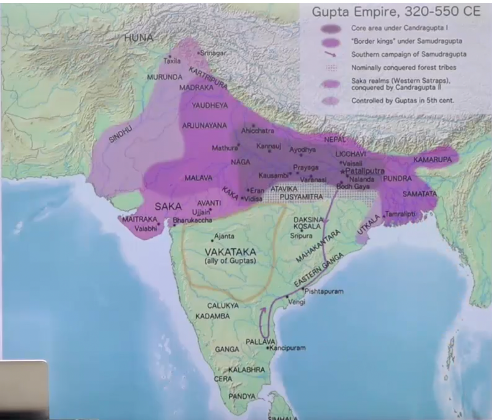
Gupta Empire
- feudatories of Kushanas
- Rulers
- Sri Gupta in 240 AD
- Chandragupta 1(320-335AD)
- Samudragupta (335-375AD)
- Chandragupta 2(376-415AD)
- Contributions
- Sanskrit literature flourished
- KALIDASA’S Abhigyan Shakuntalam
- Development of Nagra style of temple
- Sanskrit literature flourished
Dashavatara Temple at Deogarh.
-
Rock-cut architecture
- Example: The Ajanta and Ellora cave
-
Sculptures
- Standing Buddha sculpture from Sarnath
-
Science and Technology
- Astronomy, astrology developed by Navratna of Chandragupta 2
-
Establishment of a well-organized administrative system
- Provinces named Bhuktis were created
-
Education and Universities:
- Renowned learning centres like Nalanda and Vikramashila universities.
-
Medicine : Sushruta Samhita and Charaka Samhita.
-
Pushyabhuti dynasty
- Prabhakar Vardhan
- Harshvardhan(606 AD to 647 AD)
-
Sangam Age (3rd Century BC - 2rd Century AD)
- Cholas
- Capital Uraiyur
- Elara Conquered Sri Lanka and ruled it for nearly 50 years.
- Karikalan Chola.(around 90 BC) - founded Puhar
- Cheras
- Capital - Vanchi (modern day Kerela)
- trade with Romans
- Nendunjeral Aden(नेंदनजेरल अदन)
- Senguttuvan(सिंगुत्तवं)
- Pandyas
- capital was Madurai.
- Nendunjeliyan(नेंदंजेलियन) I and II
- Cholas
-
Empires in South India
- Pallavas(6th to 9th century AD):
- Mahendravarman(महेंद्रवर्धन) (600 to 630 AD)
- Narsimhavarman I (नरशिमहावरमन)(630-668 AD)
- Rajsimhavarman
- Nandivarman
- Chalukyas
- **Badami Chalukyas-**They were the Earliest Chalukyas who ruled from the 6th to 8th century, their capital was Badami..
- **Eastern Chalukyas-**In 7th Century, Eastern Chalukyas emerged and ruled till the 11th century, their capital was Vengi.
- Western Chalukyas- They Emerged in the late 10th Century and ruled till the 12th century their capital was Kalyani.
- Pulkeshin I founded the empire in 543 AD.
- Kirtivarman (566- 597)
- Mangalesa (597-609)
- Pulkesin II (609 AD to 642 AD)
- Tripartite struggle - supremacy of Kannauj for more than 150 years.
- Palas of Bengal (8th to 12th century)
- Rulers
- Palas of Bengal (8th to 12th century)
- Pallavas(6th to 9th century AD):
Gopala led the foundation of the Pala dynasty.
Dharmapala(770-810 AD)
Devpala(810-850 AD)
-
-
-
-
- Significance in history of Buddhism
-
-
-
Buddhist architecture : constructed numerous stupas, rock cut caves
Established Buddhist learning centres
Vikramashila monastery
Development of intricate Buddhist sculptures and manuscripts.
Example: The Pala bronze sculptures
Buddhist scholars and monk were patronised
facilitated its spread to Tibet, Southeast Asia and China
-
Pratiharas of Gujarat (from 8th to 11th century)
- founded by Nagabhatta I
- Mihirbhoja(मिहिरभोज) who ruled from 836 to 885 AD
-
Rashtrakutas of Deccan and South.
- Rashtrakutas(753-983 AD)
- feudatories of Chalukyas
- Founded by Dantidurga(735-756 AD)
- Krishna I
- Amoghavarsha I(814-878 AD)
- Rashtrakutas(753-983 AD)
-
Imperial Cholas (8th to 12th century)
- Rulers
- Vijayala Founded the Imperial Cholas dynasty in 850 AD
- Parantaka(957-973 AD)
- Rajaraja I(985-1014 AD)
- Rajendra Chola(1014-1044 AD)
- Contributions
- Development of Dravidian temple architecture
- Brihadeeswarar Temple at Thanjavur.
- Bronze Sculpture
- Nataraja (dancing Shiva)
- Maritime Trade and Navy
- Chola naval expeditions to Southeast Asia
- Literature : Flourishing of Tamil literature
- Example: The composition of Tamil epics like “Kamba Ramayanam” by KAMBAR.
- Efficient Administration:
- Mandalam - provincial administration
- Religious Contribution : promotion of Bhakti movement
- Shaivism developed
- Dance and music : propagation of Bharatanatyam dance and Carnatic music
- Urbanization : urban centres like Kanchipuram developed
- Development of Dravidian temple architecture
- Rulers
Saka Era - 78 AD (Kanishka)
Vikram Era - 58 BC (Vikramaditya (not gupta wala))
Gupta Era - 320 AD (Chandragupta I)
Pre-Historic
-
Stone Age
-
Chalcolithic Age
-
Iron Age
Indus Valley Civilization (IVC)
3300 - 1300 BCE
-
Indus Valley Civilization (IVC), dating from approximately 2500 to 1900 BCE was the most advanced urban settlement of that time.
-
Town Planning
- Grid Layout: streets cutting at right angles
- Advanced Drainage Systems with connected sewage and covered drains
- Public Utilities like baths, granaries, and wells
- Town Planning : Clear zoning and segregation of residential and commercial areas
- Standardized fired bricks and construction techniques
- Advanced water management techniques like reservoirs, wells and channels
- Buildings designed for environmental adaptation to summer heat and monsoon rains
-
Cultural Factors
- Economic Activity : extensive network of trade routes connecting it with Mesopotamia and Egyptian civilization
- Well developed art and craft : pottery, bead-making, metallurgy
- Egalitarian social structure : uniform housing and communal facilities
-
Harappan Society
- Characteristics of Major Centres
- Harappa: The first city that was discovered, known for its textile industry.
- Mohenjo-Daro is known for the textile industry and great public bath.
- Dhoulavira: dams, canals, hub of manufacturing jewellery made of shells and semi-precious stones, like agate and used to export timber.
- Lothal: Known for rice cultivation, dockyard, and fire alters, trade!
- National Maritime Heritage Complex at Lothal, Gujarat
- Kalibangan: In Rajasthan, known for the bangles-making industry and ploughed fields.
- Chahundaro is known for bead-making lipsticks, toy making, it had no citadel.
- Characteristics of Major Centres
-
Harappan Art & Architecture
-
Decline of Harappan Culture
- Collapse of IVC was caused by Climate Change
Vedic Society
1500 - 500 BCE
-
Original Home of Aryans
- They were nomadic pastoralists from Central Asia.
-
Socio- Economic Characters of Vedic Society
- Domesticated Horses and used spoked wheel Chariots
- The early use of iron
- They also used copper on a larger scale from the Khetri mines in Rajasthan.
- The concept of land as private property was not established.
- Later Vedic Period
- Agriculture becomes the chief means of subsistence.
- private property and a territorial settlement emerges
- People become acquainted with rice (Vrihi)
-
Vedic Literature
- The earliest books Rig Veda (1500 - 1000 BCE)
- In Sam Veda, the Prayers of Rig Veda were set to tune and modify.(melodied)
- Yajur Veda mentions hymns as well as rituals.
- Atharva Veda mentions charms and spills to cure evils and diseases.
-
Social Organization and Varna (means colour) System
- Aryans fought with Dasa(early Aryan) and Dasyus (early inhabitants).
- The Rig Veda mentions 5 important tribes called the Panchjana.
- Brhadaranyaka Upanishad: It mentions philosophical debate between Gargi(bhramavadini) and Yajnavalkya --- show about the status of women in early Vedic period.
- Even women participated in these tribal assemblies.
- Kul (Family level) ----->Gram -----> Vis -----> Jana (highest level).
- top 3 Varna has the right of Upanayanas i.e. wearing a sacred thread.
- Institution of gotra also emerged
- The practice gotra exogamy also started during that period.
-
Religion and Thought
- The symbol Swastika
- They were nature worshippers and different aspects of nature were personified as a deity.
- Recitation of prayers and performance of sacrifices were used for worshipping these gods.
- Later Vedic period Cult of sacrifice becomes more important than reciting prayers.
- Prajapati, Vishnu and Rudra (भ्रमा, विष्णु महेश) emerged as main gods.
- Upanishads were compiled which criticized rituals and laid emphasis on the right knowledge.
-
Continuity of Indian Culture and Traditions from ancient times
- Reasons
- Geographical barriers - limited large scale invasions and disruptions
- Assimilation of external cultures
- Ancient Greeks and Mughals left their mark but ultimately assimilated into Indian culture
- Strong social structure : caste system, joint families, kinship ties
- Religious rituals and oral traditions in Hinduism
- Religious tolerances particularly in Hinduism allowed coexistence of diverse traditions
- Contrast with other civilizations
- Egypt and Mesopotamia : faced repeated invasions and disruptions led to loss of original cultures
- Advent of Christianity and later Islam made significant cultural shifts
- Rise of Roman Empire transformed existing culture with many tradition being replaced by Romans.
- Reasons
Pre-Mauryan Period
-
Mahajanpadas
- Uttar Patha(उत्तर पथ) connected Patliputra To Kamboj
- Vajji was an Oligarchy that was ruled by a group of people.
-
Haryanka dynasty
- Bimbisara (544-492 BC)
- Ajatshatru (492- 460 BC)
- He convened the First Buddhist council at Rajgriha soon After the death of Buddha.
- Udayin (460- 444 BC)
-
Shishunaga dynasty (412-344BC)
- Shishunaga
- Kalashok
- He organised the 2nd Buddhist council at Vaishali.
-
Nanda dynasty (344-321 BC)
- Mahapadma Nanda
- Dhananada
- he insulted a learned Brahmin Chanakya
Jainism and Buddhism
-
Gautam Buddha
-
Growth of Buddhism
-
Mahavira
-
Growth of Jainism
Mauryan Empire
-
Chandragupta and Bindusara
- Vishakhadutta in his Play Mudra rakshasa
-
Arthashastra (Book by Kautilya)
-
Megasthenes was appointed as Greek Ambassador in his court of CGM.
- Book - ‘Indica’
-
Asoka and His Successors
- Conducted the 3rd Buddhist council at Patliputra.
-
Asoka’s Inscriptions and Sites
-
Asoka’ a Dhamma
- Physical conquest (Bherighosa) to cultural conquest (DhammaGhosa)
-
Mauryan Administration, Economy, Society and Art
- “Devanam Piadassi” - King as a Father to His People
- Patidevaks and Polisani - reporters
- Sanstha (Stationary spies) and Sanchar (wandering spies)
- Amatya - high officials, Mantri, Purohit (priest), Yuvraj (Prince) and commander in chief
- Samharta (assessment of tax), Samdhata (custodian of state treasury), Sthanikas (collected tax), Gramika - the village head
- Empire consisted of 5 provinces - Uttarpath (Taxila), Dakshinpath (Suwarnagiri), Eastern India (Tosali) Avantirath (Ujjain) and Kalinga (Dhauli)
- 6 different committees - Municipal administration of Patliputra
-
Decline of Maurya
- last Mauryan king Brihadhrath was killed by his own minister Pushyamitra Sunga in 185 BC
Post-Mauryan India
-
Sunga dynasty
- Pushyamitra Sunga (185-151 BC) - ‘brahmin rulers’
- Thwarted attacks from Greek Kings Menander
- Sanskrit Grammarian Patanjali who wrote Mahabhashya(महाभास्य)
- Agnimitra (Kalidas’s Malvikagnimitram)
- Pushyamitra Sunga (185-151 BC) - ‘brahmin rulers’
-
Kanva dynasty
-
Arrival of Indo-Greeks, Shakas, Parthians & Kushana
- Kushans (30-375 AD)
- Kanishka
- His main capital was Peshawar, known as Purushpur, Mathura became his 2nd Capital
- He was a great patron of Mahayana Buddhism and convened the 4th Buddhist Council in Kashmir
- His court included Ashvaghosa, Vasumitra, Nagarjuna and Charak
- During his reign, Mathura and Gandhara schools of art flourished
- Gold coins on a large scale
- Kanishka
- Kushans (30-375 AD)
-
Satavahanas and Other Indigenous Dynasties
- Satavahanas
- Brahmin rulers
- Amravati and Pratisthana(Paithan) were two of the capitals.
- Simuka - founder
- Gautmiputra Satkarni(106-130 AD)
- Ekabrahmana and Kshatriya-dap-Manmada.
- Vashishtiputra Pulumayi
- They were the first native Indian kings to issue coins with the portrait of the king.
- Satavahanas
-
Schools of Art: Gandhara; Mathura; Amravati
-
Imperial Guptas
-
Political history of Guptas
- The Guptas are believed to be Vaishyas who may have been feudatories of Kushanas.
- It was founded by Sri Gupta in 240 AD.
- Ghatotkach
- Chandragupta 1(320-335AD)
- Samudragupta (335-375AD)
- “Prayag Prahasti” - court poet Harisena(हरिसेन) in Sanskrit.
- Chandragupta 2(376-415AD)
- “Vikramaditya” and “Simhavikram”.
- Fa-Hien
- Navratna - DaruKuttyaVishwas-GAS
- Dhanvantri(धनवांत्रि)(expert in Ayurveda - early names in ayurveda)
- Kalidasa(कालिदास)(poet and dramatist)
- Kahapanaka(कहपनाक्का)(astrologer -wrote jyotish-shastra)
- Varahmira(वराहमीर)(astronomer, astrologer and mathematician - पंच्सिधंतिका किताब)
- Vararuchi(वाररुचि)(Grammarian of Prakrit - wrote prakrit prakasha)
- Vetala Bhatta(वेताल भट्ट)(charmer and magician - wrote mantra shastra)
- Ghatakarpara(घटकारपर)(expert in sculpture and architecture)
- Amarsimha(अमरसिंघ)(Sanskrit Grammarian) - wrote amarkosh
- Shanku(शंकु)(Architect who wrote the book Shilpsutra)
-
Kumargupta 1(415-455AD)
- Nalanda University
-
Gupta Administration
- Bhuktis(provinces) (Uparikas) -> Vishayas(districts)(Vishyapati) -> Vithis(villages) (Gramika)
- Land grants - Agrahar to Brahmans
-
Development of Art & Culture
-
Age of Golden age
-
Economic Conditions
-
Urban centres in Gupta period
-
Harshavardana
- Sources for Harsha’s Period
- Chinese Traveller Xuan Zang and his court poet Banabhatt who wrote Harshcharitam.
- He wrote Ratnavali, Priyadarshika and Nagananda.
- Sources for Harsha’s Period
-
Early life of Harsha
-
Harsha’s Administration
- Avanti - Minster of foreign affairs and war
- Simhananda - Commander in chief
- Skandagupta - Chief of elephant forces
- Drighdhvaj - Royal messenger
- Banu - Keeper of records
- Mahapratihar - Chief of the palace guard
- Sarvgata - secret service department
-
Important Officials of the empire
-
Economy under Harsha
-
Huen Tsang
-
Society
-
Religion
-
The Southern Dynasties
- Satavahanas (230 BC TO AD 225)
-
Pallavas (AD 330–796)
- Capital - Kanchipuram became a great centre of learning.
- Dravida-style architecture developed during Pallavas reign.
- Bhakti movement in Tamil Nadu emerged in Pallavas kingdom.
- Mahendravarman(महेंद्रवर्धन) (600 to 630 AD)
- introduced rock-cut temple architecture
- Wrote
- Vichitrachita(विचित्रचित्त)
- Mahavilas prahasna.(महाविलस प्रहसन)
- Narsimhavarman I (नरशिमहावरमन)(630-668 AD)
- He founded the city of Mamallapuram(Mahabalipuram).
- Vatapikonda
-
Chalukyas (AD 535–1190)
- Badami - Badami
- Eastern - Vengi
- Western - Kalyani
- Pulkeshin I founded the empire in 543 AD.
- Pulkeshin II (609 AD to 642 AD)
- Court poet Ravikriti
- He is famous for defeating Harshvardhan and Pallava king Mahendravarman but was defeated by Narsimhavarman.
- Vesara style of architecture
- Along with Sanskrit, Kannada and Telugu literature flourished.
- Bhima I
- Mondera sun temple
-
Rashtrakutas (AD 753–973)
- They were feudatories of Chalukyas
- Dantidurga(735-756 AD)
- Krishna I built the Kailash Temple at Ellora
- Amoghavarsha I(814-878 AD)
- Broach port became prosperous
- An Arab merchant named Suleman called Amoghavarsha one of the four Greatest kings of the world.
- The Kannada Literature flourished during the Rashtrakuta kingdom
-
Pandyas of Madurai (AD 590–1323)
- Their capital was Madurai.
- port was Korkai , royal emblem was Fish
- Nendunjeliyan I is an important character in the epic Silappadikaran(सिल्लापआडिकरन).
-
Cheras dynasty
- Their capital was Vanchi.
- It was a prosperous kingdom owing to its trade with Romans.
- port was Muchiri(Muziris)
-
Chola Dynasty (AD 850–1310)
- Capital - Puhar
- Vijayala Founded
- Rajaraja I(985-1014 AD)
- He constructed Rajrajeshvara and Brihadeshvara temple at Tanjore.
- He is referred to as Ulgalanda Perumal(उलगलंद पेरूमाल)(king who measured Earth)
- Rajendra Chola(1014-1044 AD)
- He founded the city of Gangaikondacholapuram.(गंगईकोंडाचोलापुरम)
- He assumed the title of Kadaramkondan(क़द्रमकोंडन).
- Pandita Cholam.(पंडित चोलम)
- Mandalams -> Valanadus(वलानाडु) -> Nadus ->
-
Trade with romans
- Ports - Bharuch, Muziris, Arikamedu (Puducherry)
- Trade routes - Silk road, grand trunk road
- Main commodities -
- Spices - cinnamon, cardamom, black pepper
- Gemstones, ivory, pearls, jewels
- Textiles - fine cotton and silk fabrics
- Iron, lead(Satvahana for minting coins)
Medieval History
-
Sources
- Chach Nama (711-712)
- Al-Biruni (973-1050) - Kitab-ul-Hind : Gazani
- Utbi - Kitab-ul-Yamini
- Hasan Nizami: Tajul-E-Maasi : Gauri, Qutub-ud-din Aibak, Illtutmish
- Amir Khusrao (1253-1325) - Ijaz-e-khusravi : Balban, Jalaluddin Khilji and Alauddin Khilji
- Disciple of Nizamuddin Auliya
- Ziauddin Barani (1285-1358) - Tarikh-i Firoz Shahi , Fatwa-i-Jahandari : Mohd. Bin Tughalaq, Firoz shah Tughalaq
- Ibn-Batuta (1304-69) - Kitab-ul-rihla, Mohd bin Tughlaq
- Yahya Sirhindi : Tarikh-e –Mubarak Shahi (1415) : Sayyid Dynasty
- Farishta (~1589) (Muhammad Qasim Farishta)(Contemporary of Mughals) - Tarikh-e -farishta and Gulshan-i-Ibrahimi
- Ain-I-Akbari of Abul Fazl
-
Marco Polo (1254 – 1324) -
- Kakatiyas
-
Nicolo Conti (1395–1469) -
- Visited Vijayanagara empire
-
Francois Bernier (1656-1668) - wrote ‘travels in mogul empire’ - Aurangzeb
-
Jean Baptiste Tavernier(1600) - French Jeweller
-
Other
- Lilavati - Bhaskar II
-
EARLY ISLAMIC CONQUEST IN INDIA
- Mehmood of Ghazni (998 AD and ruled till 1030 AD)
-
RAJPUTS
- Paramaras of Malwa - (9 - 14th century)
- successors of the Rashtrakutas
- Upendra or Krishnaraja was the founder of the Paramara dynasty
- Bhoja (1010-1055 CE)
- last known Paramara king, Mahalakadeva was defeated by Alauddin Khilji
- Yadava dynasty - about 1250 AD
- feudatories of the Western Chalukyas.
- Simhana II
- Annexed by Khilji
- Chauhan’s of Ajmer
- Vigrahraja
- Prithviraj III
- Paramaras of Malwa - (9 - 14th century)
-
TURKISH CONQUEST
- Ghurid Empire.
- Mahmood Gauri - 1173 AD
- First Battle of Tarain (1191) - Ghurid forces were completely routed by Prithviraj Chauhan.
- Second battle of Tarain(1192): - Chauhans were defeated
- Ghauri left Indian affairs in the hands of one of his trusted slaves Qutubuddin Aibak
- Ghurid Empire.
-
Delhi Sultanate - SKTSL
- SLAVE/MAMLUK DYNASTY (1206 - 1290 AD):
- Qutubuddin Aibak(1206-1210):
- Iltutmish (1211-1236):
- Razia (1236-1239)
- Balban (1266-1287):
- KHILJI DYNASTY (1290-1320):
- Jalaluddin Khilji.
- Alauddin Khilji (1296-1316):
- TUGHLAQ DYNASTY (1320-1412): GMFN
- Ghiyasuddin Tughlq
- MUHAMMAD BIN TUGHLAQ (1325-1351)
- Firoz Shah Tughlaq(1351- 1388):
- Nasiruddin Mohammad Tughlaq
- Sayyid Dynasty(1414-1450)
- LODHI DYNASTY (first Afghans to rule Delhi):
- Bahlol Lodhi became sultan in 1451 and ruled till 1489.
- Sikandar Lodhi
- Ibrahim Lodhi in 1517
- First Battle of Panipat in 1526
- SLAVE/MAMLUK DYNASTY (1206 - 1290 AD):
Babur defeated Ibrahim Lodhi
- Provincial Kingdoms during the Reign of Delhi Sultanate
- Jaunpur (1399 to 1500 AD)
- Sharqi dynasty
- Mubaraq Shah
- Ibrahim Shah
- Sharqi dynasty
- Malwa
- Jaunpur (1399 to 1500 AD)
Baz Bahadur 1551 -1561
-
Gujarat
- Jafar Khan
- Ahmad Shah
- Mahmud Begarha (1459 to 1511)
-
Bengal (1342 to 1357)
- Haj Iliyas ruled from 1342 to 1357
- Ghiyasuddin Azam
- Allaudin Hussain Shah.
-
Kashmir
- Shamsuddin Shah in 1339
- Sikandar Shah
- Zain-Ul-Abideen from 1420-1470 AD
-
Assam
- Prayag Prashasti mention the Kamrup Kingdom
- Ahom Kingdom of the East and the Kamata Kingdom in the West.
- Sukaphaa in 1228 AD.
- Ruled Assam for over 500 years
- Treaty of Yandabo. - British annexed Assam
- Suhungmung from 1497 to 1539
- 15th Century Shankar Deva
- Swargdeva Rudra Singh who ruled from 1696 to 1714
-
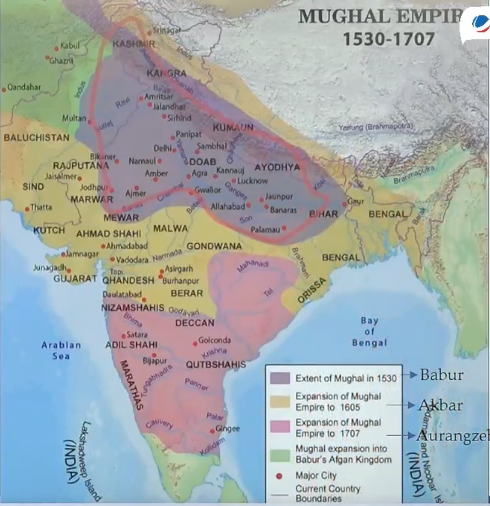
Mughal empire (1526 - 1707)
- Babur
- Humayun (1530 to 1540)
- Sur Dynasty
- Sher Shah Suri(1540-1545)
- Smile Shah
- Akbar(1556-1605)
- Battle of Haldighati(1576) - Maharana Pratap was defeated by Akbar
-
Regional Dynasty
- Eastern Ganga Dynasty (1038 to 1434 AD)
- Anang Bhima Deva III (1211 to 1238)
- Narshimha Deva (1238-1264 AD)
- They were replaced by Gajpati’s
- Gajpati Dynasty (1435-1568 AD)
- Founded by Kapilendra Deva
- Hamirdeva
- Pratap Rudra Deva
- Kakatiya Dynasty(1123-1323)
- feudatories of Rashtrakuta and Chalukyas
- Pratap Rudra - 1163
- Ganapati deva
- Rudrama Devi, She ruled from 1262 to 1289 AD.
- Hoysala Kingdom (11th to 14th Century) - Belur, Halaebdu
- Vinayaditya in 1006
- Vishnu Vardhan Raya - 1108 to 1152 AD
- Vir Ballala I
- Vir Ballala II
- Gahadavala Dynasty (11th - 12th Century) - Kannauj
- Eastern Ganga Dynasty (1038 to 1434 AD)
-
VIJAYNAGAR EMPIRE (1336 - 1565) - Under Harihara and Bukka Roy
- Sangama (1336-1485)
- Harihara Roy
- Bukka Roy
- Deva Raya II (1422-1446)
- Saluva Dynasty (1485-1505)
- Saluva Narsimha
- Tuluva (1505-1542)
- Vir Narasimha raya
- Shri Krishna deva Ray(1509 - 1529)
- Aravidu dynasty
- Rama Raya
- Battle of Raksasa thangadi - 1565
- Rama Raya
- Sangama (1336-1485)
forces of Bijapur, Ahmednagar. Golconda and Bidar defeated him in the battle of Talikotta
-
Bahamanid Sultanate(1347) - Under Bahaman shah
- Founded by Allauddin Hasan
- Firoz shah bahamani (1397-1422)
- Mahmood gawan(1463-1482)
- 5 pricipalities
- Bijapur Sultanate - Yusuf Adil shah and Adil Shahi dynasty
- Berar Sultanate- Imat shah and Imat shahi dynasty
- Bidar Sultanate- amir ali barid shah
- Ahmednagar Sultanate- Malik Mohammad and Nizam shah dynasty
- Golconda Sultanate- Qutub shah dynasty
-
Madurai Sultanate - Under Hasan shah
-
Importance of the accounts of the Chinese and Arab travellers in the reconstruction of the history of India
- Offer insights into socio-cultural practices
- Give information about political system and administration
- Highlight economic activities and occupations
- Give account of trade routes and networks
- Highlight state of educational institutions
- Fill the gaps for limited indigenous source
- Provide diverse perspective
- Helps in Corroboration historical events
-
Challenges and Considerations:
- May contain traveller’s bias and misunderstandings
- Limited to specific region
First battle of Tarain - 1191
Second battle of Tarain - 1192
Delhi Sultanate
Battle of Tarain(1192) - Battle of Panipat(1526)
-
Slave (Ghulam) or Mamluk Dynasty (1206-1290)
- Qutubuddin Aibak (1206-1210):
- Iltutmish (1211-1236):
- He implemented the Iqta system of administrative grants in India.
- Issues - Taka (silver coin) and Jittal (copper coin).
- Razia (1236-1239):
- Turkan-e-Chahalgani
- Balban (1266-1287)
- He employed spies called Barids
- Developed great contempt for non-nobility
- Mongol Invasion
-
Khilji Dynasty (1290-1320)
- Jalaluddin Khilji
- Alauddin Khilji (1296-1316)
- He sought to fix the cost of all the commodities.
- Good quality horses - (Dagh system)
-
Tughluq dynasty
- Ghiysasuddin Tughlaq
- Mohammad Bin Tughlaq (1325-1351)
- ‘Tried’ issuing token currency - Failed
- He set up a department Diwan-e-Amir Kohi to give loans to the farmers
- Rebellion in the south led to the emergence of the Bahmani(बहमनी) Sultanate and the Vijayanagar empire.
- He Honoured Jinaprabha Suri - esteemed Jain saint
-
Firoz Shah Tughlaq(1351- 1388):
- He made the Iqta System hereditary, and the same was applied in the army.
- Jizyah became a separate tax which till now was a part of land revenue.
- New cities such as Hisar and Ferozabad were established by him.
- Department of slaves called Diwan-i-bandagan
-
Sayyid Dynasty (1414-1450):
- Timur appointed Khizr Khan who founded Sayyid dynasty
-
Lodi dynasty
- Bahlol Lodhi became sultan in 1451 and ruled till 1489.
- Sikandar Lodhi. (1490-1516)
- Ibrahim Lodhi in 1517
- Babur defeated Ibrahim Lodhi in the First Battle of Panipat in 1526.
-
IQTADARI SYSTEM
- The land was classified mainly into 3 categories- Iqta, Khalisa and Inam land
-
Technological changes
- Irrigation : Persian Wheel improved water use efficiency
- Warfare : Iron Stirrups and Horseshoes enhanced combat capabilities of cavalry
- Textiles : spinning wheel and sericulture
- Coin Minting : advanced techniques like die-striking led to standardized currency
- Architectural innovations : true arch and dome; batter method
- Example: Qutub Minar, Tughlaqabad fort
- Papermaking : replaced palm leaves and birch barks
- Agriculture : improved farming techniques
-
Impact of Indian society
- Agricultural productivity increased due to irrigation
- Military advancements extended the Sultanate’s control over subcontinent
- Economic growth due to standardized currency
- Papermaking improved literacy and record-keeping
- Social mobility due to new opportunities in textile production and trade
Struggle for Empire in North India (Afghans, Rajputs and Mughals)
Mughals
-
-
Babur (1526- 1530)
- Rumi method(Tulguma) to defeat the forces of Ibrahim Lodhi
-
Humayun (1530-1540)
-
Sur Dynasties
- Sher shah Suri (1540-1545)
- Codification of many laws.
- Grand Trunk road from the Indus River to Bengal was constructed.
- Patwari maintained Patta’s of land
- Land revenue assessment based on crops and quality of land.
- Purana Kila in Delhi is an architectural heritage of the Sur kingdom.
- Sher shah Suri (1540-1545)
-
Akbar (1556-1605)
- 2nd battle of Panipat with Hemu (1556)
- After a prolonged struggle, the forces of Maharana Pratap were defeated in the Battle of Haldighati(1576)
-
Jahangir (1605-1627)
-
Shah Jahan (1628-1658)
-
Aurangzeb (1658-1707)
-
Later Mughals (1707 +)
-
Decline of Mughal Empire
-
Administration
- Wazir
- Diwan-e-Kul: He was the chief diwan responsible for revenue and finances.
- Mir Bakshi: He looked after matters pertaining to military administration.
- Sadr-e-Sudur: His chief duty was to protect the laws of Shariyat.
- Mir Saman: He was in charge of royal Karkhanas.
- To maintain proper communication channels Darogai-i- Dak was appointed.
- Waqainavis and Waqainigars were appointed to provide news of provinces directly to the emperor.
- Subas(Subedar, Diwan) -> Sarkars(Fauzdar , Amil) -> Parganas(Kotwals, Shiqdar) -> villages(Muqaddam ,Patwari)
- SSPV
- Revenue assessed through ‘batai’ and ‘nasaq’ systems
-
Mansabdari
- Mansab means rank or position in official hierarchy in Mughal court
- Zat - rank
- Sawar - size of contingent (horses)
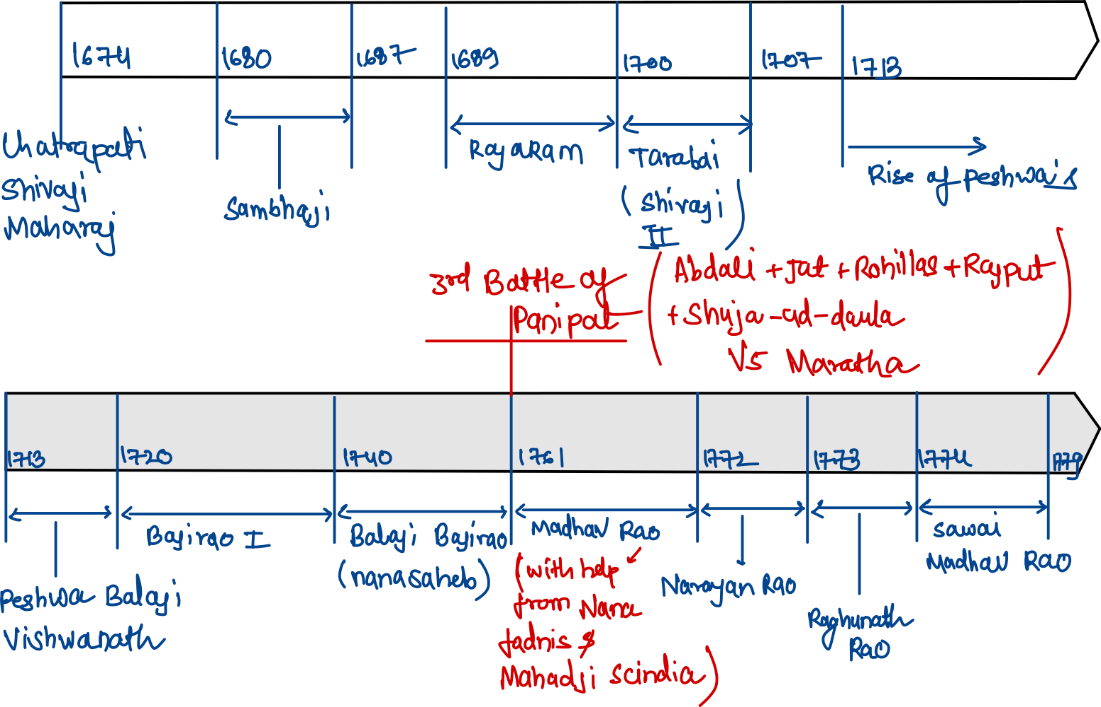
Maratha Empire
- Administration
- King (Shivaji) was assisted by a council of ministers called Ashtapradhan
- Peshwa – Finance and general administration
- Senapati – Military commander
- Amatya – Accountant General
- Waqenavis – Intelligence, posts and household affairs.
- Sachiv – Correspondence
- Sumanta – Master of ceremonies
- Nyayadish – Justice
- Panditarao – Charities and religious administration
- Treaty of Purandhar 1665 between Shivaji and Mughal commander Jai Singh.
- King (Shivaji) was assisted by a council of ministers called Ashtapradhan
Deccan Sultanate
-
Bahamanis (1347)
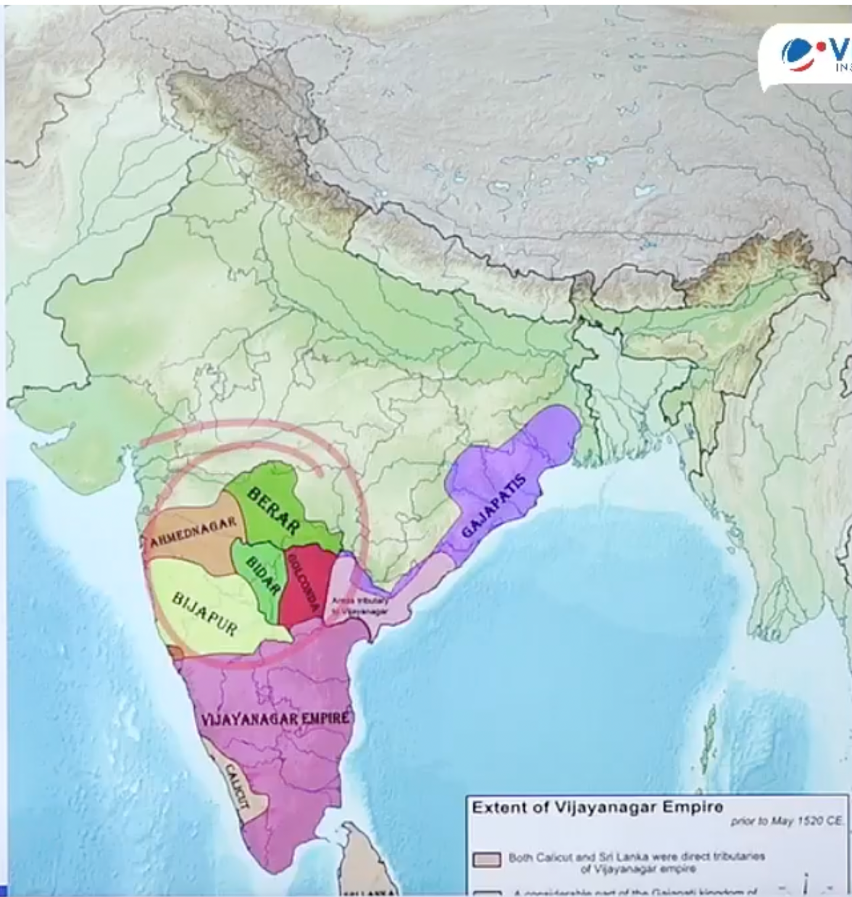
- Firoz shah bahamani (1397-1422)
- Mahmood gawan(1463-1482) was a great PM who served many sultans.
- Bahmani sultanate was divided into 5 principality
- Bijapur Sultanate - Yusuf Adil shah and Adil Shahi dynasty
- Berar Sultanate - Imat shah and Imat shahi dynasty
- Bidar Sultanate - amir ali barid shah
- Ahmednagar Sultanate - Malik Mohammad and Nizam shah dynasty
- Golconda Sultanate - Qutub shah dynasty
-
Vijaynagar empire (1336-1542)
- Vijaynagar kingdom was ruled by 4 dynasties- Sangama; Saluva; Tuluva and Aravidu dynasty
- Hampi , Tungabhadra river
- Sangam dynasty - Harihara and Bukka Roy
- Tuluva dynasty -
- Krishna Deva Ray (1509-1529)
- Golden age
- Telgu work - amukta malyada
- Ashta diggaj - tenaliraman, Allasani paidana(Telegu poet)
- Krishna Deva Ray (1509-1529)
- Battle of Talikotta
- Top officers of the army were known as Nayaks or Poligars.
- Mandalam(Nayak) > nadu > sthalas > Grams
-
Regional dynasties
- Eastern Ganga Dynasty (1038 to 1434 AD)
- Konark temple(sun temple) and Jagannath Puri temple.
- Gajpati Dynasty (1435-1568 AD)
- Pratap Rudra Deva who was greatly influenced by Sri Chaitanya Mahaprabhu.
- Kakatiya (1123-1323)
- Warangal , Rudradeva I
- Represent Republican tradition
- Rudrama Devi
- Kohinoor
- Ramappa Temple
- Anubhav Mandapam of Lord Basavesvara - first religious parliament of world
- Eastern Ganga Dynasty (1038 to 1434 AD)
Assam
- प्रयाग प्रशस्ती of gupta time mentions about Kampup kingdom in Assam
- Burman Dynasty - Pushya Burman
- Ahom Kingdom
- Ahom’s were mongoloid tribe
- Established by Sukaphaa in 1228 AD - 1826 AD with treaty of yandabo
- Suhnugmung 1497-1539 also called swarg narayan
- Shankar deva - a vaishnavite reformer
- Swargdeva Rudra Singh - 1696 - 1714 - Rangpur was his capital
- कालिका पुराण, योगिनी तंत्र
Modern Indian History
- Introductions
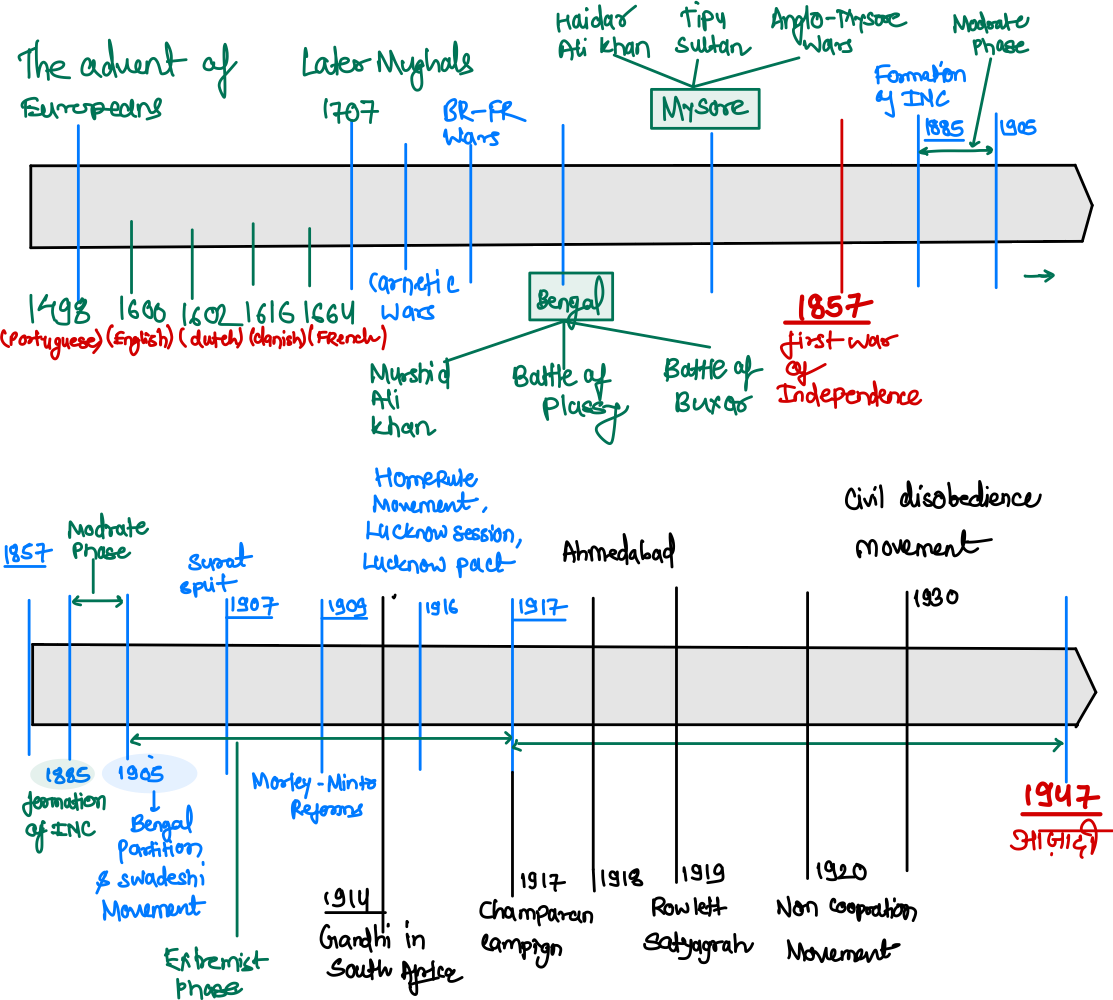
- Indian National Movement was unique experiment of it’s kind. Non-violence, satyagraha etc were doctrines that set a new paradigm for fighting by appeal to conscience.
- Conclusions
- British realised that they can only delay but not deny the grant of independence to Indians.
- Article 51A(b) to cherish and follow the noble ideals which inspired our national struggle for freedom.
Important Modern History Events Before 1857
-
European Penetration of India
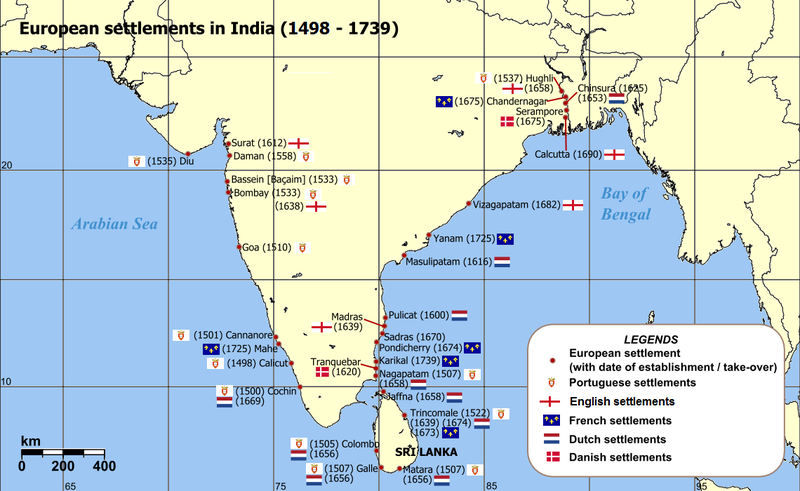
- Portuguese 1498 - 1961
- PRINCE HENRY ‘THE NAVIGATOR’(1398-160) promoted Seafaring activity.
- VASCO DA GAMA, 1498 - Calicut. 1501 - Trading centres at Calicut, Cochin & Cannanore.
- DE ALMEIDA 1505 - ‘Bluewater policy’ (Kartaze or Cartaze system)
- ALBUQUERQUE(1509 to 1515) - Conquered Goa(1510)(from Bijapur)
- Nuno-Da-Cunha - Diu, Daman and Bassein in 1534 & 1538.
- Dutch 1602-1759
- Trading centres at Pulicat, Agra, Surat, Cambay, Patna, Dacca, Nagapattinam, Hariharpur.
- In 1759 they were defeated by the English in the ‘Battle of Bedara’.
- English 1600-1947
- 1608 - The first British envoy led by SIR WILLIAM HAWKINS came to Jahangir’s court.
- opened their warehouses at Surat and Masulipatnam.
- 1615 - Another British Envoy led by SIR THOMAS ROE.
- trading centres at Agra, Ahmedabad, and Baroach (Bharuch).
- 1639 - created Saint Fort George , Madras
- 1668 - Bombay was transferred to EIC
- 1698 - British got three villages on lease—> Govindpur, Sutanati, Kalikatta - created Saint Fort William Calcutta.
- 1608 - The first British envoy led by SIR WILLIAM HAWKINS came to Jahangir’s court.
- Danish 1616 - 1845
- Tranquebar, Freidricknagore & Serampore.
- WILLIAM CAREY, 1799 - established a printing press for printing the bible, 1819 - established Serampore College
- 1845 - Denmark gave Serampore to Britain.
- French 1664
- Surat(1668), Masulipatnam(1669), Pondicherry(1674), Chandranagore,(1673)
- 1740 - Appointment of Dupleix by the French.
- Portuguese 1498 - 1961
-
Later Mughals - 1707
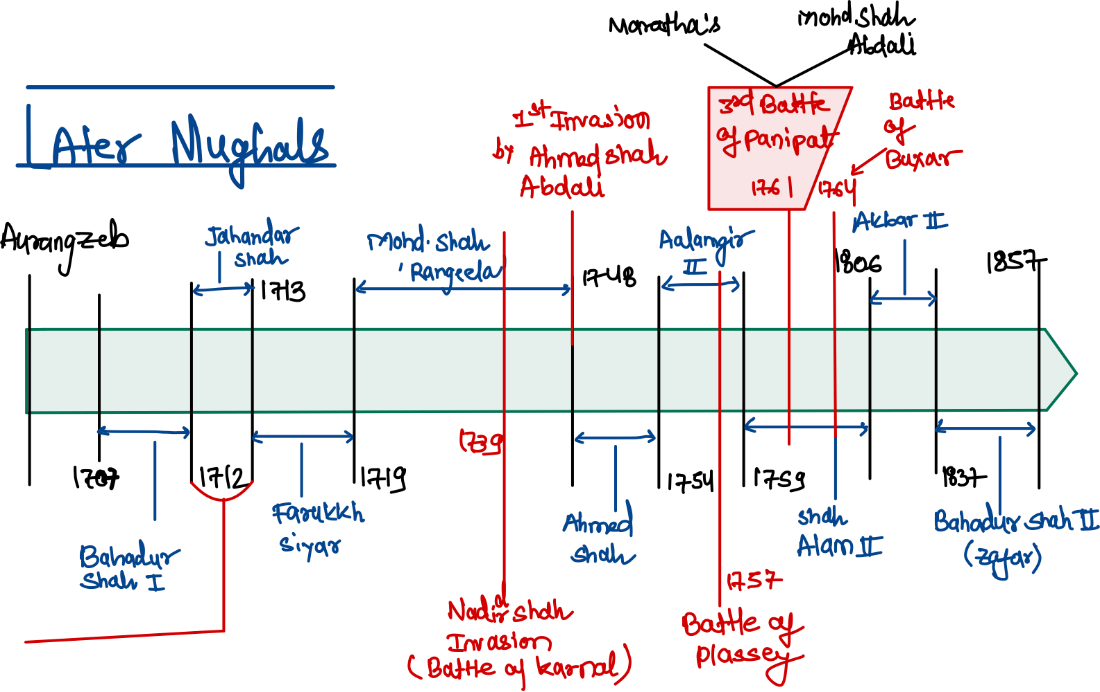
- Farukkh Siyar gave Royal Farman of 1717 to the EIC, Bombay, Bengal and Madras free of customs duty, mint its own coin and further fortify Calcutta.
- Decline of Mughals
- Political causes
- No clear line of succession
- Powerful nobles began to carve out semi-independent states.
- Political causes
Murshid Quli Khan founded Bengal in 1717.
Saadat Khan founded Oudh in 1722.
Asaf Jah founded Hyderabad in 1724.
-
-
-
- Economic causes
- ‘war state’
- ‘Jagirdari crisis’
- ‘peasant revolts’
- Socio-religious causes
- Aurangzeb re-imposed Jizya tax and destroyed Hindu temples.
- No fresh technological input in military.
- Corruption and misgovernance
- Socio-religious causes
- Economic causes
- ‘war state’
- ‘Jagirdari crisis’
- ‘peasant revolts’
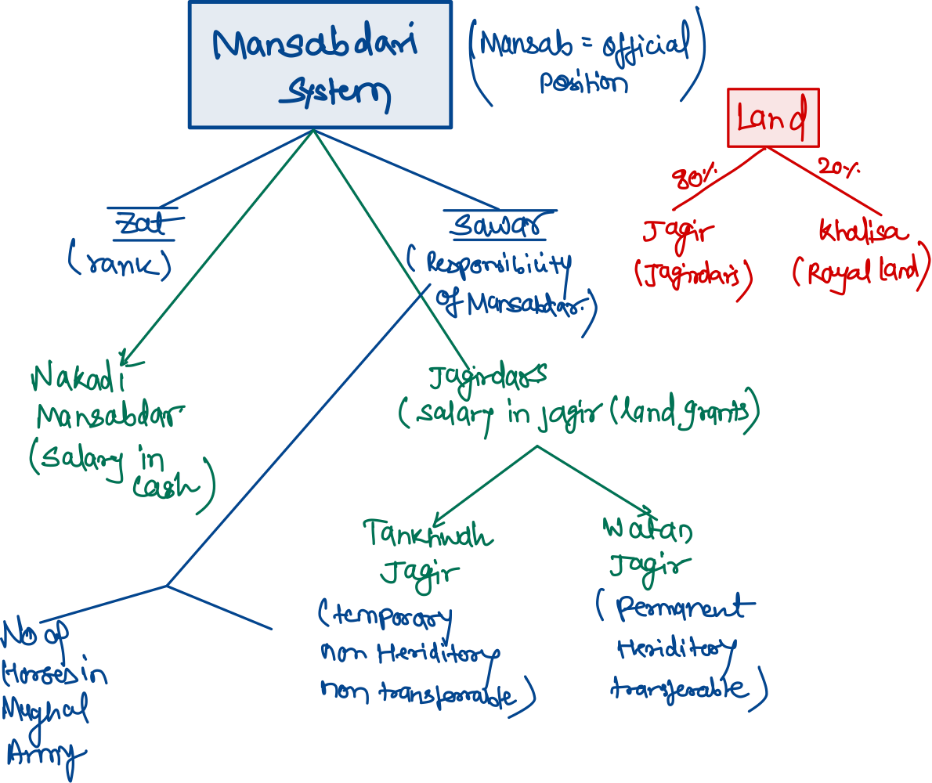
- The Mansabdari system was a military-administrative system introduced by Emperor AKBAR (1571 CE) to manage the Mughal army and bureaucracy. It created a hierarchical structure where officials (Mansabdars) were granted ranks (Mansabs) based on their military and administrative roles.
-
-
-
Spectre of fragmented polity
- Decline of the Mughal Empire
- Weak successors
- Corruption and inefficiency in Mughal administration
- Rivalries between nobles eroded the cohesion of empire
- Rise of regional powers
- Marathas
- Sikhs confederacy under BANDA BAHADUR
- Rajputs asserted greater independence
- Hyderabad carved out by Asaf Jah
- Oudh by Sadat Khan
- Bengal by Murshid Quli Khan
- External Invasions
- Persian Invasion under NADIR SHAH in 1739
- AHMED SHAH ABDALI invasion in 1748
- Advent of Europeans
- British East India Company exploited the fragmented polity to expand its influence
- Example: The Battle of Buxor in 1764
- French influence grew especially in Carnatic region
- British East India Company exploited the fragmented polity to expand its influence
- Impact of fragmentation
- Perpetual state of war - led to widespread destruction
- Social unrest - peasant and tribal movements
- Economic decline - trade and commerce suffered because of lack of political stability
- Decline of the Mughal Empire
-
Regional powers in 18th Century
- Successor states (Bengal, Awadh, Hyderabad)
- Rebellious states (Punjab, Maratha, Mysore)
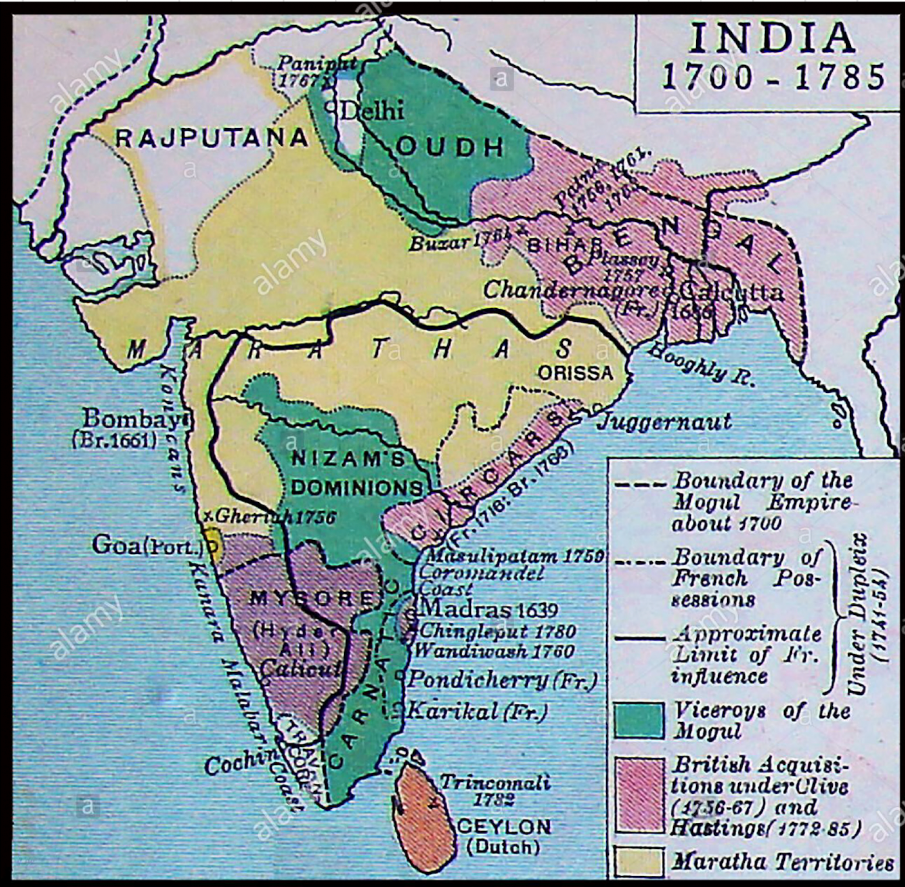
-
Carnatic Wars
- APP424956
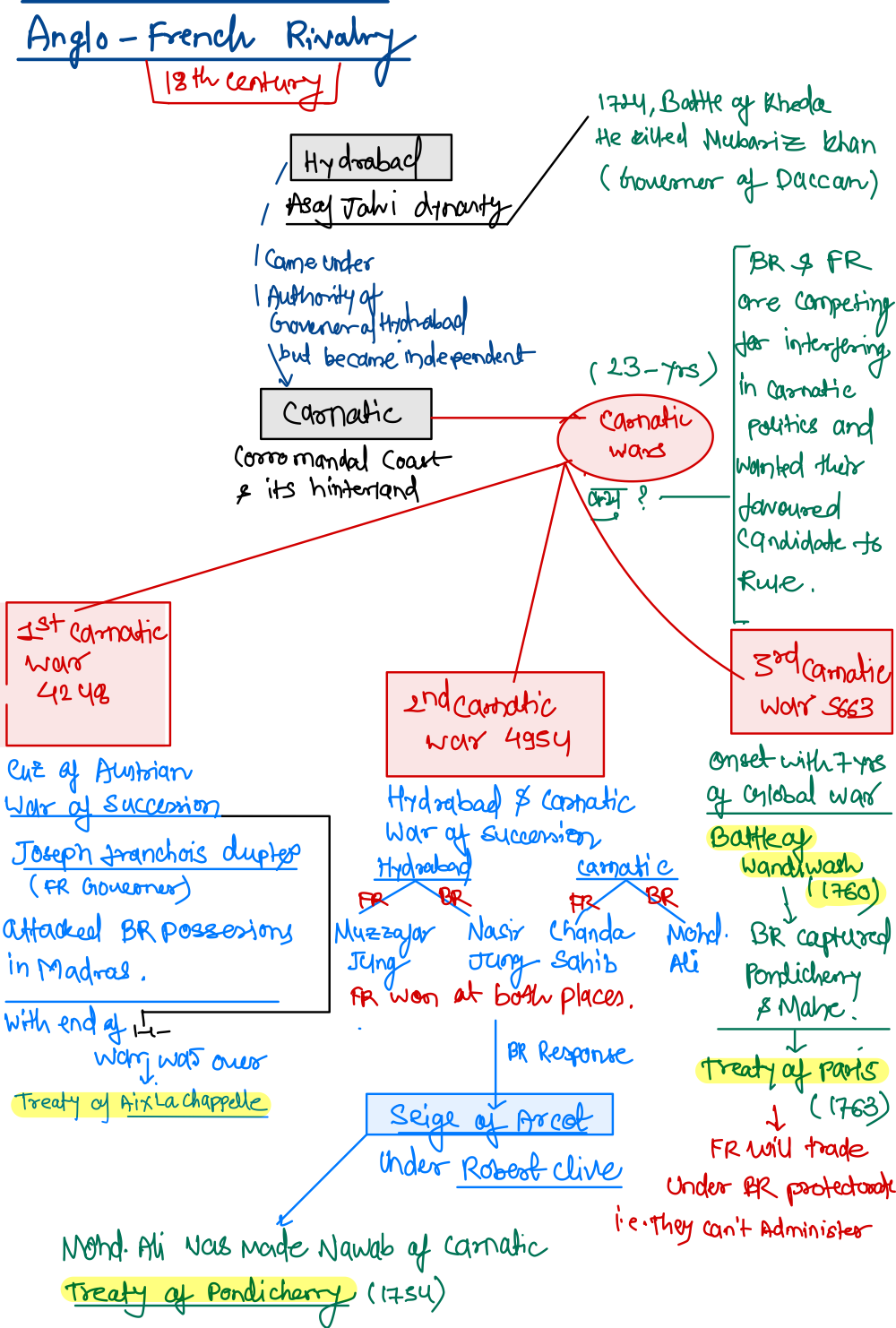
Anwaruddin Khan-> Mohd Ali- Conclusion
- This war put an end to French imperial ambitions in India, and they were reduced to trade under British suzerainty in India.
-
Battle of Plassey & Buxar
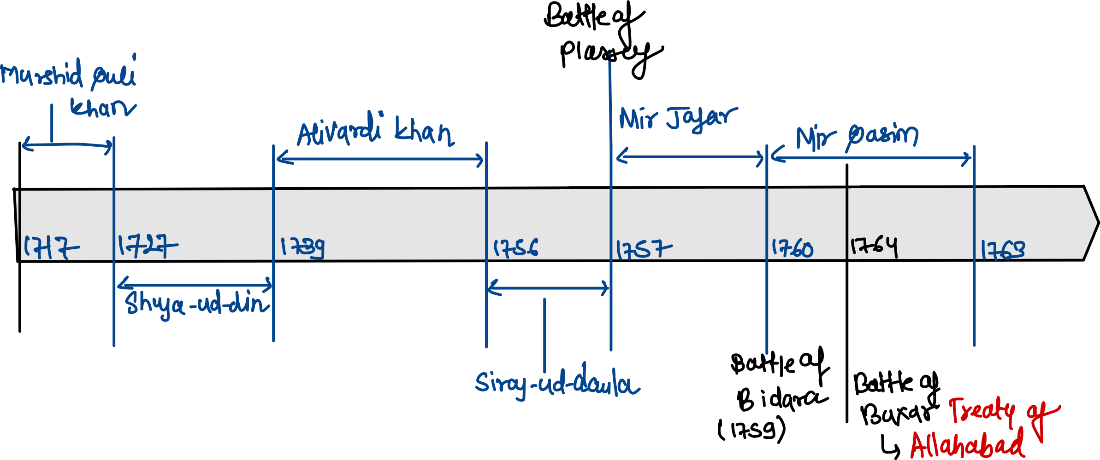
- Timeline of rulers of Bengal
- 1717-27 : Murshid Quli Khan
- Effective revenue collection system
- Supported trade and merchant bankers - Jagat Seth
- 1727-39 : Shuja-ud-din and Sarfaraz
- 1739-56 : Alivardi Khan
- 1751 - granted Orissa, Right of Chauth to Marathas.
- 1756-57 : Shiraj-ud-daula
- Black Hole Tragedy
- Battle of Plassey (1757)
- 1717-27 : Murshid Quli Khan
Paved the way for British rule in Bengal
Revenue from Bengal enabled the British to build a strong army
The Company also received the Zamindari rights of 24 Pargana.
Bullion imported from Europe was replaced by the tax collection from Bengal.
-
-
-
- 1757-60 : Mir Jafar
- Battle of Bidara (1759) - defeated Dutch as well.
- 1760-63: Mir Qasim
- Battle of Buxar (1764)
- 1760-63: Mir Qasim
- 1757-60 : Mir Jafar
- Battle of Bidara (1759) - defeated Dutch as well.
-
-
Shah Alam II, Suja-ud-daula, Mir Qasim.
Treaty of Allahabad(1765)
British got Diwani rights and the right to revenue collection - Bihar, Bengal, Orissa.
The dual system of administration was imposed in Bengal whereby all financial rights were in hands of the British and puppet nawab will look into civil administration.
-
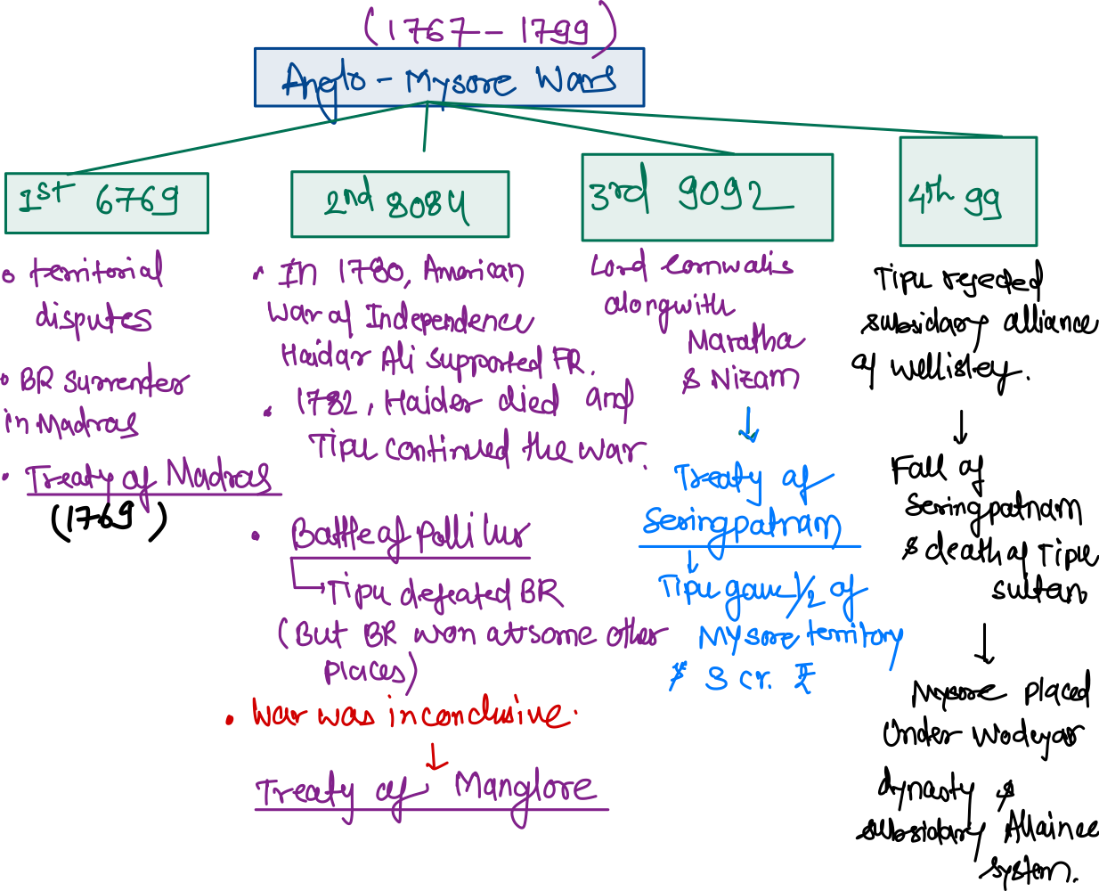
Anglo-Mysore War
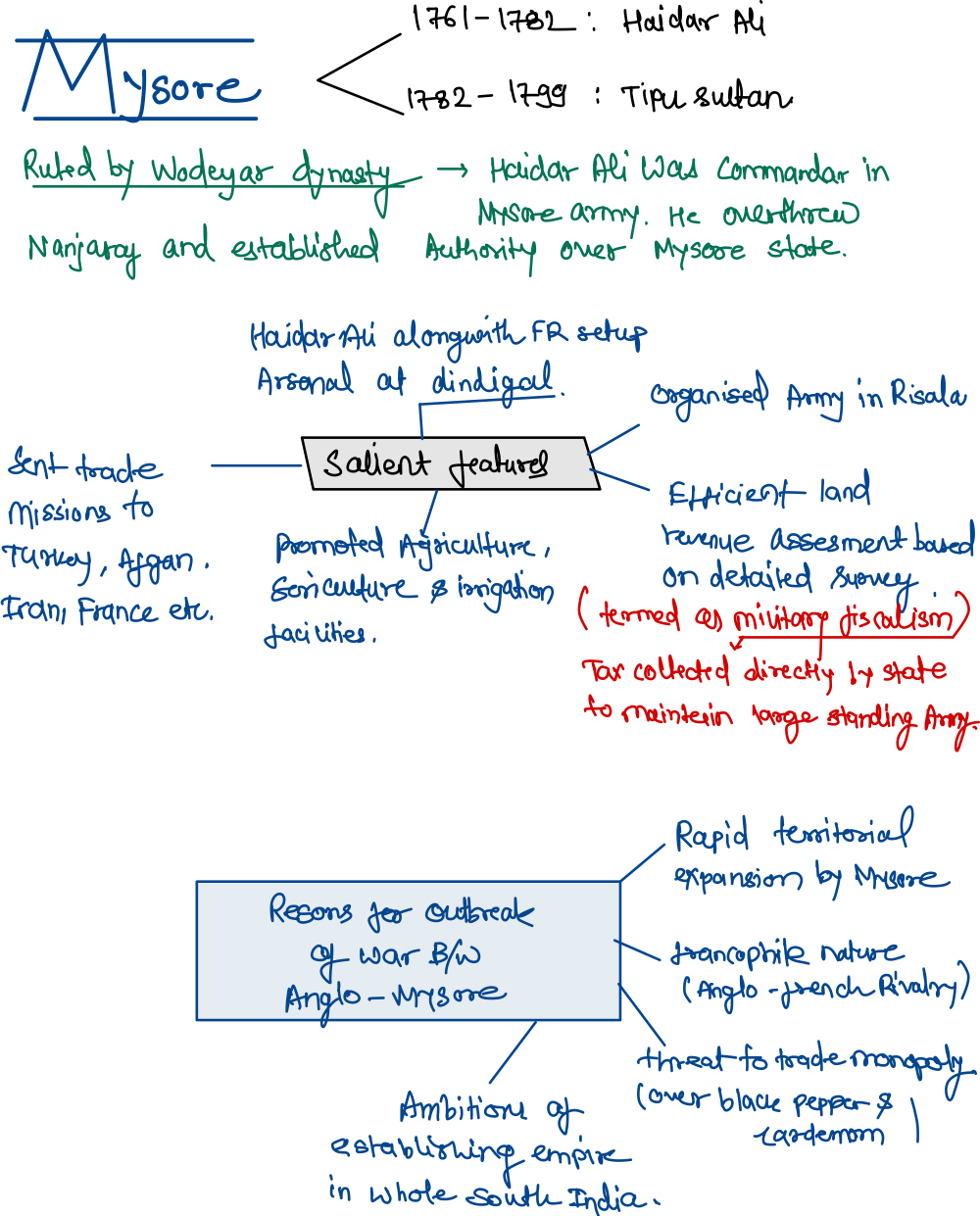
- 18th century, Mysore was ruled by Wodeyar dynasty.
- 1761 - 1782 : Haider Ali
- 1782 - 1799 : Tipu Sultan
- Invented Mysorean rocket
- Tree of liberty at his capital Seringpatnam
- Francophile - joined Jacobin club.
- Donations to the famous Sringeri Sharda-peetham
- MMS 67809099
-
-
-
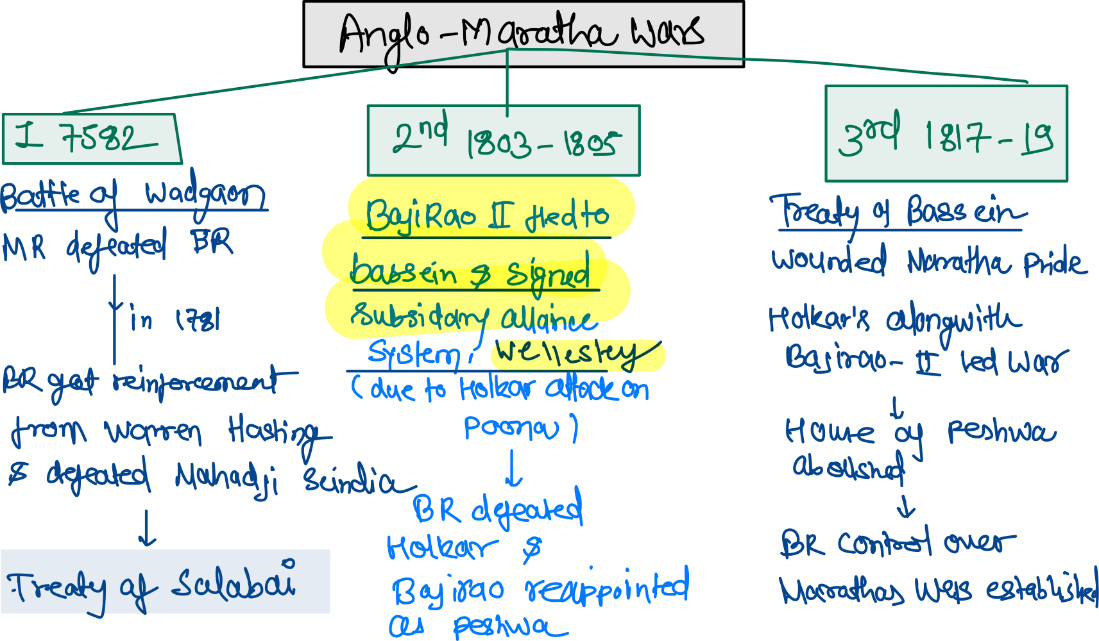
Anglo Maratha War
- 5 Houses of Maratha:
- Peshwa - Poona
- Holkar’s - Indore
- Bhosle - Nagpur
- Gaekwad - Baroda
- Scindia - Gwalior
- Saranjami System(also mokasa) - started by Rajaram, Land granted to Maratha Sardars for providing military support
- 5 Houses of Maratha:
-
3rd Battle of Panipat - 1761 (P61)
-
Subsidiary alliance system - Introduced by Wellesley (1798-1805).
-
Correction - Treaty of bassein(1802) - 2nd AM War
-
Third AM war
- Treaty of poona
- Treaty of gwalior
- Treaty of mandsaur
-
Anglo Punjab War
- Guru Govind Singh - Banda Bahadur - 12 misl’s
- 1790 Ranjeet Singh who belonged to Sukerchakia Misl create one powerful Sikh state.
- friendship treaty of Amritsar in 1809.
- He gave up his claim on Cis-Sutlej area that came under british protectorate
- British acknowledged sovereign right on maharaja on trans Sutlej area.
- friendship treaty of Amritsar in 1809.
- After the death of Ranjeet Singh, 1845
- First Anglo-Sikh war (Rani Jindan <> Major Broad Foot) - Treaty of Lahore(1946).
- Size of the Khalsa army was reduced to half and the British got Sindh.
- Jalandhar Doab annexed.
- Second Anglo Sikh war 1849 - battle of Chillianwallah.
- First Anglo-Sikh war (Rani Jindan <> Major Broad Foot) - Treaty of Lahore(1946).
-
Anglo Afghan Wars
- Forward Policy of Auckland
- First Anglo-Afghan War (1839–42)
- JOHN LAWRENCE (1864–69) and the Policy of Masterly Inactivity
- Lytton - policy of ‘proud reserve’
- Second Anglo-Afghan War (1878–80)
- Treaty of Gandamak (May 1879)
- Second Anglo-Afghan War (1878–80)
- Forward Policy of Auckland
-
Anglo Burma Wars
- 24-52-85
- First Burma War (1824–26)
- Treaty of Yandabo
- Second Burma War (1852)
- Third Burma War (1885)
-
Anglo-Tibetan Relations
- Treaty of Lhasa (1904)
-
Anglo Nepal wars
- 1814–16 - Treaty of Sagauli
-
Socio-economic Condition of People
-
British Conquest of India
-
First governor general of Bengal - (1772-1785) Warren Hastings. He set up Calcutta Madrasah.
- Setup Asiatic Society of Bengal (1784)
-
The Regulating act of 1773
- 1772, Company on verge of bankruptcy, applied for a 1-million-pound loan to british parliament
- Governor-general of Bengal (Bombay and Madras under him)
- An executive council of 4 members was created to assist Governor-General.
- Supreme court at Calcutta in 1774 - 1CJ(Elijah Impey) , 3J.
- Prohibited private trade of company servants
- Loopholes
- No discretionary power to GG.
- No clear demarcation of judicial and adjudicating power between GG & CJ.
-
Pitts India Act of 1784
- Board of control in Britain
- Demarcation of commercial and political functions of the company
-
Lord Cornwallis(1785-1793) in 1785 (governor-general) with discretionary power
- Laid foundation of the Indian Civil Service
- Permanent Land Revenue Settlement of Bengal, Bihar and Orissa.
-
Charter Act of 1793
- Sir John Shore (1793–98)
- Governance based on written laws(civil laws)
-
Wellesley (1798-1805)
- Subsidiary Alliance System (1798)
- Fort William at Calcutta, (1800)
- Extended permanent settlement to madras
-
Minto I(1807-1813)
- Treaty of Amritsar with Ranjit Singh (1809).
-
Charter Act, 1813
- Lord Hastings (1813-1823)
- Napoléon Policy of continental blockade
- Ended the monopoly of British EIC (except tea trade and trade with China)
- Christian missionaries
- 1 lakh for development of education, literature, science.
-
Charter Act, 1833 (St. Helena Act)
- Ended all privileges of EIC and as a commercial body, only administrative function remained.
- All restriction on European immigration acquisition of property lifted.
- Territorial possessions of EIC were held in trust of HIS MAJESTY.
- Law Commission - Lord Macaulay for the codification of Indian law - IPC and CrPC came into existence
- IPC came into effect in 1860.
- Lord Macaulay was the first law member in the GG executive council but the law member was not entitled as a full member.
-
Provisions for employment of Indians in public service was squashed by Court of Directors
-
GG of British Indian territory -> GG of India.
-
Lord William Bentick was the first GG of India.(1828-34(GG Bengal) 1834-1835)
- Abolition of sati and other cruel rites (1829).
- Founded Calcutta Medical collage
-
Charles Metcalfe - (1835-36) - Liberator of the Indian Press
-
Henry Hardinge (1844-1848)
-
Charter Act of 1853
- Lord Dalhousie (1848-1856)
- बहुत doctrine of lapse लगायी है इसने - Satara (1848), Jaitpur and Sambhalpur (1849), Udaipur (1852), Jhansi (1853), Nagpur (1854), and Awadh (1856).
- Annexation of Punjab (1849).
- Wood’s Dispatch 1854
- Railways - 1853 with the first passenger train running between Bombay (now Mumbai) and Thane.
- Lord Dalhousie (1848-1856)
-
The legislative and Executive functions of the GG council were separated.
-
GG Legislative council and added six members to it.
-
4 out of 6 new member from local representation in the Indian legislative council by Madras, Bombay, Bengal, Agra.
-
It marks the beginning of the Parliamentary system.
-
Introduced an open competition system of selection and recruitment of Civil Servants.
- Satyendra Nath Tagore was the first Indian to qualify for this exam in 1863.
-
British Policies & Their Impact – Economic, Administrative & Socio-cultural
-
-
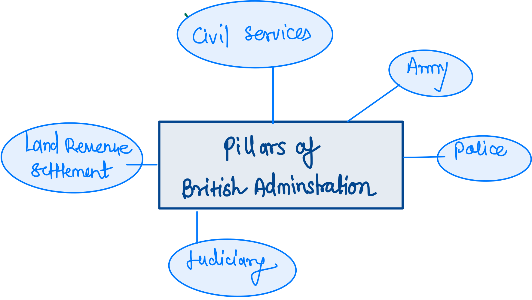
Army
- Queen’s army - army of occupation
- Troops Army - army of annexation, fighting wars.
- British created narrative that Gurkha, Rajput, Sikh, Pathan be the Martial races. (divide and rule)
- Success of army can be attributed to the absence of modern nationalism at that time.
-
Police
- William Bentick abolished the office of SP and placed law and order under the District Collector.
- In 1860, the Police Commission was appointed which led to the enaction of the Police Act, 1861.
-
Judiciary
-
Economic policy
- One way free trade and tariff policy
- Commercialization of Agri
- Ruins of artisans and handicrafts
- Ruralisation
- Absentee landlordism
- Destruction of Indian shipping Industry
-
-
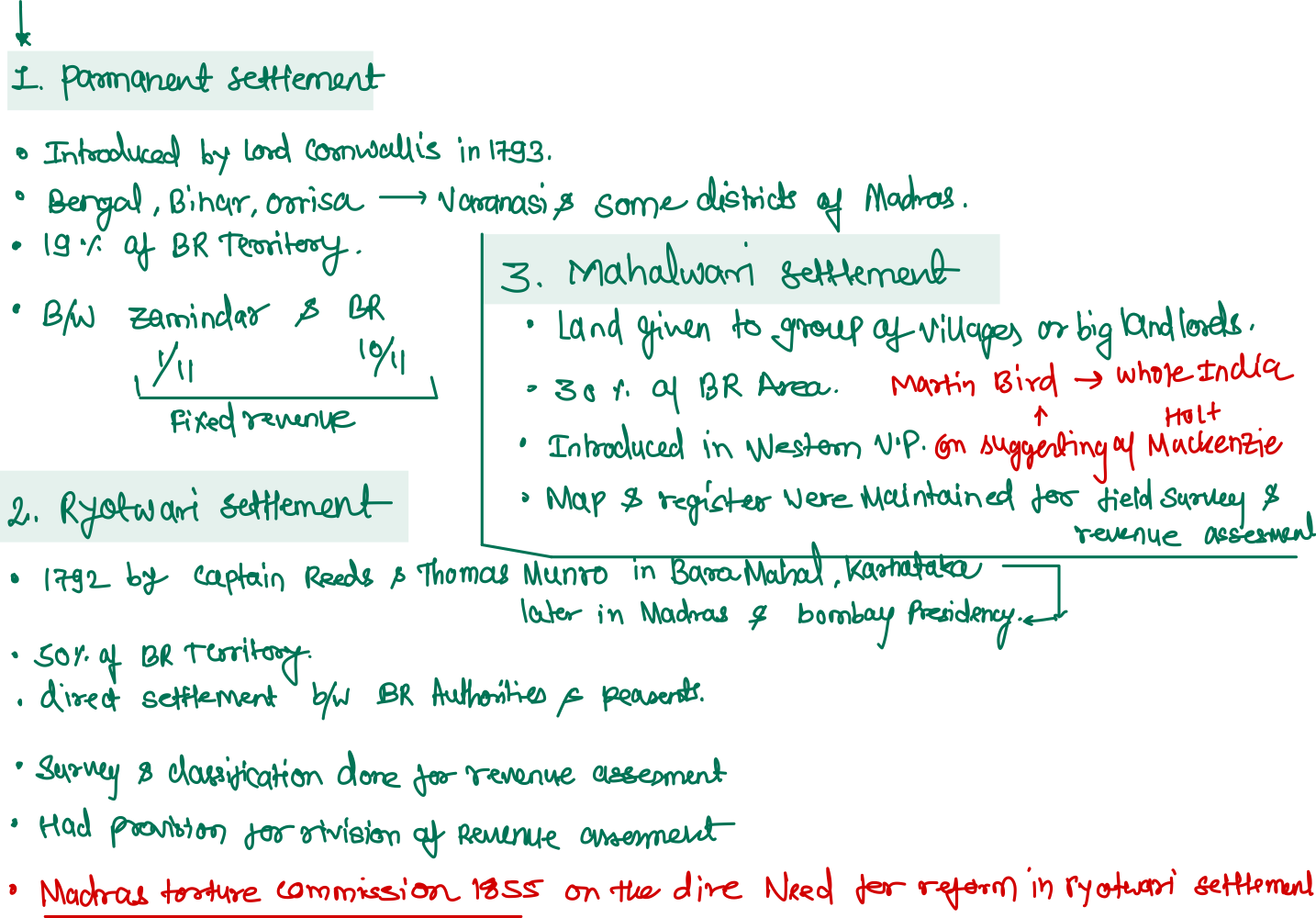
Land Revenue Settlement under the British
-
Ryotwari - 1820
-
Mahalwari - 1822
- mauzawar - NWFP
- malguzari - Central Provinces
-
Socio-cultural Reform Movements
- Introduction
- Socio-religious reforms movements of 19th century are often called as phase of Indian renaissance.
- Based on ideology of rationalism, humanism and universalism, egalitarianism (RUHE) to provide equality and justice to all.
- Introduction
-
Reasons for rise and growth
- British colonial rule introduced Western education which created new class of educated Indians
- Christian missionary activities exposed problems in Indian religious rituals
- Influence of Enlightenment ideas of rationality, equality, liberty, humanism inspired Indian intellectuals
- Industrialization and capitalism altered traditional family structure and roles
-
Significance
- Social justice : addressed social evils like sati, child marriage, and caste discrimination
- Education : focus on modern and scientific education for both men and women
- Example: The establishment of numerous institutions like Hindu College (1817), Aligarh Muslim University, and Bethune College for women.
- Religious Reform : removing orthodoxy and idolatry promoting rationalism in religion
- Example: Arya Samaj’s emphasis on Vedic principle
- Nationalist Awakening : revival of ideal of Vedas, sense of national identity
- Example : SRI AUROBINDO’S theory of cultural nationalism
- Empowerment of Women:
- Economic Impact: Promotion of self-reliance and indigenous industries
- Interfaith Dialogue: promoting communal harmony and plurality
-
Linkage with emergence of national identity
- Revival of Indian Culture and Heritage
- Example: Raja Ram Mohan Roy translated many Sanskrit texts
- Spread of Modern Education
- Created educated Indians who were aware of political developments in West
- Proliferation of newspapers, journals and literary works helped in spreading nationalist ideas
- Example: Newspapers like “Amrita Bazar Patrika” and journals like “Bengalee”
- Fostered political consciousness : laid groundwork for formation of Indian National Congress in 1885
- Cultural Nationalism:
- Bharat Mata Bankim Chandra Chatterjee
- Influence of liberalism : democracy, natural rights, liberty
- Revival of Indian Culture and Heritage
-
Young Bengal Movement:
- Founded in 1820s by HENRY LOUIS VIVIAN DEROZIO, a teacher at Hindu College, Calcutta.
- Inspired by ideas of French Revolution - equality, liberty and fraternity
- Inspired students to challenge oppressive customs
- Advocated social reforms in caste system, women’s education
-
Brahmo Samaj:
- Founded by Raja Ram Mohan Roy in 1828
- Aimed at reforming Hinduism by eliminating idolatry, caste discrimination, and superstitions.
- Roy’s efforts included the abolition of sati, promotion of women’s rights, and modernization of education.
- Under Debendranath Tagore, expanded its activities, including spiritual education
- Tattwabodhini Sabha (1839)
- Keshab Chandra Sen brought a more radical approach - interfaith dialogue, intercaste marriage, etc
- Addressed social issues - child marriage, polygamy, widow remarriage, women’s education
-
Conclusion
- Not only reformed Indian society but also led to rise of Indian Nationalism.
| 19th-century reforms | 20th-century reforms |
|---|---|
| - - - Most reformers were upper caste men who wanted to bring improvement in the position of women and backward caste in the society. - They were acting as agents of change for their subjects. - The agenda of reform in the 19th century was limited to practices and issues related to orthodoxy superstition child marriage, widow remarriage, etc. - Narrow social base. | - - - Both agents of change and their subjects were from a backward section of the society. - Examples – Narayan guru Periyar, Dr. Ambedkar, Tyagraj, etc. - The agenda of reform was very broad whereby backward classes were demanding equal political social economic and citizenship rights, the right to vote, etc. - Wider social base. |
| Hinduism | Islam - ADA | Sikhism |
|---|---|---|
| Raja Ram Mohan Roy (1772–1833) - - 1815, Atmiya Sabha - Tufa-ul-mujahidin - weekly newspaper - sambad kaumudi - Mirat-ul-Akbar - Calcutta Unitarian committee(1823) - 1825, Vedanta College - 1828 - Brahma Sabha -> Brahmo Samaj - Hindu college Calcutta 1817 - Along with David hare | Aligarh movement - - Sir Syed Ahmed Khan - Asbab-e-bagawat-e-hind - Anglo oriental college in Aligarh -> 1920 it became AMU - Condemned polygamy, the Parda system - Magazine Tehzeeb-ul-Akhlak | Nirankari movement - - Dayal Das - One formless God |
| Debendra Nath Tagore - - 1839, Tattva Bodhini Sabha - 1842 he joined Brahmo Samaj | Droom-Uloom Deoband Movement - - Qassim Wanotavi - Rashid Ahmed Gangohi - Revivalist - Issued a fatwa against sir Syed Ahmed khan | Namdhari/Kuka movement (1841–71) - - bhagat Jawaharlal in 1840 - baba Ram Singh - highly critical of the caste system, child marriage, and female infanticide |
| Keshab Chandra Sen - - 1858, Joined Brahmo Samaj - Radical views like cosmopolitanizing, expelled in 1865 - Indian Mirror - 1866, he established Brahma Samaj of India - Sadharan Bharhma Samaj in 1878 - - Indian Reform Association | Ahmadiyya Movement - - Mirza Gulam in 1899 - Liberal principles | Singh Sabha movement - - oppose the proselytizing activities - created Khalsa schools |
| Young Bengal movement (1826–31) - - Anglo-Indian Henry Vivian Derozio - He was professor at Hindu college between 1826- 31 - Inspiration - French revolution - Dakshinaranjan Mukherjee, Ram Gopal Ghose, Krishna Mohan Banerji. | Gurudwara Reform Movement 1920-1925 - - Off suit of Singh Sabha - Shiromani gurudwara prabandhak committee act, 1925 | |
| Ishwar Chand Vidya Sagar - - Women’s emancipation, Hindu widow remarriage act 1856. - Age of Consent Act - abolished child marriage - Bengali weekly newspaper, Som Prakash. - He wrote bahubivah. - Secretary of Bethune female school | ||
| Satya Shodhak Samaj - - 1873, Jyotibha Phule, Savitri bai Phule(teacher), Fatima Begum - Against Brahminical domination - Infanticide, orphanage, widows, abolition of caste - He authored Gulamgiri and Sarvajanik Satya Dharma (सार्वजनिक सत्य धर्म) | ||
| Gopal Baba Walangkar - - Vital Vidhvansak, 1888 - Hindu Dharma Darpan, 1894 | ||
| Arya Samaj - - Dayanand Saraswathi in 1875 in Bombay - Revivalist, Monotheism - Satyarthi Prakash then Veda Bhasya Bhumika - Shudhi movement - Swami Hansraj, Swami Shradha Nand - Dayananda Anglo-Vedic (D.A.V.) College Lahore, 1886 | ||
| Ramakrishna Mission and Swami Vivekananda - - Founded in 1897 - religious universalism - denounced caste system, complex rituals, superstition, etc. | ||
| Theosophical society - - Madame P. Blavatsky and Colonel Olcott - 1890 Mrs. Annie Besant joined - 1898, central Hindu college -> 1916, Banaras Hindu University under Madan Mohan Malviya. | ||
| Prathana Samaj - प्राथना समाज, 1867 - - Atmaram Pandurang in 1849 - Emphasis on monotheism - Inspired by Kehsub Chandra Sen - - Mahadev Govind Ranade - Poona sarvajanik sabha ,1870 - Indian national congress. | ||
| Pandita Ramabai - - Child marriage - Arya Mahila Samaj in Poona in 1881 - Mukti mission in 1889 - Sharda Sadan in 1890 - Advocate of conjugal rights -> age of consent act | ||
| Sri Narayan Dharam Pripalana Yogam in 1903 - - Sri Narayan guru of Kerala - Aravippuram Movement, 1888 - He belonged to Ezhava caste (toddy tappers)(untouchables) - One caste, one religion, one god, one mankind | ||
| Kandakuri Veer Salingam - - Telugu speaking area, Hitkarini sabha and in 1874 | ||
| South India Liberal federation - - 1916 TS Nair and P Thyagaraja - Renamed as justice party. - 1937, EV Ramaswamy Naicker’s (Periyar) self-respect movement -> Dravid Kadagam - Under Anna Durrai, it became DMK. |
-
Uprisings Against British Pre-1857
- Introduction -
- Tribal uprisings were directed against the encroachment of their land for cultivation and interference with the social and culture matters of tribals.
- Introduction -
-
Impact of Colonial Rule on Tribals:
- Land Alienation: zamindari system and the commercialization of agriculture
- Colonial forest policies restricted tribal access to forests depriving them of traditional livelihoods
- Example: The Indian Forest Act of 1865 declared forests as state property
- Socio-cultural interference : Missionary activities undermined tribal customs and belief system
- Forced labour : colonial plantation, mining and industrial project, construction project
- Introduction of New Legal Systems clashed with traditional customary laws leading to sense of injustice
-
Tribal Response to Colonial Oppression:
- Rebellions and Uprisings led by charismatic leaders
- Example: The Birsa Munda Rebellion (1899-1900)
- Alliances with Nationalist Movements:
- Participated in Swadeshi, NCM, CDM
- Religious Movements : leaders used religion to unite and mobilize people
- Santhal Uprising
- Cultural Resistance: Preservation of traditions, customs, ritual became a symbol of resistance against cultural assimilation
- Example: The Khasi community maintaining matrilineal society
- Migration further into isolated area to escape colonial oppression
- Rebellions and Uprisings led by charismatic leaders
| Bengal and eastern India | Northern India | Western India | South India |
|---|---|---|---|
| CHUAR UPRISING (1766 - 1795) - - Durjan Singh | WAHABI MOVEMENT - - Syed Ahmed - Revivalist | BHIL Uprising (1818-1846) - - Sewaram | VIZIANAGARAM |
| KUKA Revolt (Namdhari revolt) of 1840 - - Bhagat Jawahar Mal - Baba Ramdas | KOLI UPRISING: (1829-44) - - fisherman community rose in revolt | DIWAN VELU THAMPI’S REVOLT (1805) | |
| Sanyasi Uprising (1770) Fakir Uprising (1776) - - Majnum Shah, Chirag Ali, Bhawani Pathak and Devi Choudhrani Bankim chandra chatopadhyay - anandmath, choudharani | RAMOSI UPRISING (1822, 1825, 1839) - - BR policy of annexation of maratha territories. - Chittur Singh - Pratap Singh of Satara - Vasudev Balwant Phadke | RAMPA REVOLT (1922-1924) - - Manyam Uprising - Alluri Sitarama Raju - Koya tribe | |
| PAIKA REBELLION (1817) - - Bakshi Jagbandhu | GADKARI REVOLT OF KOLAPUR & SAWANTWADI (1844) | Moplah Uprisings - - 1836 and 1854 - 1921 | |
| AHOM KINGDOM (1828) - - Gomdhar Konwar | |||
| KHASI UPRISING (1829): - - Tirath Singh, participation from Garo, Khamtis & Singhpos. | Kittur Rebellion (1824) - - Rani Chennamma of Kittur - Against the Doctrine of Lapse | ||
| PAGAL PANTHIS (1830) - - Karam Shah, Tipu | |||
| KOL Mutiny (1831) - - Buddhu Bhagat | |||
| KHOND UPRISING (1837 - 1856) - - British trying to stop practice of Human sacrifice of Meriah - Chakra Bisoi | |||
| FAIRAZI REVOLT (1838 - 1857) - - Haji Shariatullah, Dadu Mian | |||
| SANTHAL Uprising (1855-56) - - Sidhu & Kanhu Murmu | |||
| Indigo Revolt (1859-1860) Digambar Biswas and Bishnu Biswas | |||
| MUNDA REVOLT (1899-1900) - - Ulgulan revolt - Birsa Munda |
-
Conclusion - The culmination of uprisings due to exploitative policies of EIC had led to revolt of 1857.
-
Societies
| 1st cotton mill in India | 1853 | Bombay |
| 1st jute Mill | 1855 | Calcutta |
| All India Kisan Sabha (earlier All India Kisan Congress) | 1936 | Lucknow, NG Ranga, Sajanand Saraswati, Indulal Yagnik periodical |
| All India Trade Union Congress | 1920 | Lala Lajpat Rai - President Dewan Chaman Lal as the first general secretary. |
| All India Trade Union Federation | 1930 | NM Joshi |
| All india SC federation | Ambedkar | |
| Arya mahila samaj | Pandita ramabai saraswati | |
| The Independent labour party | Ambedkar | |
| All India Women’s organization | Sarla devi Choudhrani | |
| Bharat Stree Mahamandal | Sarla Devi Choudhrani | |
| Bombay Association | Dadabhai Naoroji | |
| Bombay mill hands Association | 1890 | NM Lokhande First trade union of the country |
| Bombay Presidency Association | 1885 | Pherozeshah Mehta, Badruddin Tyabji |
| British Indian Association | 1851 | Calcutta Raja Radhakanta Deb, Debendranath Tagore (entirely Indian) |
| Bharat Dharma Mahamandal | Madan Mohan Malviya Orthodox educated Hindus | |
| Central Hindu collage in Banaras | 1898 | Annie Besant |
| Dharma Sabha | 1830 | Radhakant deb Orthodox society - opposed even abolition of sati |
| East India Association in London | 1866 | Dadabhai Naoroji |
| FICCI | 1927 | Purshottam Thakurdas, GD Birla, John Mathai, Ardeshir Dalal |
| Hindu college at Calcutta | 1879 | David Hare and Alexander Duff with the help of Raja Ram Mohan Roy. First women’s collage in India |
| India Peasants’ Institute | 1933 | NG Ranga |
| Indian Association | 1876 | Surendranath Banerjee and Ananda Mohan Bose in 1876. |
| Indian social conference | MG Ranade, Raghunath Rao Advocated for inter-caste marriage, opposed polygamy, pledge movement (<> child marriage) | |
| Indian Liberal Federation | 1919 | Surendranath Banerjee |
| Indian civil liberties union | 1936 | JLN |
| Independence of India League | 1928 | JLN and SCB |
| Indian League | 1875 | Sisir Kumar Ghosh |
| Landholders society | 1838 | Calcutta |
| Ladies social conference (Bharat mahila parishad) | 1904 | Ramabai Ranade Under the parent organization National social conference in Bombay |
| Madras Mahajan Sabha | 1870 | M. Veeraraghavachariar, G. Subramania Iyer and P. Anandacharlu, |
| Majdoor mahajan sabha | 1920 | Mahatama gandhi, Ahmedabad |
| Madras labour union | BP Wadia | |
| Madras native association | 1852 | Gazulu Lakshminarasu Chetty |
| Mahila seva Mandal | Savitribai Phule - India’s first women teacher First school for girls Native female school in Pune Satyashodhak samaj | |
| Poona sarvajanik sabha | 1867 | Mahadev Govind Ranaday |
| Sanskrit college at banaras | 1791 | Jonathan Duncan |
| Servant society of India | 1905 | Gopal Krishna Gokhale , BN Rao, Alladi K. Iyer, MC Setalvad |
| Swadesh Bandhab Samiti | Ashwini Kumar Dutt | |
| Seva sadan | 1908 | Diwan Dayaram gidumal |
| Theosophical Society | Madame H.P. Blavatsky, Colonel MS Olcott | |
| Working men’s club | Sasipada banerjee | |
| Widow remarriage association \ विधवा विवाह उत्तेजक मण्डल | 1850 | Vishnu Pandit Shastri |
Publication
| Amrit bazar patrika | Sishir kumar ghosh, Motilal ghosh | |
| Bande Mataram | Aurobindo Ghosh Bipin Chandra pal | |
| Bandi Jeewan | Sachindra Sanyal | |
| Bande Matram | Paris | Madam bhikaji cama |
| Aanadamath | 1882 | Bankim chandra Chatterjee (also Chatopadhyay) - Rajsimha - last novel |
| Bangalee | Surendra nath banerjea | |
| Bharat Shramjeevi. | 1870 | Sasipada Banerjea |
| Bengal Gazette | 1780 | James Augustus Hicky (Irishman) First newspaper of India |
| Bandi Jivan | Sachindranath Sanyal | |
| Deenbandu | 1880 | NM Lokhande |
| Deshar Katha | Sakharam Ganesh Deuskar | |
| Darpan and Digdarshan | 1832 | Balshastri jambhekar |
| Durgesh nandini | 1862 | Bankim Chandra Chatterjee |
| Gadar | San francisco | Lala hardayal |
| Gandhi versus Lenin | SA Dange | |
| Hindoo Patriot | Girish Chandra Ghosh Harishchandra Mukherjee | |
| Hindustan and Advocate | GP Verma | |
| Indian Mirror | NN Sen | |
| Indian Mirror (fortnightly— first Indian daily paper in English) | 1862 | Devendranath Tagore |
| Indian Sociologist | London | Shyamji Krishnaverma |
| India Gazette | Calcutta | Henry Louis Vivian Derozio |
| Indian opinion | MG, south africa se | |
| Kesari in Marathi Mahratta in English | Bal Gangadhar Tilak | |
| Lala Lajpat rai | - - The story of my deportation - 1908 - Arya samaj - 1915 - United states of America - A Hindu’s Impression - 1916 - Young India, 1916 - England’s debt to India 1917 | |
| Mahatma Gandhi | - - Indian opinion 1903 - Young India, 1913 - Navajivan in Gujarati, 1916 - Harijan in 1933 | |
| Bhimrao Ambedkar | - - Mooknayak (leader of the mute) - 1920 - Janta 1930 - The problems of rupee its origin and its solution 1923 - Bahishkrit Bharat, 1927 - Freedom versus freedom 1939 - Annihilation of Caste 1936 - The Untouchables, 1948 - Buddha or Karl marx 1956 - Buddha and his Dhamma 1957 | |
| Mirat-ul-Akbar (First journal in Persian) | 1822 | RRMR |
| New India | Bipin Chandra Pal, Annie Besant | |
| Nil Darpan | 1859 | Deenbandhu Mitra |
| Rast Goftar | 1851 | Dadabhai Naoroji |
| Sambad Kaumudi | 1821 | Raja Ram Mohan Roy |
| Sandhya | Bhramabandhab Upadhyay Sub Editor - Shyamsundar Chakrabarti | |
| Shramajeevi | 1870 | Shashipad Banerjee, workers rights |
| Sudharak | Gopal krishna Agarkar | |
| Swadeshmitran , The Hindu | G. Subramanya Iyer | |
| Somaprakasha | 1858 | Dwarkanath Vidyabhushan |
| Talwar | Berlin | Virendranath chattopadhyay |
| Tatwabodhini patrika | Rabindranath Tagore published ‘bharoto bhagvo bidhata’ which was adopted as national anthem on 24 Jan 1950 | |
| Voice of India | Dadabhai Naoroji | |
| Yugantar | Founder - Barindra Kumar Ghosh Editor - Brahmabandhab Upadhyay | |
| Vanguard | MN Roy |
Peasant organization and movements in 20th Century
| UP Kisan Sabha | 1918 | Gaurishankar Mishra, Indira Narayan Dwivedi, and Madan Mohan Malviya | |
| All India Kisan Sabha (AIKS) | 1936 | Swami Sahajanand Saraswati - President, NG Ranga - General secretary | |
| Awadh Kisan Sabha | 1920 | After division of UP Kisan Sabha Gaurishankar Mishra, Baba Ramchandra, Matabadal Pandey, Kedarnath Pandey, Jawaharlal Nehru. | |
| Baksht movement | 1946 | Karyananda Sharma, Sehjanand Saraswati, and Rahul Sanskritayayan in Bihar | |
| Bardoli Satyagrah | 1926 | Vallabhbhai Patel - “Sardar”, Women mobilisation. | |
| Communist Party of India | 1920 | MN Roy at Tashkent | |
| Congress Socialist Party | 1934 | JP Narayan, Acharya Narendra Dev, and Minu Masani | |
| Eka Movement | 1922 | Madari Pasi , Sitapur, Bahraich, and Hardoi (UP) | |
| Hind Mazoor Sabha | 1948 | Ashok Mehta, T.S. Ramanujam, GG Mehta | |
| Kisan Sabha movement | 1933-34 | Andhra districts under leadership of N.G. Ranga | |
| Moplah Rebellion | 1921 | Ali Musaliar, Kun Hamad Haji, took communal overtone (H-Poligars, M-Peasants) | |
| South Indian Federation of Peasants and Agricultural Labour | 1935 | N.G. Ranga , E.M.S. Namboodiripad(CPI-M founder) | |
| Swaraj Party of INC | Muzaffar Ahmed, Qazi Nazrul Islam, and Hemant Sarkar | ||
| Tebhaga Movement | 1946 | Will pay only 1/3 of rent | |
| Utkal Kisan Sabha | 1935 | Malti Choudhary |
Revolt of 1857
-
Lord canning - (1856- 1862)
- Causes, Leaders, and Nature of revolt of 1857
- Causes -> Military - Economic - Religious - Political
- Leaders ->
- Delhi - General Bakht khan
- Kanpur - Nana Saheb, the adopted son of Peshwa Baji Rao II.
- Lucknow - Begam Hazrat Mahal, Uda devi pasi(Dalit women)
- Bareilly - Khan bahadur
- Bihar - Kunwar Singh a zamindar from Jagdishpur
- Faizabad - maulvi Ahmed Ullah.
- Jhansi - rani Laxmibai of Jhansi
- Opposed by
- Causes, Leaders, and Nature of revolt of 1857
-
Suppression of revolt of 1857
- Using telegraph services, technical superiority of british.
- The revolt was completely suppressed by 1859
-
Causes of revolt
- Greased cartridge
- Military discontent : racial discrimination, poor wages, harsh conditions
- Economic causes : oppressive land revenue system, destruction of traditional industries
- Political annexation : doctrine of lapse, annexation of lands of zamindars
- Social and Cultural Interference : Christian missionaries along with social reforms perceived as threat
-
Consequences of Revolt of 1857
- End of East India Company Rule
- Example: The Government of India Act 1858 transferred power to British Crown
- Increased Military Presence :
- Example: The ratio of British to Indian soldiers was increased to 1:2. Critical posts exclusively under British control
- Policy of Divide and Rule
- Example : concept of Marshal races and dividing Hindus and Muslims
- Princely States Policy : assurance for non-interference and respecting sovereignty of compliant states
- Policy of religious non-interference
- Administrative Reorganization : restructuring ICS for effective and centralized control
- Change in land revenue policy : introduction of Zamindari in some areas to create loyal class of landlords
- Educational reforms to create a class of loyal administrators
- Example: The establishment of universities in Calcutta, Bombay, and Madras in western values
- Suppression of Dissent
- Vernacular Press Act (1878) o curb nationalist sentiment
- Drain of Wealth : export of cash crops like cotton and indigo, import of finished industrial products
- End of East India Company Rule
-
First War of Independence - nationalist perspective
- Widespread civilian participation from diverse backgrounds — peasants, artisans, merchants, religious leaders — joined the uprising
- Fight against British colonial rule
- Unified symbols of defiance : proclamation of Bahadur Shah Zafar as the symbolic leader
- Resentment of socio-religious policies : interference in local customs, religious conversions, and land reforms
- Early seeds of nationalism
- Pan-Indian aspirations for independence
-
Sepoy Mutiny - colonialist perspectives of British historians - SIR JOHN LAWRENCE and CHARLES BALL
- Immediate trigger by sepoy grievances : introduction of greased cartridges, discrimination, racism
- lacked a unified leadership : titular figures like Bahadur Shah Zafar lacked authority to coordinate
- Confined to Northern India: Major centers of revolt included Delhi, Kanpur, Lucknow, and Jhansi
- Focus on immediate grievances : confiscation of land, kingdom, poor working condition
- Lack of support from educated Intellectuals, rulers, big merchants, and zamindars. - considered them as revolt of feudal order against capitalism
- Absence of national consciousness
-
Act of Good Governance 1858 (GOI Act)
- Queen Victoria’s Proclamation of 1858
- Abolished double government by abolishing COD & BOC
- Governor-General of India to that of Viceroy of India
- Secretary of the state was made responsible for the government of India.
-
INDIAN COUNCILS ACT, 1861
- Restored the legislative powers to Bombay and Madras presidencies
- However laws passed need to assent of governor general. Legislative council of Calcutta has authority over whole india.
- Imperial legislative council
- Viceroy Canning started the portfolio system
- Viceroy to issue ordinances
- Associate Indians with the law-making process.
It originated as sepoy mutiny and later it evolved into a wider anti-colonial struggle
I|C
-
Introduction
- Indian freedom movement is characterised as most creative mobilisation for freedom in history. It employed novel methods of non-violence, non-cooperation, satyagraha to fight colonial power by attack on conscience.
- British transformed India into a colonial economy, the structure and interest of Indian economy was determined by british.
- 18th Century India had a 23% share in world economy which was reduced to 3% by the time India got independence.
- Share of exports fell from 27% to 2%.
-
Conclusion
- It is said that ‘The sun never set on the British empire because even God couldn’t trust the Englishmen in the dark’ SHASHI THAROOR. Highlights the cunning and divisive policies of the them.
Indian National Movement
-
Ideological Strands:
- Gandhian Non-Violence and Satyagraha
- Socialist
- Marxist
- Revolutionary
- Dalit Movement
- Cultural Nationalism
- Women’s Movement
- Peasant and Tribal Movement
-
Impact on National Movement
- Broadened Social Base
- Increased political awareness about rights and need for independence
- Strengthened mass movements
- Led to the formation of numerous organizations and unions
- Promotion of Social Reforms
- Encouragement of cultural movements
- Foundation for nation building post independence
-
Limitations
- Led to internal conflicts and disagreements among leaders
- Surat Split
- Allowed Britishers to exploit internal divisions to their advantage
- Lack of unified leadership created challenge to maintain unified direction
- Resulted in fragmented efforts rather than a coordinated national strategy.
- Alienated other groups : Hindu nationalist ideologies risked alienating Muslim communities
- Led to internal conflicts and disagreements among leaders
-
New objective in vision for Indian Independence since 1920s
- Satyagraha and Non-Violence
- Purna Swaraj (complete independence)
- Swadeshi - economic self reliance
- Social reforms - abolition of untouchability, women’s rights
- Social Justice - Sarvodaya
- Communal Harmony
- Agrarian reforms like land redistribution, tenancy reforms, abolition of zamindari
- Rural development - revival of small scale industries
- Mobilizing all sections of society
- Seeking global support and solidarity for India’s independence
Growth of Nationalism in India (1858-1905)
-

-
Political, Economic & Administrative Unification of the Country
-
Role of Western Education
-
Role of Press
- first newspaper, ‘Bengal Gazette’ 1780 by JAMES AUGUSTUS HICKEY.
- Growth of Vernacular Press : Sambad Kaumudi’ by Raja Rammohan Roy in Bengali and ‘Kesari’ by Bal Gangadhar Tilak in Marathi.
- Nationalist Publications : ‘The Hindu’ and ‘Amrita Bazar Patrika’
-
Rediscovery of India’s Past
-
Early Political Movements
- Bombay Association - 1852 by Dada Bhai Naoroji.
- East India Association - 1866 in London by dada Bhai Naoroji.
- Indian association of Calcutta - 1876, by Surendra Nath Banerjee and Anand Mohan Bose.
- Madras Mahajan Sabha - 1884, by MV Raghavachariar and P Anand Charlu and Gsubhramaniya Iyer.
- Bengalee newspaper with renowned editors including Girish Chandra Ghosh, Surendra Nath Banerjee.
-
Lord Lytton (1876–1880)
- Vernacular Press Act (1878) - Restriction on freedom of press
- The Arms Act (1878)
- The Second Afghan War (1878–80)
-
Lord Ripon (1880–1884)
- Repeal of the Vernacular Press Act (1882)
- Ilbert bill (Indian’s can try Europeans)
- resolution on local self-government (1882).
- Non official to be in majority
- William Hunter Education commission (1882).
- Mysore given back to woodyar dynastry
- Factories Act, 1881
- Improving working conditions of labour
- prohibited the employment of children under the age of seven
- Working hours restricted for child to be 9 hrs a day(7-12 yrs)
-
Formation of INC
- Lord Dufferin 1884–88
- 1st session - 1885, Gokuldas Tejpal Sanskrit College in Bombay
- Formal shape by AO Hume.
- Presided by Womesh Chander Banerjee.
- 2nd session - Calcutta 1886 - Dadabhai Naoroji
- 3rd session - Madras, 1887 - Syed Badruddin Tyabji
-
INDIAN COUNCILS ACT, 1892
- Lord Lansdowne 1888–94
- Factories Act, 1891
- Minimum age 7->9
- Maximum age 12-> 14
- Maximum working hours - 7 for children, 11 for women, men left unregulated
- Did not apply to British owned tea and coffee plantations
- Factories Act, 1891
- Lord Lansdowne 1888–94
-
Increased the functions of legislative councils and gave them the power of discussing the budget and addressing questions to the executive.
-
It provided for the nomination of some non-official members of the (a) Central Legislative Council and (b) that of the provincial legislative councils.
-
Era of Moderates (1885- 1905)
- adopted methods of constitutional agitation, prayers, and petitions within the four walls of law.
Growth of Militant Nationalism & Revolutionary Activities (1905-1918)
-
CM, HC, RI, WL, WM (सीएम हाई कोर्ट revolve around WM)
-
Lord Curzon (1899-1905)
-
Lord Minto (1905-1910)
- Establishment of Muslim League by Aga Khan (1906).
-
Lord Hardinge (1910-1916)
-
Lord Chelmsford (1916-1921)
- Saddler University Commission (1917-19)
- Appointment of S.P. Sinha as governor of Bihar (the first Indian to become a governor)
-
Lord Reading (1921-1926)
- Chauri Chaura(5th Feb, 1922)
- Trade Union Act, 1926
-
Lord Irwin (1926-1931)
- Harcourt Butler Indian States Commission (1927)
- Whitley Commission on Labour, 1929
- ‘Deepavali Declaration’ (1929).
-
Lord Willingdon (1931-1936)
- Second Round Table Conference (1931) -
- Failure led to resumption of CDM.
- Second Round Table Conference (1931) -
-
Lord Linlithgow (1936-1944)
-
Lord Wavell (1944-1947)
-
Lord Mountbatten(March 1947 - विदाई तक)
-
Started in 1905, with the decision to divide the province of Bengal into two parts.
-
1905, Banaras - Gopal Krishna Gokhale. Boycott of Manchester cloth and Liverpool salt.
-
Swadeshi & Boycott Movement
- Activities :
- Bengal
- Rabindranath Tagore - Amar Sonar Bangla
- Bankim Chander Chatterjee’s -Vande Mataram
- Abanindra Nath Tagore - Painted Bharat Mata
- Maharashtra
- Sakharam Ganesh Deveskar - Wrote Deserkatha in 1904 (colonial hypnotic conquest of mind)
- National council of education was established
- Bengal
- Limitation
- Divide and rule policy - Led to the establishment of All India Muslim League.
- 1906, Agha Khan and nawab Salim Ullah of Dacca founded AIML.
- Divide and rule policy - Led to the establishment of All India Muslim League.
- Activities :
-
INC Calcutta session (1906) - Naoroji
- The resolutions for ‘Swaraj’, Swadeshi, Education and boycott of foreign goods were passed in this session.
-
Surat Split , 1907
- Difference on idea of swaraj, Swadeshi, Boycott and National Education Resolution
- Moderates - masses are not ready, Extremist - ready
- Presided by moderate leader Ras Bihari Ghosh.
- Extremist leaders
- Bal Gangadhar Tilak - His newspaper - Mahratta in English and Kesari in Marathi.
- Lala Lajpat Rai, Bipin Chander pal and Aurobindo Ghosh
- Chidambaram Pillai , Raj narayan Bose, Vishnu Shankar Chiplunkar , Surendra Nath Tagore
- Moderates
- Ras Bihari Ghosh, Gopal Krishna Gokhale, MG Ranade, Dadabhai Naroji, Pherozeshah Mehta
- DE Wacha, WC Banerjee
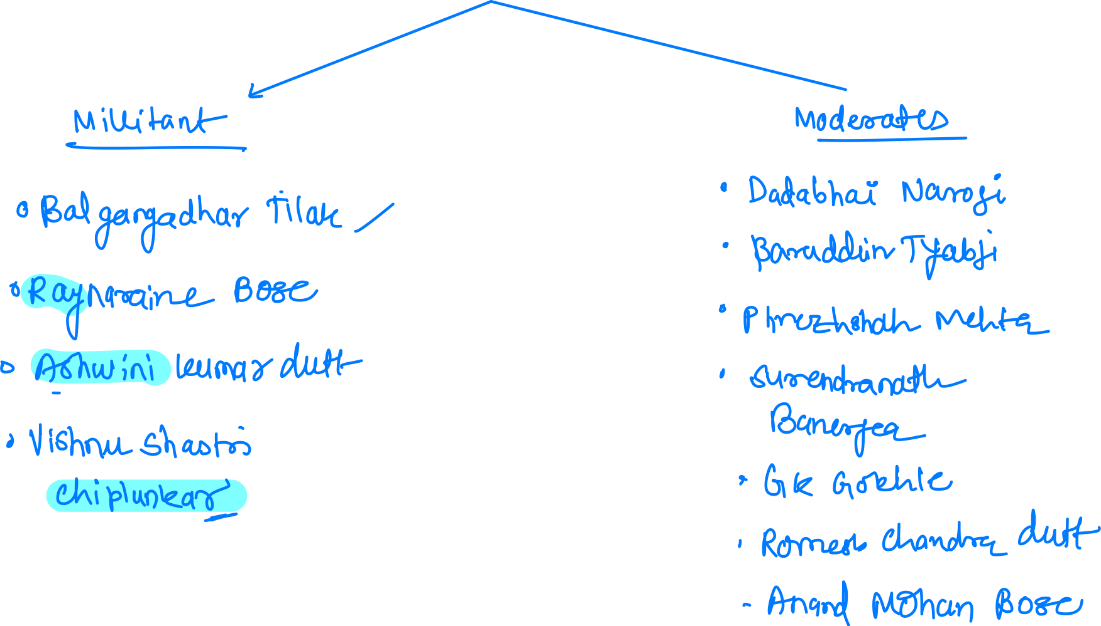
-
International Influence
-
Morley – Minto Reforms (INDIAN COUNCILS ACT OF 1909)
- Provision of election for the provincial legislative council through an electoral college.
- They introduced a separate electorate for the Muslims.
- Voting on separate budget items was allowed by the act; but the budget as a whole could not be voted upon.
- One Indian member to viceroy executive council - Satyendra Prasad Sinha.(Law member)
- It retained official majority in central legislative council.
-
1909 Lahore - Madan Mohan Malviya
-
Growth of Communalism
-
Revolutionary Activity
- Inspiration from revolutionary activities abroad. Ex-Japan defeated imperialist Russia.
- Vasudev Balwant Phadke
- 1897, Chapekar Brothers - assassinated British officer WC Rand and lieutenant Ayerst
- Anushilan Samiti - Barender Dutt and Bhupender Dutt, Pulin Bihari Das, Gyanendra Nath Basu
- Promotha Mitter, Barindrakumar Ghosh, Jatindranath Bannerji are founders.
- Known for assassination of oppressive British officers, swadeshi dacoity.
- Weekly - Yugantar
- Vinayak Damodar Savarkar
- 1904, Abhinav Bharat
- Wrote ‘1857, first war of independence’
- Delhi - 1912, Rash Behari Bose, Sachinder Nath Sanyal
- Madras - Vanchi Iyer killed justice Arche
- Bharat Swashashan Samiti(known as India house in London) - 1905, Shyamji Krishna Verma, 1909, Madan Lal Dhingra assassinated Curzon Wylie.
- Madam Bhikaji Cama
- Ghadar Movement
- 1913- 1915, in Canada and the west coast of the US.
- Tarak Nath(newspaper - Free Hindustan), GD Kumar, Ramnath Puri(Circular-ae-Azadi).
- Lala Hardayal founded the Hindi Association of Portland.
- The Hindi Association decided to start a weekly paper Ghadar.(Urdu, Gurumukhi)
- Komagata Maru Incident (1914)
- Secular approach
-
Home rule movement
- Tilak, Annie Beasant wanted reforms on lines of Irish Home Rule League.
- Tilak
- Tilak , 1916 , Maharashtra
- Tilak’s demand included Swarjaya, formation of linguistic states, and education in vernacular medium.
- Annie Beasant
- BW Wadia and CP Ramaswamy Iyer
- Motilal Nehru, CR Das, Madan Mohan Malviya, Tej Bhadur Saproo, Mohammad Ali Jinnah, Lala Lajpat rai.
- British Response
- came down with severe repression
- Britishers arrested Annie Besant, Wadia and George Arundale.
- She became the first Women President of Congress in 1917.(Calcutta)
- came down with severe repression
- Contributions
- Facilitated the reach of print media
- Created powerful organisational links
- Gandhiji became the president of the All India Home Rule League in 1920. Its name was changed to ‘Swaraj Sabha’.
-
(INC) Session of 1916 (Lucknow) -
- Presided by Ambika Charan Mazumdar
- Reunification
- Lucknow Pact (with Muslim league) -
- Congress accepted separate electorate for Muslims, 1/3rd representation in central government.
- Critical analysis - future communalism, domino effect on other communities.
- There is no demand for dominion status for India at this point in time!
-
Calcutta, 1917 - Annie Besant
Congress session
| Place | Year | President | काहे इंपोर्टेंट है |
|---|---|---|---|
| Bombay | 1885 | Womesh chandra banarjee | 1st Session |
| Calcutta | 1886 | Dadabhai Naoroji | |
| Madras | 1887 | Syed Bharuddin Taiyebji | |
| Calcutta | 1890 | Phirozshah Mehta | - - Kadambini Ganguly addressed the session, first women graduate of Calcutta University. |
| Banaras | 1905 | Gopal Krishna Gokhle | Swadeshi and Boycott Movement |
| Surat | 1907 | Rash Bihari Ghosh | Surat Split |
| Lahore | 1909 | Madan Mohan Malviya | Morley Minto Reforms |
| Lucknow | 1916 | Ambika Charan Mazumdar | Lucknow Pact, Unity between M & E |
| Calcutta | 1917 | Annie Besant | 1st women President |
| Amritsar | 1919 | Motilal Nehru | Khilafat movement |
| Calcutta | 1920 | Lala Lajpat Rai | This was a special session of congress NCM Resolution by MG |
| Ahmedabad | 1921 | CR Das | Presided from jail, appointed Gandhi as sole authority on NCM. |
| Gaya | 1922 | CR Das | Swaraj Party |
| Belgaum | 1924 | MG Gandhi | Only session chaired by MG |
| Kanpur | 1925 | Sarojini Naidu | First Indian Women President |
| Madras | 1927 | MA Ansari | Resolution against using Indian troops in Iran, China and Mesopotamia |
| Calcutta | 1928 | Motilal Nehru | All India Youth Congress Nehru Report |
| Lahore | 1929 | Jawahar Lal Nehru | Poorna Swaraj Declaration |
| Karachi | 1931 | VB Patel | Resolution on FR and National Economic Programme Endorsement of Gandhi-Irwin Pact |
| Lucknow | 1936 | JL Nehru | Socialist Ideas for national development |
| Faizpur | 1937 | JL Nehru | First session to be held in village |
| Haripura | 1938 | Subhas Chandra Bose | National Planning Committee under JLN |
| Tripuri | 1939 | Subhas Chandra Bose Rajendra Prasad | SCB defeated Pattabhi Sitarammiya, SCB Created Forward Bloc |
| Ramgarh | 1940 | Abul Kalam Azad | QIM to be launched at appropriate time |
| Wardha | 1942 | Quit India Resolution after failure of Cripps Mission | |
| Bombay | 1945 | Support for INA POW | |
| Meerut | 1946 | JB Kriplani | Last session before Independence |
Revolutionary Activities
| Konsi Activity | Year | Kisne Kari | Activities |
|---|---|---|---|
| Hindustan Republican Army | 1924 | Sachindra Nath Sanyal, Yogesh Chatterjee | |
| Hindustan Socialist Republican Association | Chandra Shekhar Azad | ||
| Punjab Naujawan Bharat Sabha | 1926 | Bhagat Singh , Lahore | |
| Indian Republican Army | 1930 | Surya Sen | Chittagong Armoury Raid |
Beginning of Mass Nationalism (1919-1939)
-
Mahatma Gandhi – His Ideas & Leadership
- According to Gandhi, Independence of India should not just mean independence from foreign rule. It also involves independence from servitude of casteism, patriarchy, capitalism etc.
-
He opened Phoenix farm after getting inspired by JOHN RUSKIN’S book “Unto This Last”. For training his cadre on non-violent satyagraha.
-
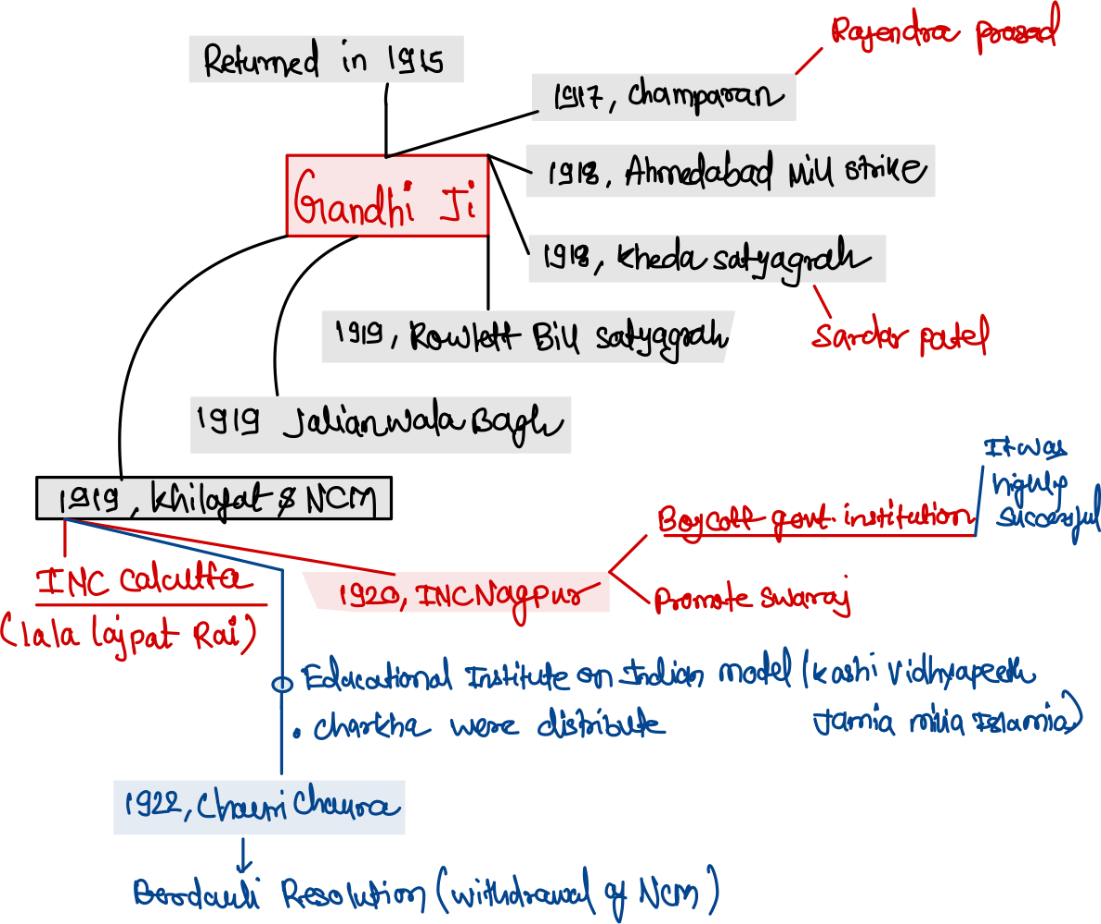
-
CAKRJK
-
1917, Champaran Issue - Gandhi’s First Civil Disobedience in India
- Raj Kumar Shukla persuaded him to come to Champaran
- Indigo plantation on 3/20th of their landholding (Tinkathia System)
- European planters had taken advance rents
- Commission ordered planters to refund 25% of the money they have illegally taken from the peasants.
-
1918, Ahmedabad Mill Strike - First Hunger Strike
- Demands for increase in salaries
- Ambalal Sarabhai agreed to go to Tribunal, It awarded 35% increase in the wages of the workers.
- Sister of Ambalal Sarabhai, Anusuya Behan was one of the ardent supporters of Gandhi in this case.
- Morarji Desai was associated with this movement
-
1918, Kheda Issue - No Tax Campaign
- Gujarat sabha - submitted petition to implement the revenue code, which provided for remission of taxes if yield < 1/4
- Government suspended the collection of land revenue owning to crop failure
- Gandhi was supported by Sardar Patel, Indulal Yagnik, Vithalbhai Patel
-
Montagu-Chelmsford Reforms (Government of India Act 1919)
- Colonial government policy for development of self-governing institutions
- Dyarchy in the provinces (executive councillors and popular ministers)
- Reserved subjects(Governor through executive councillors)(land revenue, law and order) and transferred subjects (ministers)(health, education, agriculture, industry, local government)
- Bicameral legislation was introduced at the central level
- System of communal or separate electorate was further extended to Sikh community and Anglo-Indian community
- Women were also given the right to vote.
- Three of the eight members of the Viceroy’s executive Council (other than the Commander-in-Chief) were to be Indian.
- Provision for establishment public service commission (In 1926 public service commission was setup for the first time in India)
- Separate exam for ICS to be held in India, First held in Allahabad in 1922.
-
Rowlatt Act, Satyagraha
- 1919, aimed at curtailing the Civil Liberties in the name of curbing terrorist violence.
- 13th of April Baisakhi Day, Jallianwala Bagh Massacre
- General O Dyer
- Rabindranath Tagore renounced its Knighthood in protest.
- Gandhi overwhelmed by the total atmosphere of violence withdrew the movement on the 18th of April 1919, etc.
-
Non-cooperation & Khilafat Movement
- 1919, Khilafat Committee - Ali Brothers i.e. Shaukat Ali and Mohammad Ali; Ajmal Khan, Maulana Azad, Hasrat Mohani.
- 1919, All India Khilafat Conference was held in Delhi, Gandhiji was the president.
- (INC) Session Calcutta, 1920 (Lala Lajpat Rai) - Gandhiji said swaraj can be achieved within one year.
- This is the launch of NCM
- Nagpur Session of INC (December 1920) (C. Vijay Raghavacheriar)
- Focus on constructive work like Khadi, Hindu-Muslim Unity, removal of untouchability, improving the condition of women, etc.
- Congress working Committee (Provincial, All India)
- develop Hindi as a contact language
- Charkha and Khadi became national symbols
- 5th of February 1922, Chauri Chaura of Gorakhpur District -> Gandhi decided to withdraw NCM.
- At this point in time Madam Annie Besant, Madan Mohan Malviya and Mohammad Ali Jinnah resigned from Congress.
-
Swarajists & No-Changers
- On issue of participation in legislative councils by GOI Act, 1919
- 1922, Gaya session(CR Das) Swarajists/Pro-Changer - CR Das, Motilal Nehru supported -> they created ‘Khilafat Swaraj Party’
- In 1923, They won 42 out of 101 elected seats in Central Legislative Assembly
- In 1925, Swarajists were successful in electing Vithal Bhai Patel as the first Indian speaker of the Central Legislative Council
-
No-changers - Vallabhai Patel, Rajendra Prasad, C Rajagopalachari, Gandhi
-
1924 Belgaum (Maharashtra) session - only session chaired by MG
-
Vaikom Satyagraha - 1924
- Untouchables rights to use forbidden road to vaikom temple
- Periyar EV Ramaswamy
- Shree Narayana Guru and N. Kumaran Asan. T.K. Madhavan(editor of Deshabhimani)
- Gandhi supported the movement
- After CDM Guruvavur satyagraha - 1931 on the same theme of temple opening
- K. Kelappan, poet Subramaniyam Tirumambu
- Led to November 12, 1936, the Maharaja of Travancore issue proclamation for temple for all Hindus
-
Revolutionary activities II - Emergence of New Forces – Socialistic Ideas, Youth & Trade Unionism
- 1924, Hindustan Republican Army, Sachindra Sanyal and Yogesh Chatterjee, Kakori Train Dacoity
- Ramprasad Bismil, Ashfaq Ullah Khan, Rajendra Lahiri, Roshan Lal were convicted and hanged.
- Chander Shekhar Azad converted to HSRA.(Hindustan socialist republican association)
- 1931, Chander shaker Azad shot himself dead in a public park at Allahabad.
- At the request of Azad, Bhagwati Charan Vohra wrote the “Philosophy of Bomb”.
- 1924, Hindustan Republican Army, Sachindra Sanyal and Yogesh Chatterjee, Kakori Train Dacoity
-
Bhagat Singh - Naujawan Bharat sabha and Lahore Chhatra Sangh, Marxist thought.
- “Why I am atheist”
- Assassination of the officer Saunders responsible for Lajpat Rai’s killing.
- Bhagat Singh along with Batukeshwar Dutt threw a bomb in the central assembly on the 8th of April 1929.
- 23rd of march 1931, Bhagat Singh, Sukhdev and Rajguru were hanged by the British authority.
-
Revolutionaries in Bengal
- Indian republican army of master Surya Sen, Kalpana Dutt Joshi and Preety Lata Wadedar - raid on armouries of Chittagong in 1930.
- Shanti Ghosh and Suniti Choudhary assassinated Charles Stevens.
- Bina Das tried to kill the governor-general of Bengal Stanley Jackson (Governor General of Bengal)
-

-
1924, Bahishkrit Hitakarini Sabha - BRA (Educate, Organize and Agitate)
-
Simon Commission & Nehru Report
- 1928, Indian statutory commission arrived to examine effects and suggest reforms of GOI Act, 1919 after 10 years.
- Endorsed by the liberal federation of Tej bahadur Sparu, Hindu Mahasabha, Muslim league
- Lala Lajpat rai, JLN was beaten up for protest.
-
1928, Calcutta Session - Motilal Nehru
-
Motilal Nehru Report
- Dominion status for India.
- Adult suffrage and equal rights to women.
- Responsible government in the centre and provinces.
- Complete disassociation of state from religion in any form.
- Response
- Rejected on dominion status
- Muslim League, Hindu Mahasabha, and Sikh community rejected Nehru report.
-
INC Session Lahore 1929 (Jawahar Lal Nehru)
- Purna Swaraj’s declaration, tricolour flag adopted
- On the 26th of Jan 1930, the independence pledge was read out and collectively affirmed.
- CDM was sanctioned to be launched by Gandhi.
-
Civil Disobedience Movement
-
Round Table Conferences
- First Roundtable conference -
- Congress did not participate
- Gandhi-Irwin Pact March 5, 1931 - Goal of ‘Poorna Swaraj’
- INC Karachi, 1931 (VB Patel) - resolution regarding fundamental rights and national economic plan
- Second roundtable conference
- Gandhi participated
- Third Round Table Conference, 1932
- Congress did not participate.
- Deliberations of RTC led to GOI Act 1935
- 1934 formally withdrew the civil disobedience movement.
- First Roundtable conference -
-
Communal Award & Poona Pact
- August 1932, British PM Ramsay McDonald announced the communal award for depressed classes.
- Gandhi decided to observe a fast unto death on the 20th of September 1932
- As a result, the Poona pact was signed between Gandhi and BR Ambedkar.
- At the end of September 1932, Gandhi established all India untouchability league.
-
Government of India Act, 1935
- This act also led to the establishment of the Federal court of India, UPSC, RBI, etc.
- Diarchy was introduced at the centre, abolished in state (provincial autonomy)
- The bicameral legislation was reconstituted at the central level.
- As per act 3 lists of legislation were created - federal, concurrent and provincial.
- The act enfranchised 14% of the Indian population.
- Governor retained power to veto legislation and making ordinances.
-
Participation in Elections to Central Legislature (1934) & Provincial Assemblies (1937)
- Congress got clear majority in 6 provinces Bombay, Madras, United Province, Central Province, Bihar, and Orrisa.
- A coalition government was formed in Sindh, NWFP, and Assam.
- In Bengal Krishak Praja Party and the Muslim League formed the government in the Punjab Unionist party of Sikander Hayat khan formed the government.
-
INC Session 1936, Lucknow (JLN)(Put an idea for adopting socialism - > reaction ‘Bombay manifesto’ )
- All-India Kisan Sabha(AIKS) - Swami Sahajanand Saraswati became 1st president
-
INC Session 1937, Faizpur - grievances of farmers, no proposal of
Zamindari- JLN, first session in village
-
Haripura session, 1938 -
-
Tripuri session, 1939 - Subhas Chandra Bose defeated Pattabhi Sitaramayya
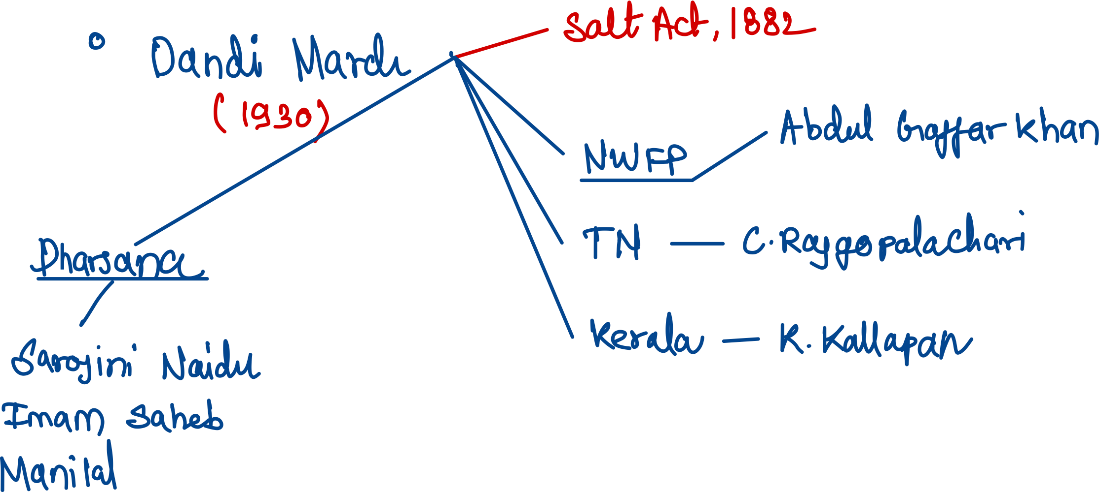
Towards Freedom & Partition (1939-1947)
-
National Movement During World War II
- In September 1939, WW-II broke out and the British government declared India to be a party to world war second without consulting with Indian leaders.
-
Growth of Communalism
- Lahore Resolution (March 1940) - Muslim League, demand for separate state for Muslims.
-
August Offer, 1940
- Viceroy Linlithgow (longest serving 1936 to 1944) - Dominion status as the objective for India.
- Congress rejected the august offer.
-
Individual Satyagraha, 1940
- Vinoba Bhave was the firsts Satyagrahi, Nehru second, and Braham Dutt third.
-
Peasant Movements
-
State People’s Struggle
-
Cripps Mission March, 1942
- Sir Stafford Cripps was a senior labour politician.
- PM was Winston Churchill
- To Secure the full cooperation of Indians in WW-II.
- Dominion status for India.
- Right of provinces to secede was promised (opposed by congress)
- failed due to its lack of immediate transfer of power.
-
Quit India Movement, 1942 (also called August movement)
- WW-II near about 87000 Indian soldiers were dead.
- Gandhiji wrote leave India to God if that is too much, leave her to anarchy, I would risk it.
- All the congress leaders were arrested and kept in different jails.
- For example - Gandhiji, Sarojini Naidu, and Mahadev Desai were imprisoned at agha khan palace, Pune, Nehru at Ahmad Nagar fort.
- Underground Movement - Achyut Patwardhan, RP Goenka, Chotubhai Puranik, Aruna Assafali, Sucheta Kriplani, Ram Manohar Lohia, Ramnandan Mishra, and JP Narayan.
- Parallel government
- Ballia UP - Chittu Pandey, 1942
- First parallel government
- Tamluk - Midnapore in Bengal - Jatiya Sarkar in December 1942.
- They created their own armed force known as Vidyut Vahini.
- Satara - 1923, Prati Sarkar in Satara was established, most effective and longest surviving parallel government.
- YV Chavan and Nana Patil.
- Nyayadan Mandal for dispensing justice and also conducted “Gandhi Marriages” (Group marriages)
- Toofan Sena (typhoon army) to carry out guerrilla attacks against the Raj
- Ballia UP - Chittu Pandey, 1942
-
C. Rajagopalachari’s CR Formula (1944), failure of Gandhi- Jinnah talks (1944).
-
INA & Subhash Chandra Bose , 1945
- Forward Bloc
- The idea of INA was first conceived in the Malay Peninsula by Captain Mohan Singh who had the full support of Rash Bihari Bose.
- Free India Legion or Mukti Sena with 3,000 Indian prisoners of war.
- End of September 1942, INA formally came into existence.
- He created a women’s regiment named after Rani Jhansi. Captain Laxmi Sehgal was one of the officers of the regiment.
- INA surrendered unconditionally to the British in Singapore in 1945.
-
Wavell Plan, and Shimla Conference 1945
- Except for the governor-general and commander in chief, all the members of the executive council were to be Indians.
- An interim government should be formed within the premise of the 1935 Act.
- Hindus and Muslims to have equal representation.
- Governor-General can exercise a veto on the advice of ministers.
- Negotiations on the new constitution after the war is over.
-
Support for the Muslim League:
- The Direct Action Day (1946), called by the Muslim League, led to widespread communal riots.
-
Nationalist Upsurge Post-World War II
- INA Trials - Bhula Bhai Desai, KN Katju, JLN, Asaf Ali, Tej Bahadur Sapru, etc supported victims.
- 3 INA officers- Prem Sehgal, Gurbaksh Dhillon, and Shahnawaz Hussain were handed punishment.
- 21st of November 1945 during INA Calcutta trials.
- 11th of Feb, 1946 at Bombay
- Third Upsurge- RIN Revolt at Bombay - The Royal Indian Navy revolt in Indian History is seen as the last nail in the coffin of British rule.
-
Cabinet Mission , May 1946
- Clement Attlee’s (PM UK) sent AV Alexander, Pethick Lawrence, and Stafford Cripps.
- Cabinet Mission rejected the demand of the Muslim League for a separate nation.
- It proposed to divide Indian states into 3 categories: Hindu Majority states, Muslim Majority states in West, Muslim majority states in the East- Bengal, Assam.
- It provided that the central government at Delhi would have powers over defence, foreign affairs, and communications.
- Muslim League withdrew from interim government to demand for separate Pakistan
-
Mountbatten Plan (1947)
- Expedition of process of partition led to poorly managed partition.
- The rushed boundary demarcation by the Radcliffe Commission resulted in mass migrations and communal violence.
-
Independence with Partition
- 1946, meerut - J.B Kriplani was the president of the Congress
- 1948, Jaipur - Pattabhi Sitaramayya
-
Peasant movements between 1857-1947
| Movement | Date | Why | Where | Leader |
|---|---|---|---|---|
| Indigo Revolt | (1859–60) | Planters forcing to grow indigo | Nadia | Digambar Biswas and Bishnu Biswas |
| Pabna Leauges | 1870s - 1880 | Zamidaar, rent | ||
| The Kisan Sabha Movement | 1918 | Rai Bareilly, Faizabad | Gauri Shankar Mishra and Indra Narayan Dwivedi | |
| Eka Movement | 1921 | Madari Pasi | ||
| Mappila Revolt | 1921 | Landlords, -> Communal | ||
| Bardoli Satyagraha, Gujarat | 1926 | Increase the land revenue by 30 per cent | - - - Vallabhbhai Patel (women -> sardar) - K.M. Munshi and Lalji Naranji (supported by resign, Bombay LC) | |
| Tebhaga Movement | 1946 | jotedars <> bagchasi or adhyar (sharecroppers) | Rajbanshis, Bengal |
Post Independence India
Nation Building
-
Partition and Its Aftermath
- Mountbatten Plan
-
Integration of Princely States
-
Linguistic Regionalism in India
-
Reorganisation of States
-
Issue of Official Language
-
Tribal Consolidation
-
Regional Aspirations
Foreign Policy
-
Non-Aligned Movement
-
Panchsheel - IT-EPA
-
Wars with Pakistan & China
-
Nuclear Policy
Economy
-
Planned Development
-
Green Revolution, Operation Flood & Cooperatives
-
Agrarian & Land Reforms
-
Industrial Reforms
-
LPG Reforms
Polity
-
Era of One-Party Dominance
-
Emergence of Opposition Parties
-
Emergency: Crisis of Democratic Order
-
Rise of Regional Parties
-
Coalition Era
Social
-
Popular Movements
-
Communalism
-
Indian Women Since Independence
- Issue of Women and Evolution of Women Movement
-
Naxalism
Post-Independence Policy of Science And Technology
-
India’s Policy in the Field of the Science and Technology
-
Impact of Economic Reform on the Science and Technology in India
World History
Beginning of the Modern World
-
Renaissance
-
Discovery of Sea Routes
-
Reformation
-
Counter Reformation
-
Industrial Revolution
-
European Nations Settle North America
-
Rise of Slave Trade
-
American War of Independence
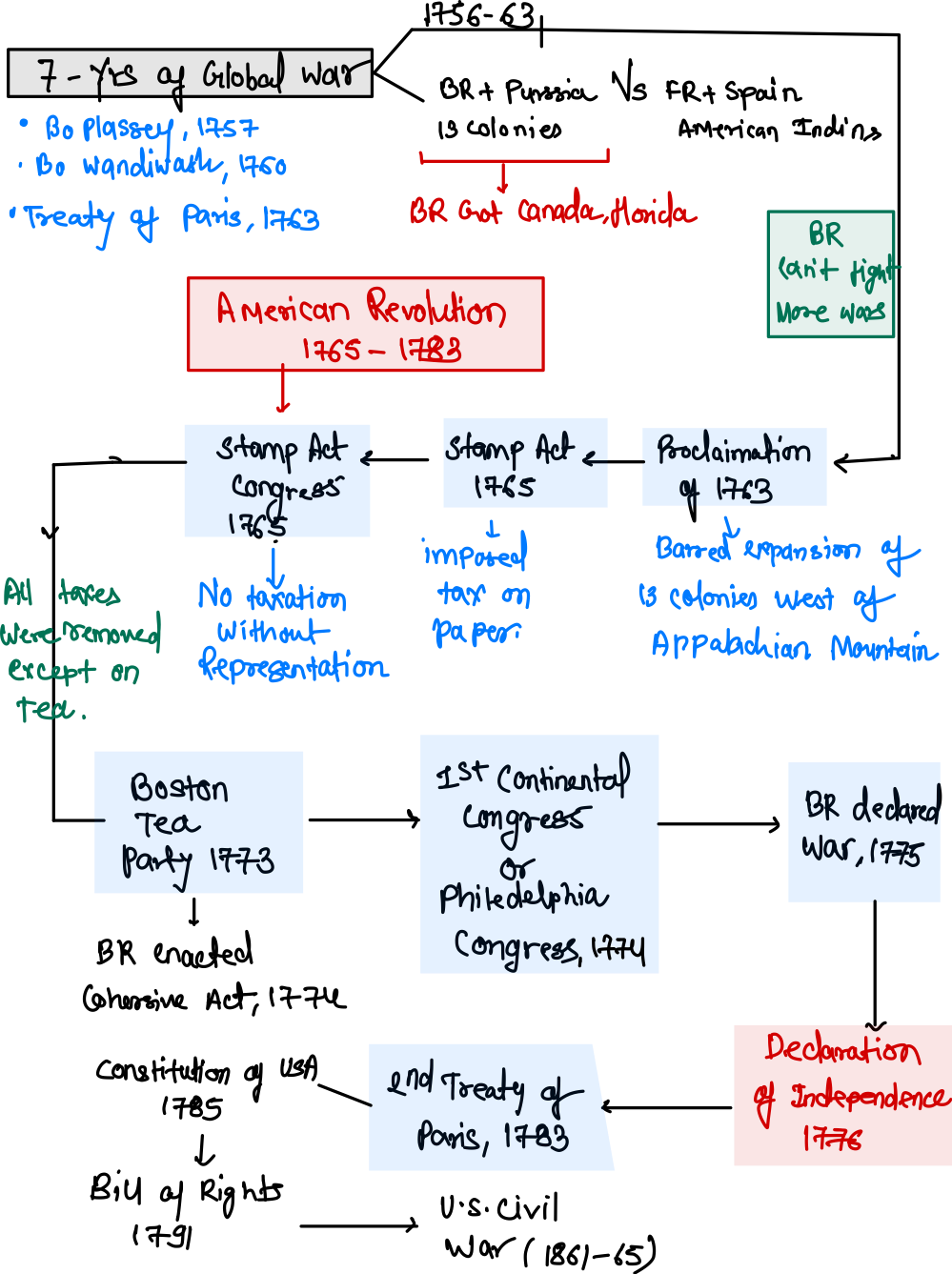
- Foundation of American Colonies
- The Independence of United States of America
- The American Revolutionary War
- What was the impact of American Revolution?
- US Civil War
- Impact of Civil War on USA
- Global Impact of US Civil War
- Impact on India
-
French Revolution
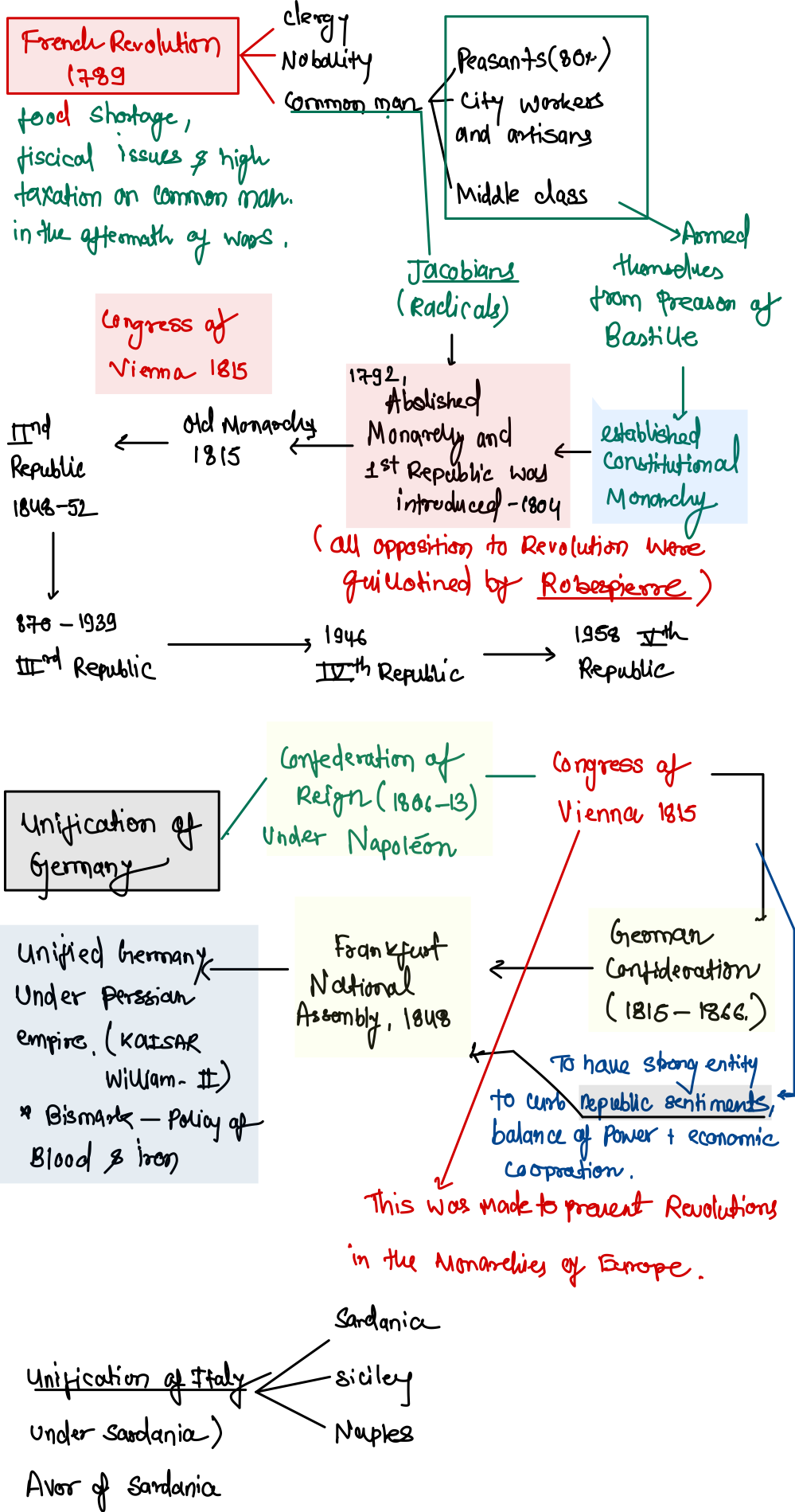
- Causes
- The revolution in France
- France under Napoleon
- Impact of revolution
- Significance of revolution
-
Nationalism in Europe
- Rise of the nation- state system
- Unification of Italy
- Unification of Germany
-
Rise of Capitalism, Colonialism & Imperialism
- Colonialism
- In China
- In China
- Colonialism
-
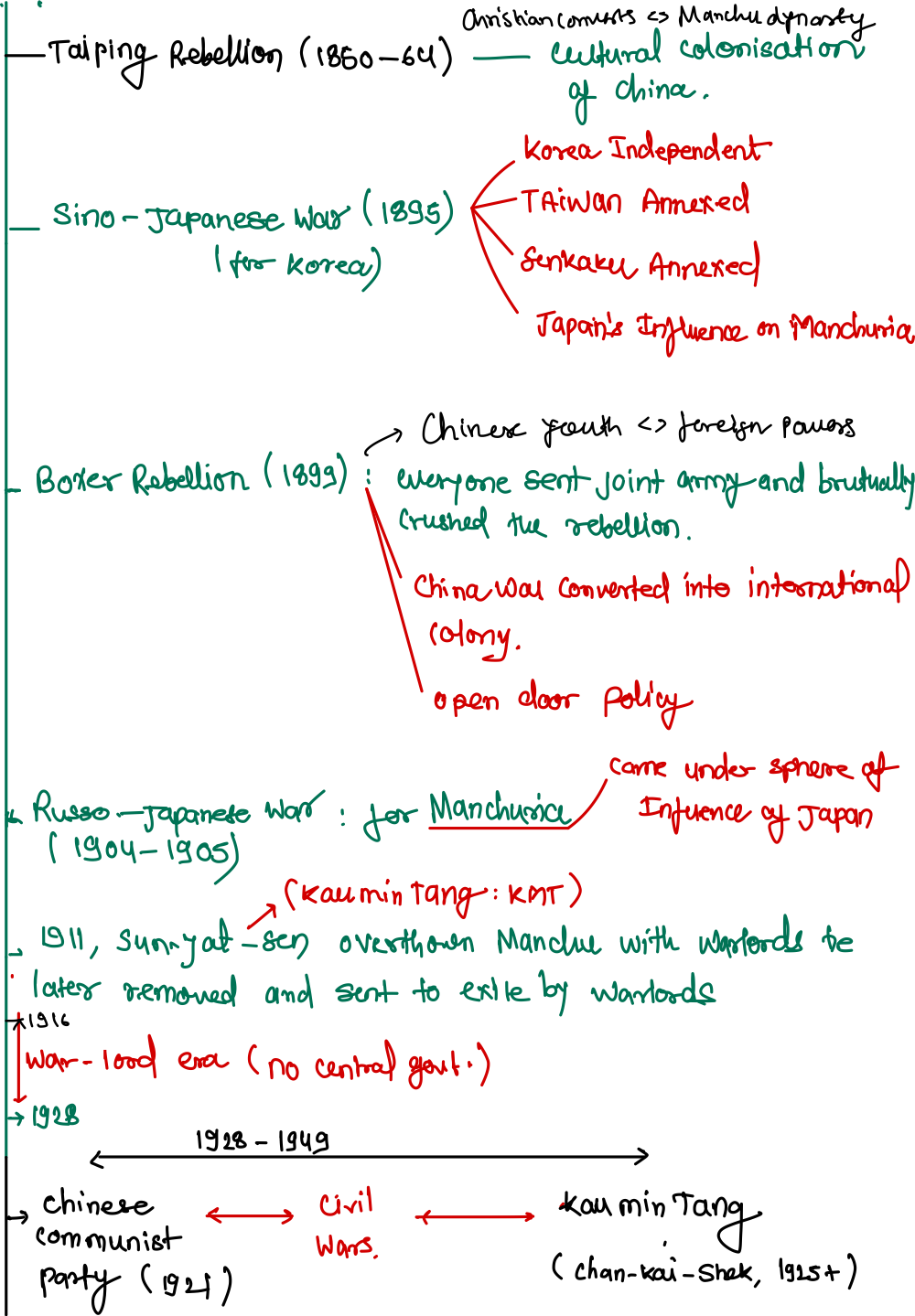
-
In Africa
-
The age of Imperialism (1870-1914)
-
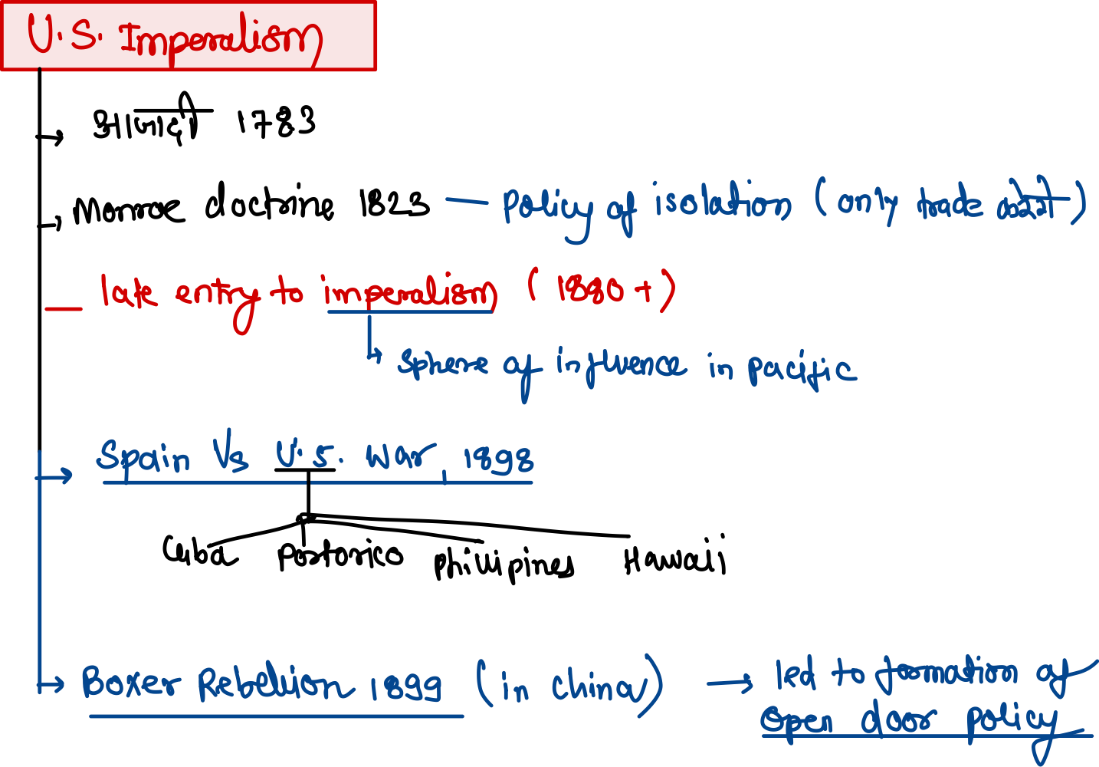
-
Imperialism in Asia
- Japan
- Japan
-
Analysis of Colonialism
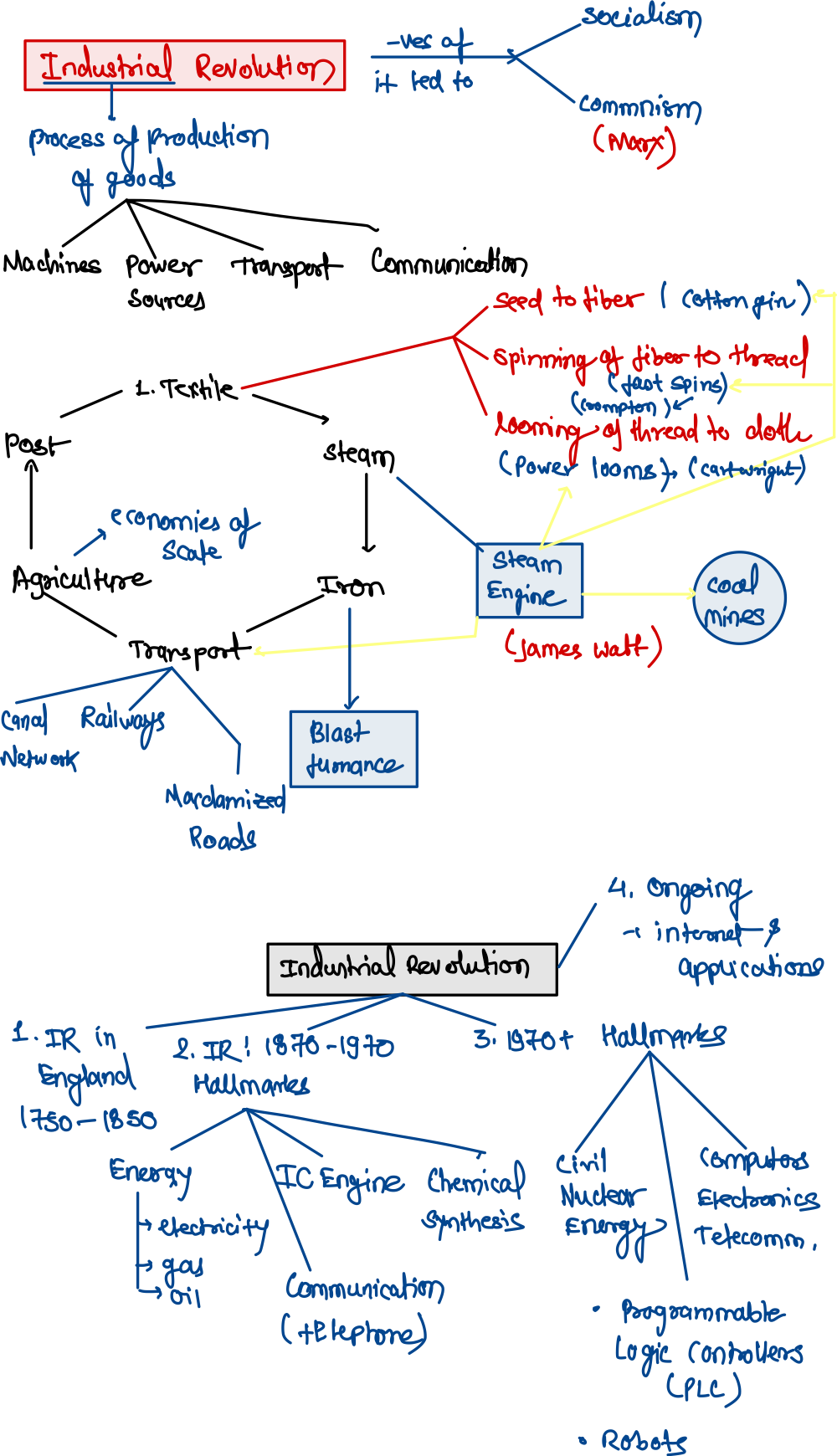
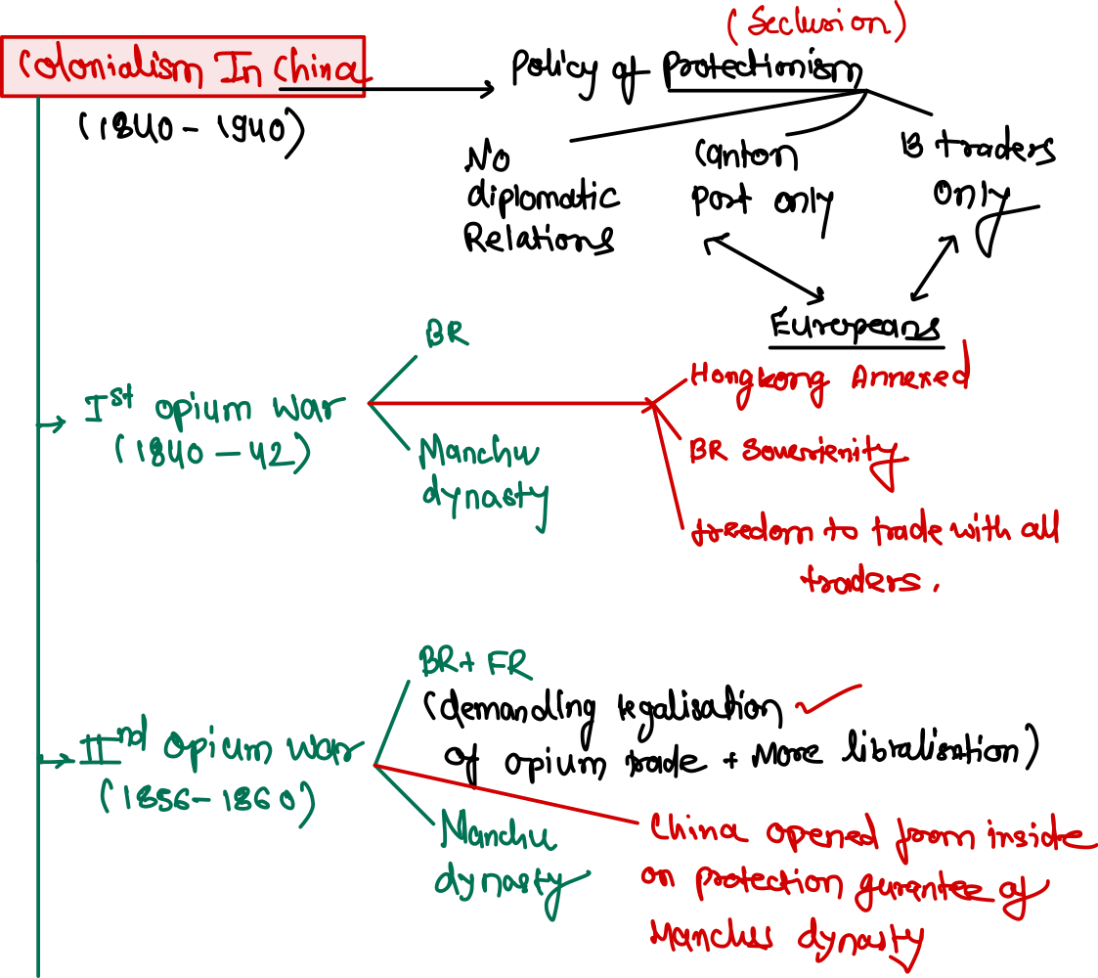
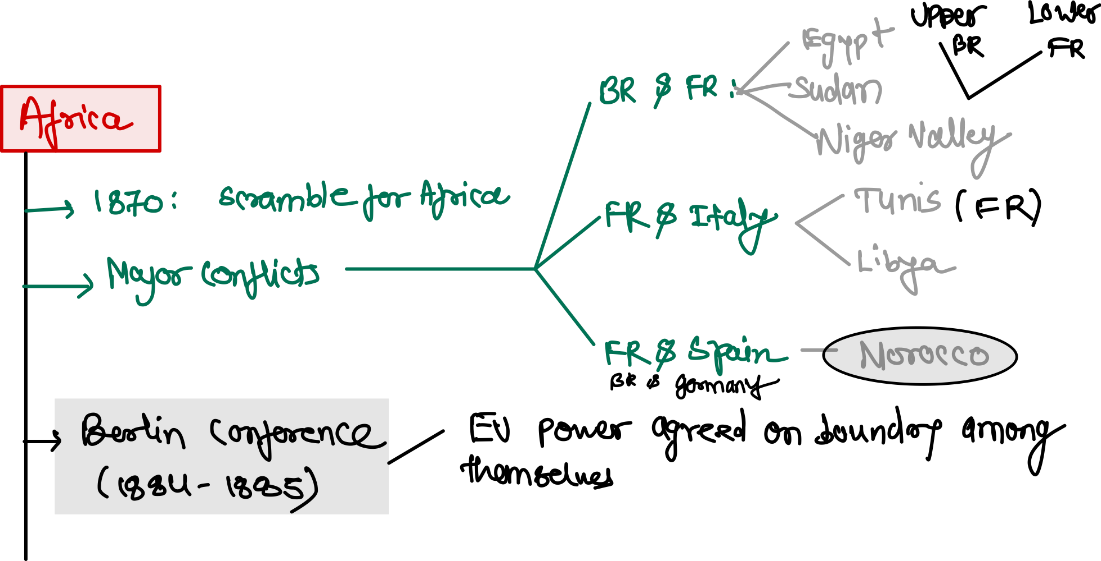
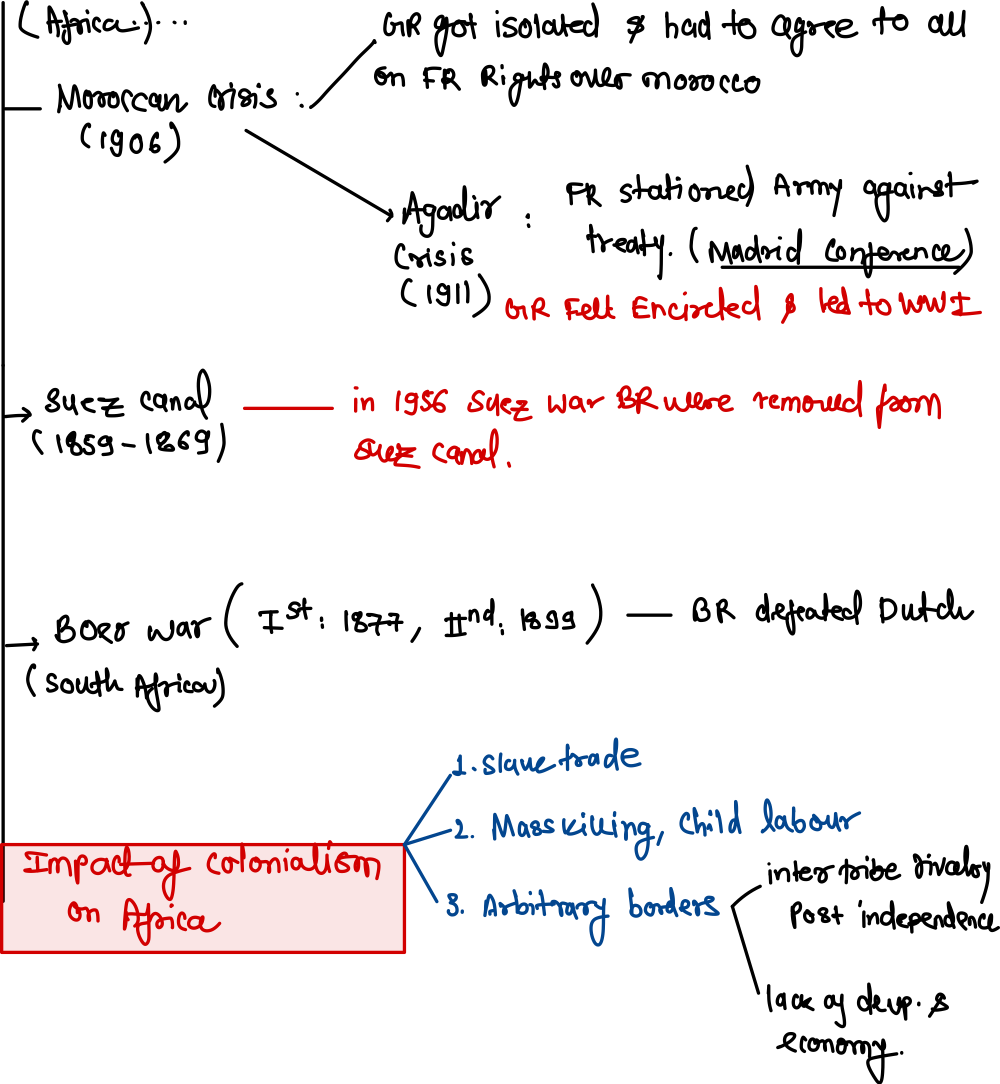
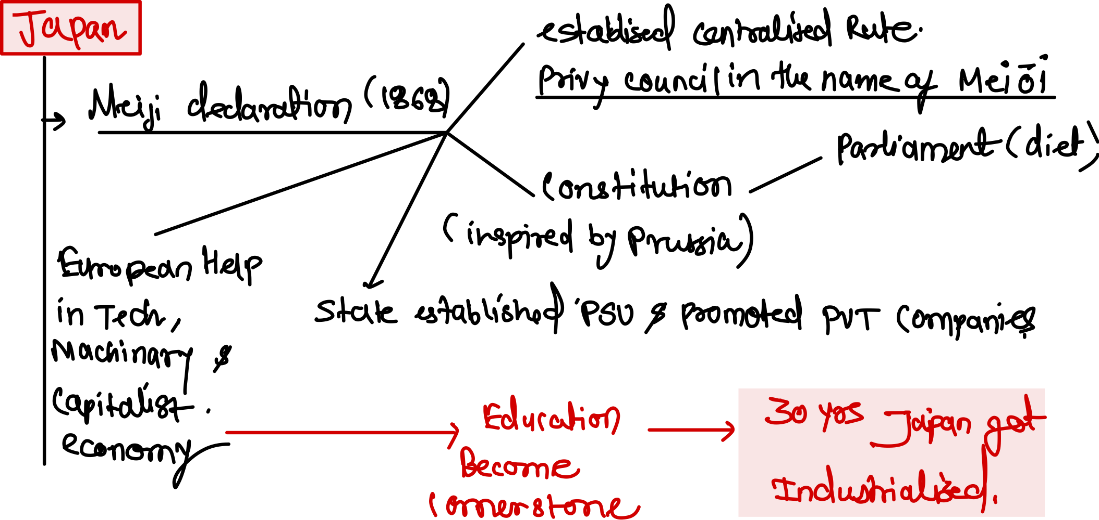
World War I
-
Causes of the War
-
Scope & Course of the War
-
End of the War & Peace Treaties
-
Consequences of the War
-
League of Nations
-
Russian Revolution
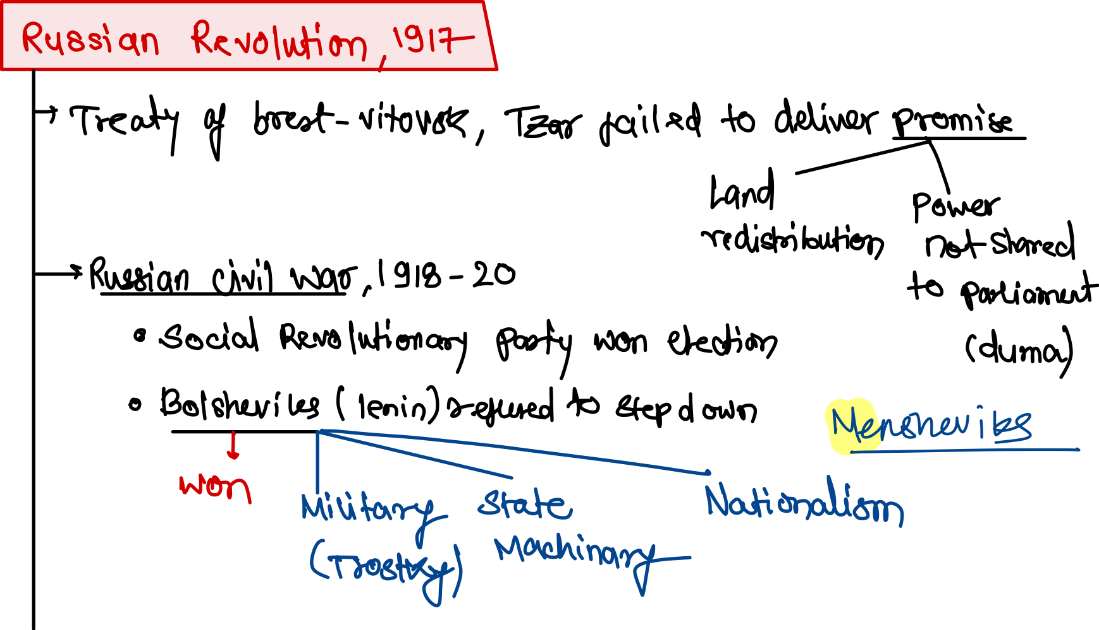
- Major events in pre-revolution Russia
- Causes
- Course of revolution
- Consequences
- Aftermath of the war
- Post-Lenin Russia
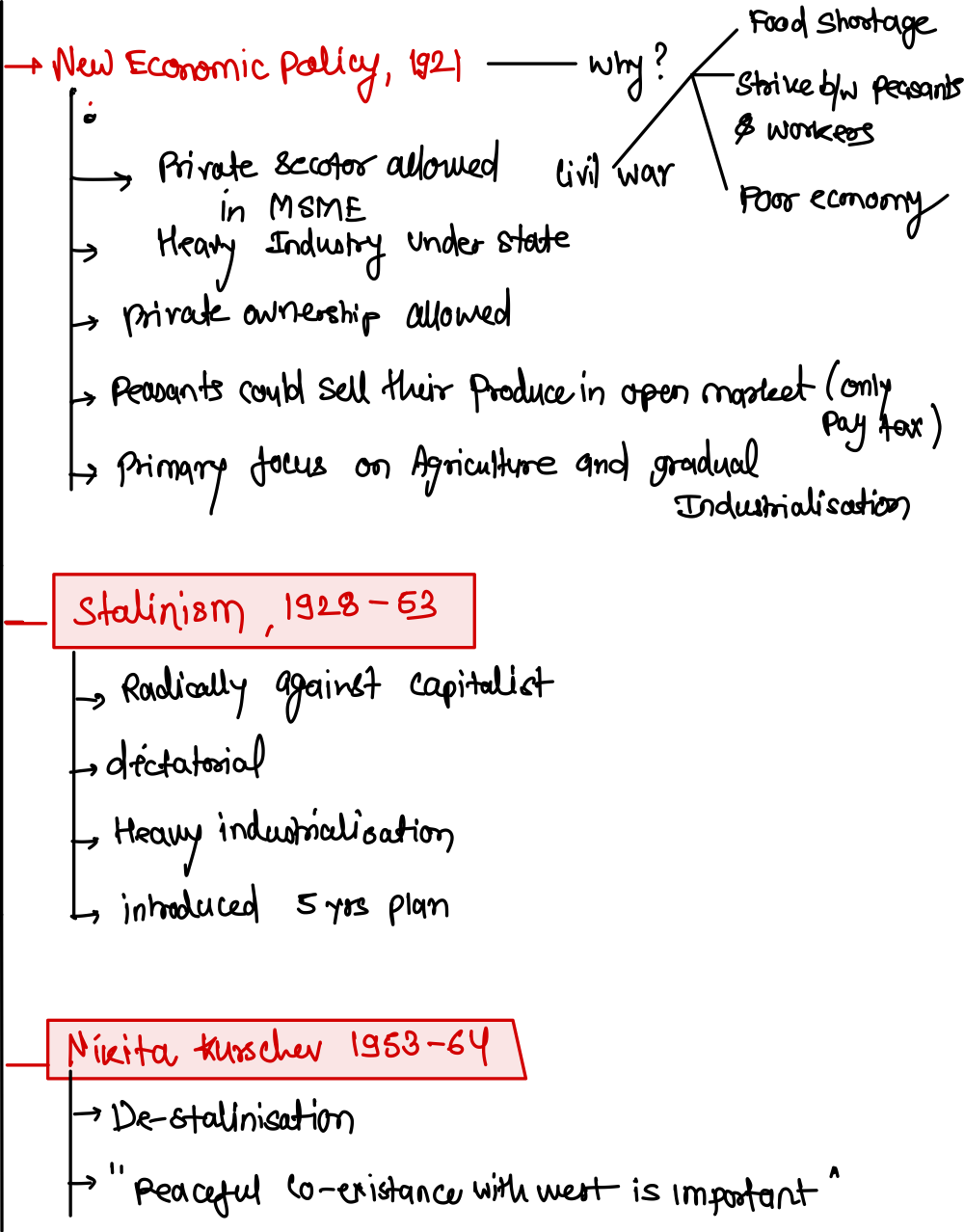
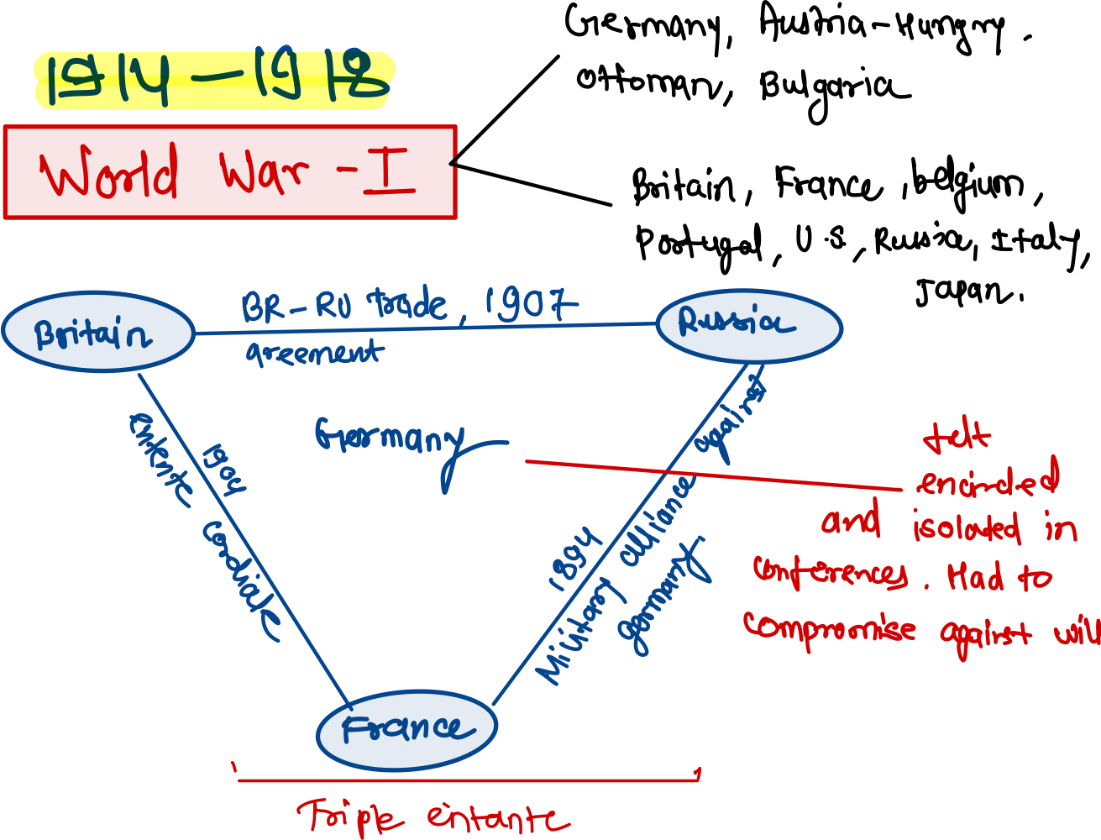
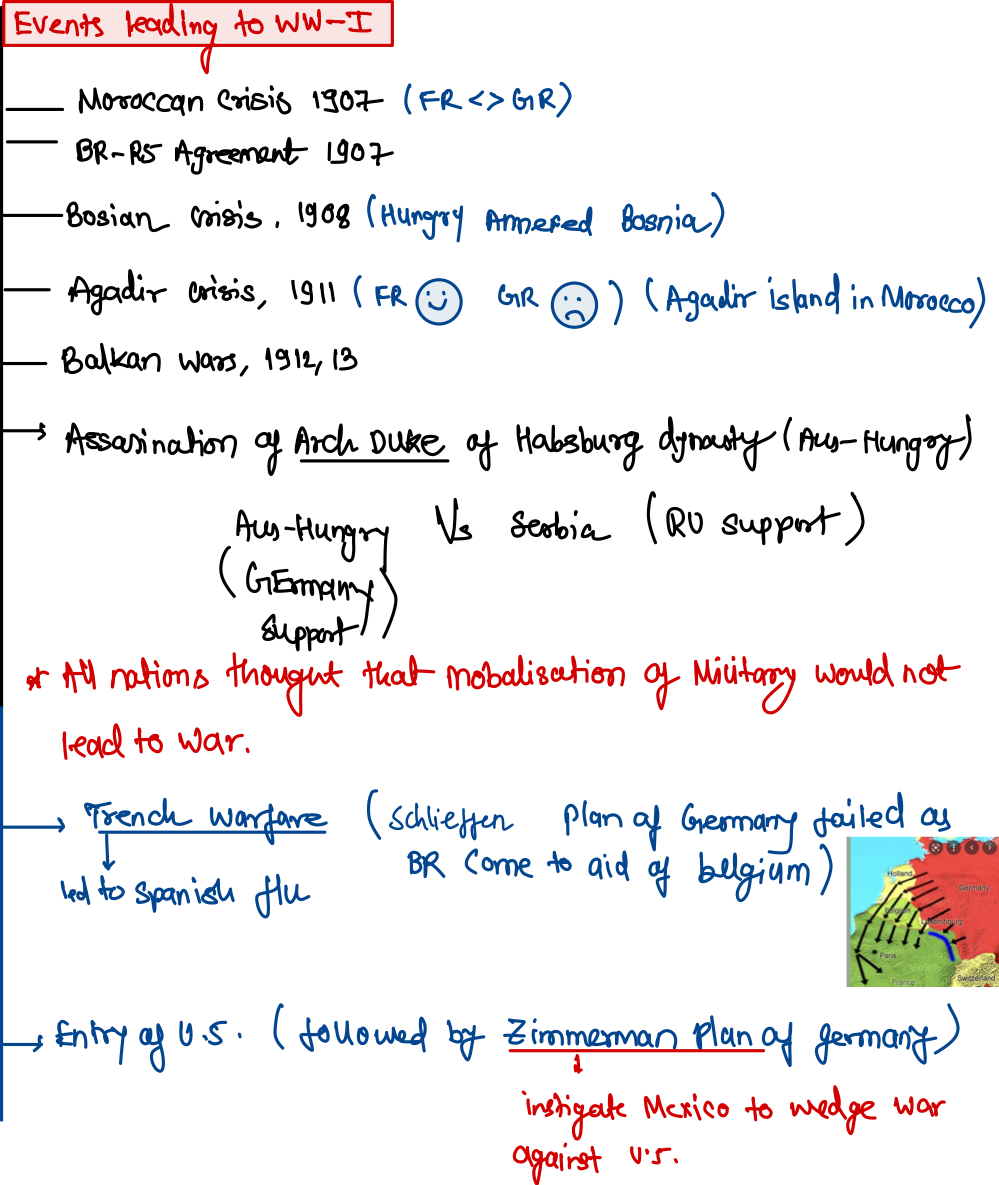
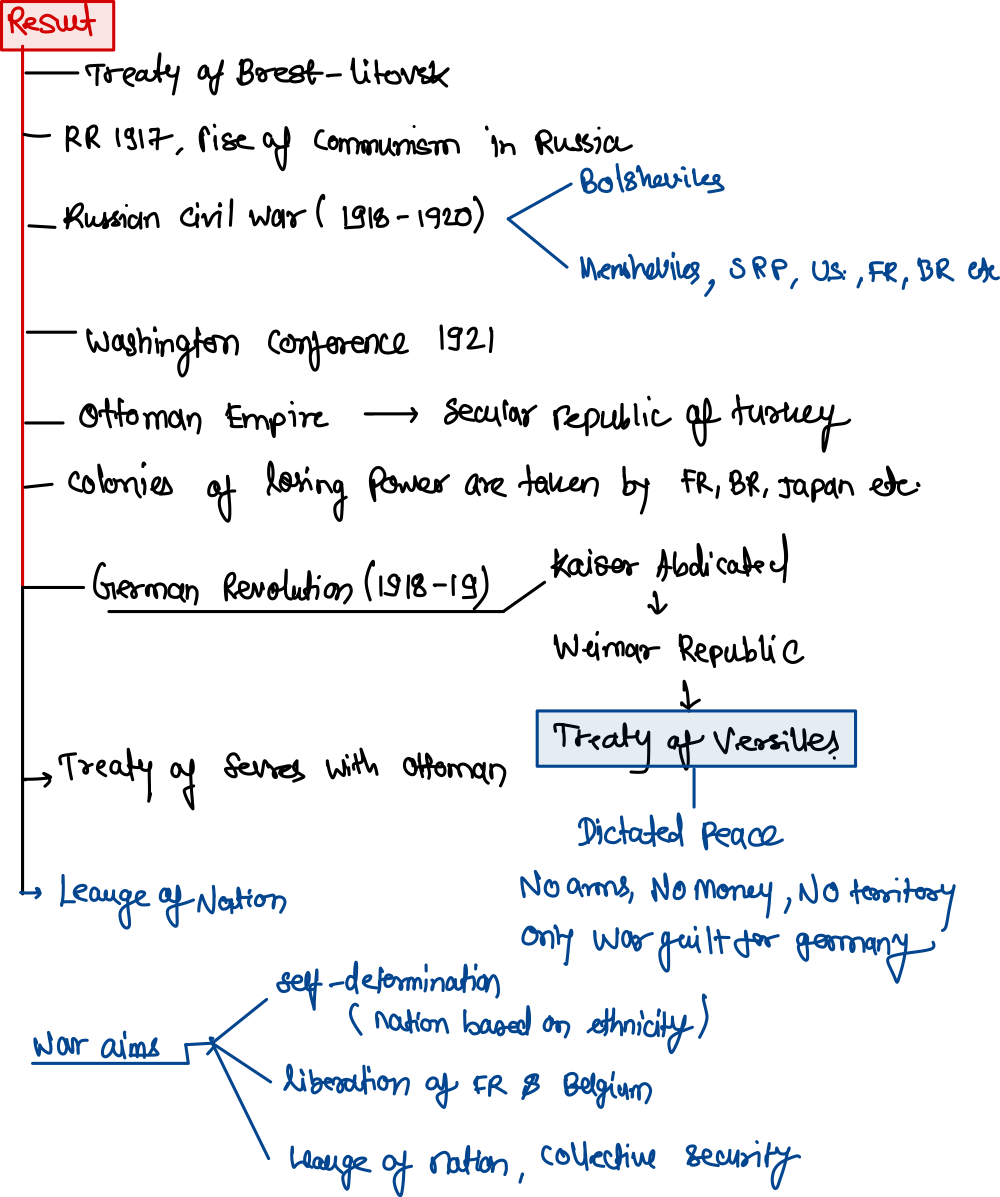
World Between the Two Wars
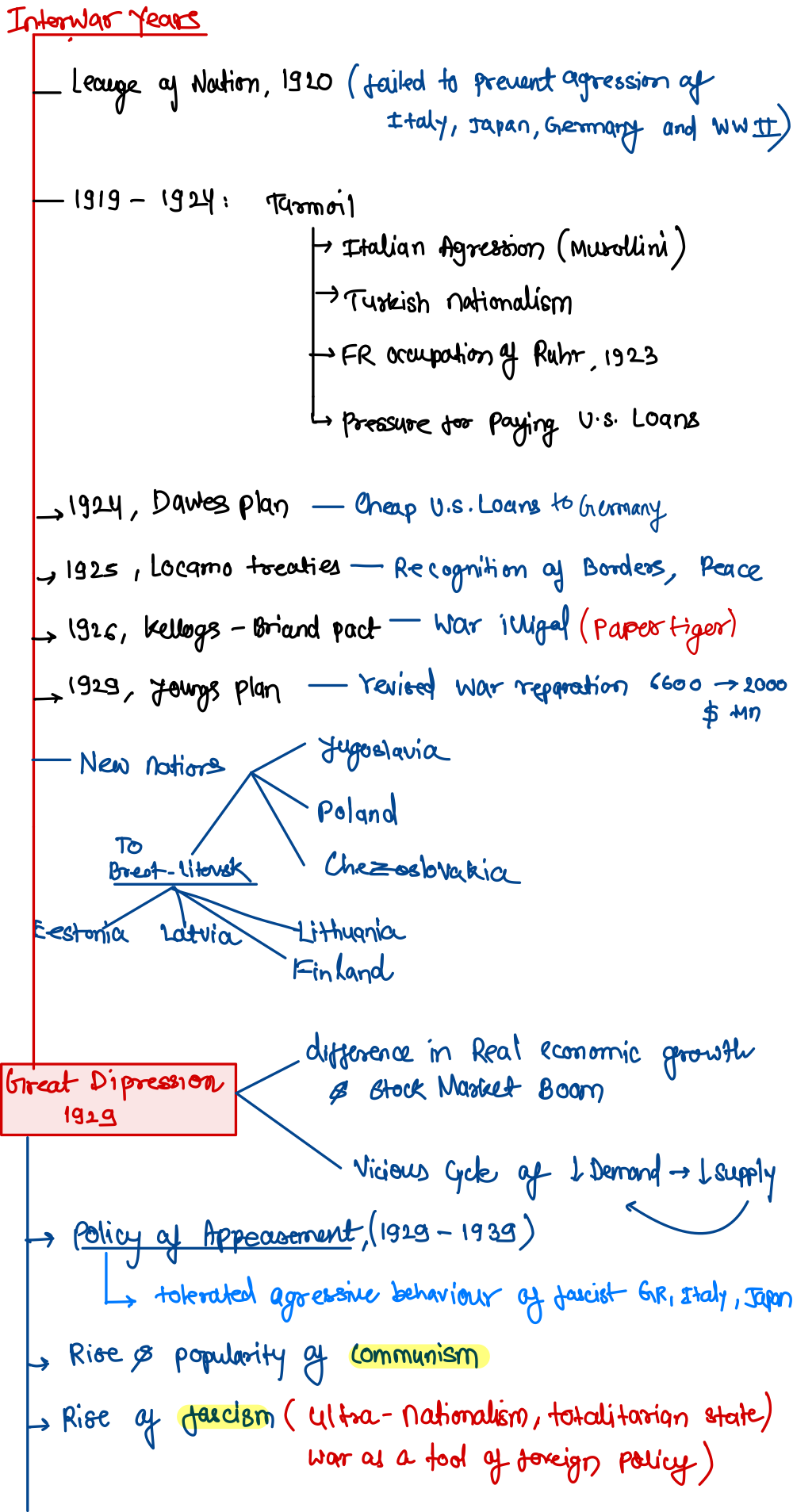
- Europe After the War – Fascism & Nazism
- The Great Depression
- Emergence of Soviet Union
- Nationalist Movements in Asia & Africa
- US as a Strong Power
World War II
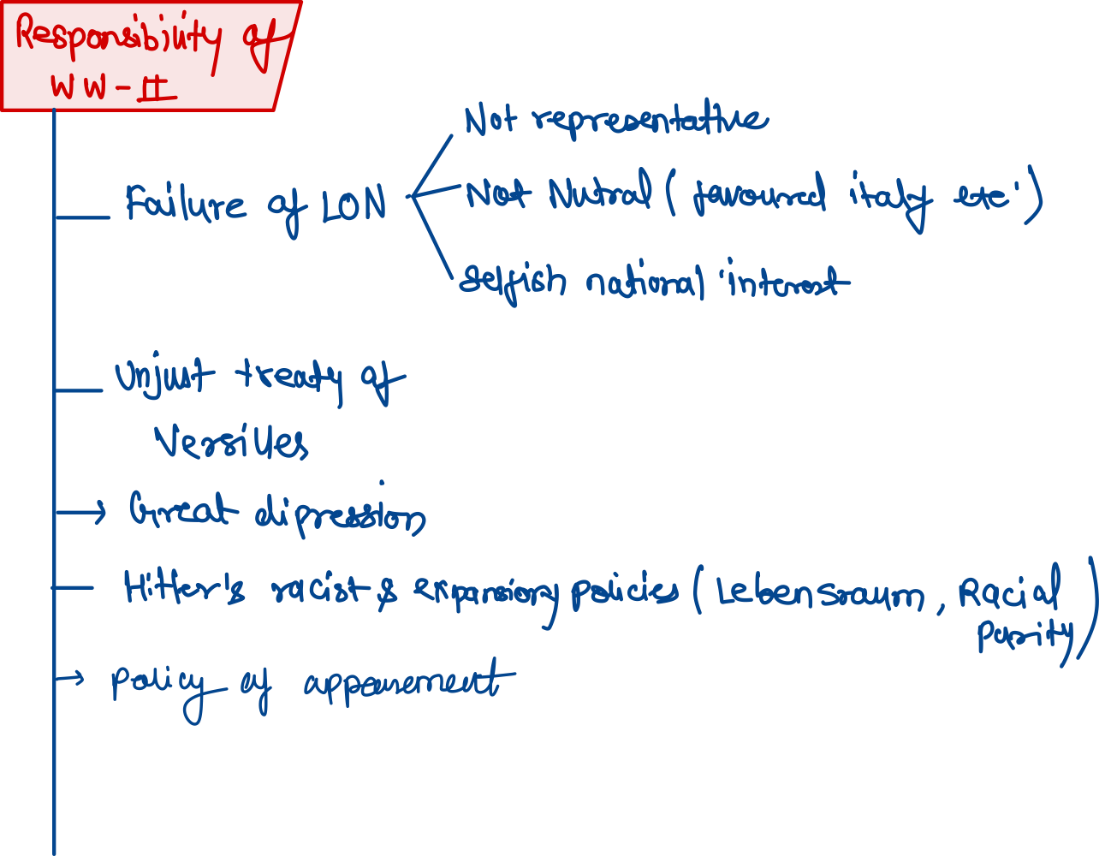
- Fascist Aggression & Response of Western Democracies
- Outbreak of the War
- Theatres of the War
- US Entry into the War
- Global Nature of the War
- The Holocaust
- Resistance Movements
- After-effects of the War
Decolonialisation & Redrawal of National Boundaries
-
Europe after World War II
-
Cold War
-
Rise of Asia & Africa
-
Developments in West Asia & North Africa
- 1979 Iranian revolution - Iran withdrew from Baghdad Pact(1955) that became CENTO.
-
Spread of Communism
-
Korean War
-
Vietnam War
-
Cuban Crisis
-
Collapse of Soviet Union
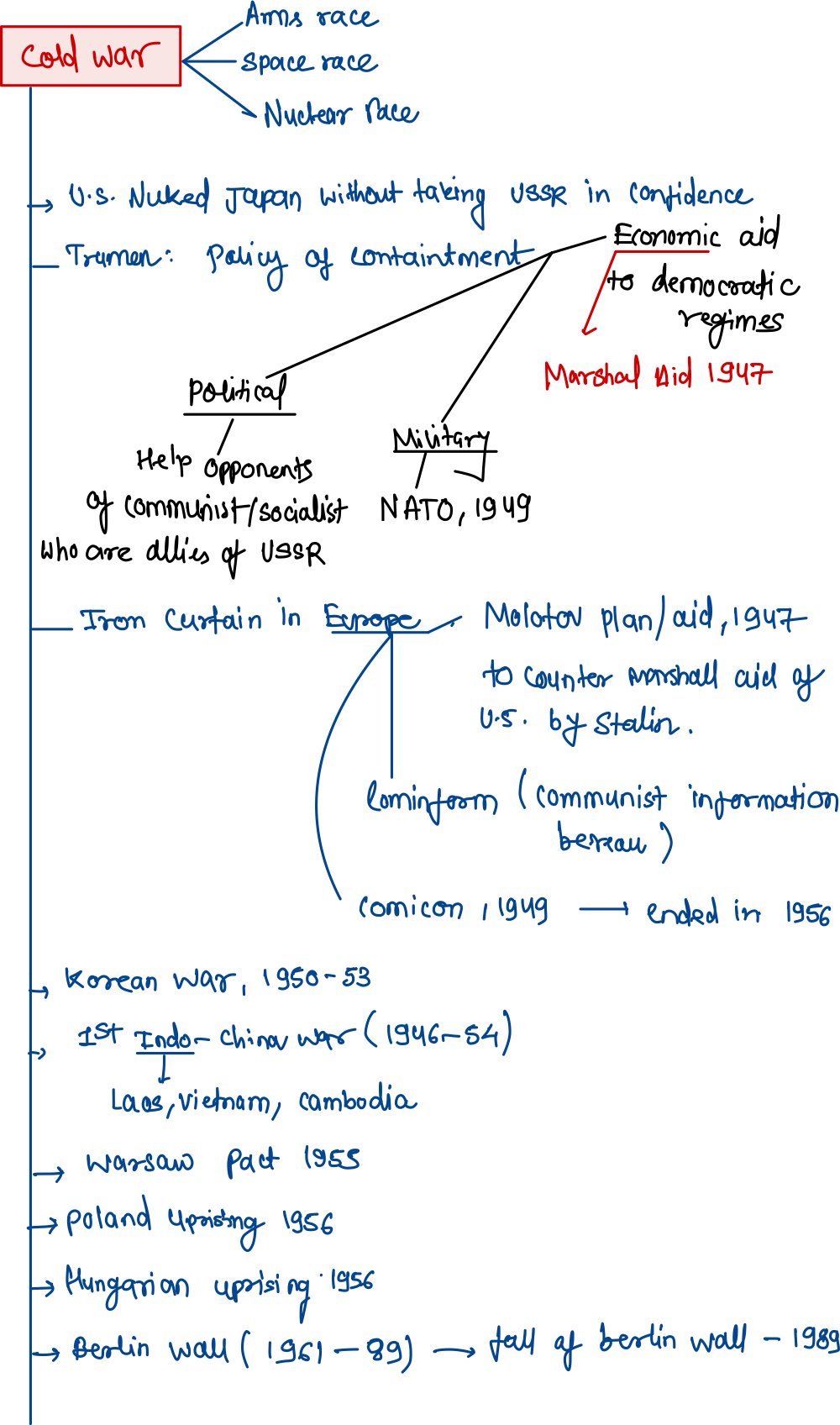
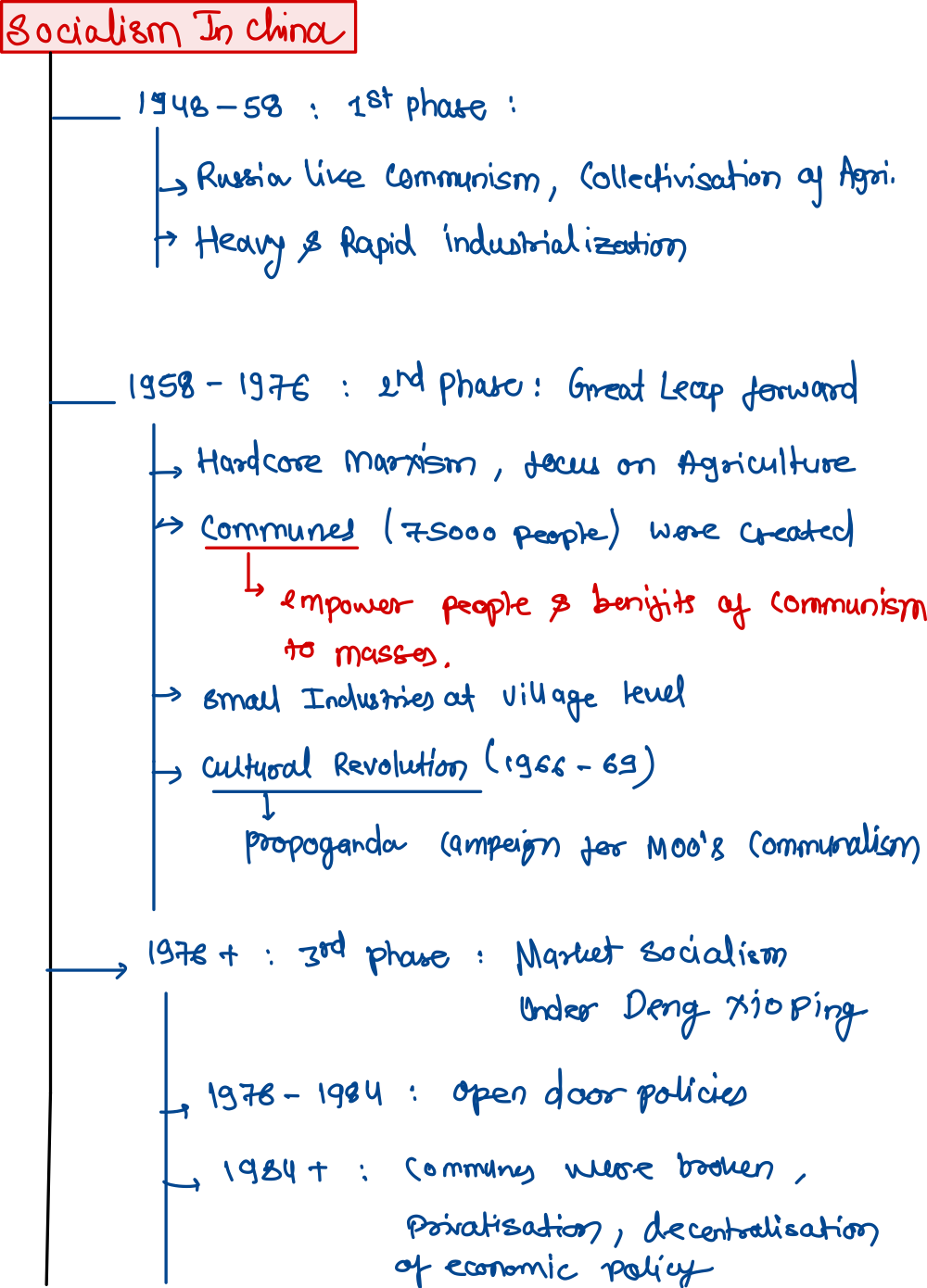
Concept, Types & Social Impact of Political Philosophies
- Communism
- Capitalism
- Socialism