- Plato’s allegory of the cave
- Human perception cannot drive true knowledge
- Real knowledge can only come via philosophical reasoning
- Doctrine of double effects
- If a decision went wrong, but was taken with the right intent and mindfulness, will be moral behaviour. But any decision taken to harm someone under ill intent will not be ethical decision.
- Ethics
- Externally imposed (morals internally)
- Tend to be consistent and objective (moral - subjectivity)
- Teleology
- Ethical doctrine which asserts that every entity have an inherent purpose or end (telos) towards which they strive
- “The good of an individual is contained in the good of all”
- The statement suggests that individual wellbeing is deeply connected with wellbeing of society as a whole.
- Interconnectedness : decision of individual have ripple effect on society.
- E.g. GANDHI’s promotion of Khadi
- Mutual dependence : we rely on other for resources, support and sense of belonging
- Human beings should always be treated as ‘ends’ in themselves and never as merely “means”
- The statement is rooted in deontological ethics of IMMANUEL KANT.
- End in themselves : Humans possess inherent worth and dignity based on their own existence, not on their utility.
- Intrinsic Worth
- Ensuring fair wages and humane working conditions for all
- Respect for Autonomy
- Informed consent in data sharing
- Human Dignity
- Abolition of untouchability
- Ethical Relationship : based on mutual respect, not selfish gain
- Against Utilitarianism
- Business should focus on ESG rather solely on profit
- Intrinsic Worth
- Means to an end : reduced human value as a tool to achieve goal - disregarding their value.
- E.g. slavery
- Significance
- Safeguarding life and personal liberty
- Social justice
- The crisis of ethical values in modern times is traced to a narrow perception of the good life.
- The crisis of ethical values in modern times means erosion of values due to impact of urbanization, globalization, economic development and technology.
- Arguments
- Individualism : “every man for himself” mentality : overshadowing ethics and compassion
- E.g. breaking up of JF
- Materialism and Consumerism
- E.g. McDonalisation of food habits
- Instant Gratification and Hedonism
- Binge watching of web series
- Narrow markers of success : wealth, fame, beauty
- Fast fashion, social media envy
- Competition
- Reduce trust in interpersonal relations
- Technology : reduced us to narrow virtual existence detached from real world experiences.
- 1000 friends on Facebook, none in real life
- God is dead
- Individualism : “every man for himself” mentality : overshadowing ethics and compassion
- Counter arguments
- Depends on individual
- WARREN BUFFET - 99% wealth to philanthropy
- Tribals worship nature - sacred grooves
- Positives of modernity : liberty, innovation, creativity, independent decision-making
- Depends on individual
- Moving beyond narrow perception
- Value education
- Broadening conception of good life
Significance
- Individual
- Integrity : to resolve ethical dilemmas, resist temptations of wrongdoing
- Compassion towards weaker sections
- Society
- Promotes Justice and Equality
- Organizations
- Builds Trust and Cooperation
- Environment
- Ensures Sustainability : by non-exploitative use of natural resources

Challenges | Consequences of Unethical Behaviour
- Individual
- Loss of self-respect : can lead to guilt, shame, and a diminished sense of self-worth.
- Mental and emotional harm : can cause stress, anxiety, and even depression.
- Limited personal growth : reduce opportunities for learning, moral development and forming genuine connections.
- Social
- Increased conflict and distrust : hate speech, communalism, racism, intolerance
- Social and economic problems : poverty, discrimination, inequality, exploitation
- Governance
- Weakened governance : leads to corruption, misuse of power.
- Environmental
- Overexploitation of resources, pollution, and ecological degradation
- Unethical use of technology : purposes such as mass surveillance, privacy violations threatening democracy
How Ethics Can Be Developed?
- Internal development
- Critical thinking : analyze situations objectively, identify potential biases, and consider various perspectives.
- Defining core values and principles : What matters most to you? What do you believe in? What is your philosophy of life?
- Moral reasoning : Learn about different ethical frameworks and theories, such as utilitarianism, deontology, and virtue ethics.
- Develop self-awareness : being honest, recognizing personal bias, and acting with integrity
- External Engagement
- Education : Read books on ethics, philosophy, and social justice.
- Role models : learning from individuals who embody the ethical values you aspire to.
- Social accountability : speaking up against injustice, wrongdoing, challenging status quo and advocating reforms.
What Are Different Theories of Ethics?
- Consequentialist approach - morality of action is judged solely by it’s consequences.
- State consequentialism : raison d’état [MACHIAVELLI]
- HANS MORGENTHAU - ethics apply to individuals not states
- Society consequentialism : Socialism [KARL MARX]
- “Falsehood takes the place of truth when it results in unblemished common good.”- TIRUKKURAL
- Lies for Social Harmony
- E.g. withholding information to prevent chaos
- Emergency Situations:
- E.g. espionage involve deception to protect national interest
- Avoiding Harm:
- E.g. Doctor lying about terminally ill patient for hope and improvement
- Conflict Resolution:
- Concealing truth to reach peace
- Protection of Vulnerable Groups
- Utilitarian
- Quantitative
- Believes that all pleasures are alike
- The greatest happiness of the greatest number is the foundation of morals and legislation. - JEREMY BENTHAM
- CARVAKA (चार्वाक)
- Qualitative
- All pleasures are not equal.
- Intellectual pleasures better then sensory pleasures
- It is better to be a man dissatisfied than a pig satisfied; better to be SOCRATES dissatisfied than a fool satisfied” -MILL
- Advantages
- Pragmatic solutions
- Progressive taxation for social welfare program
- Whistleblowing to protect public interest - EDWARD SNOWDEN
- Greater good
- Torturing terrorist to know the location of planted bombs
- Utilitarian approach
- Covid 19 Lockdown : restricting freedom to protect public health
- Emergency Situation : life/death - strict adherence to ethics not possible
- E.g. war or national security
- E.g. Bangladesh Liberation War for protecting human rights
- Violent Revolution against oppressive regime
- E.g. Student Protest - Bangladesh
- ‘do or die’ [GANDHI] during QIM 1942
- “Falsehood takes the place of truth when it results in
- Pragmatic solutions
- Quantitative
- State consequentialism : raison d’état [MACHIAVELLI]
- Deontological approach - morality is judged by duty or action and not the consequences.
- Some actions are right and wrong in themselves, irrespective of consequences
- IMMANUEL KANT - Categorical moral reasoning
- Asserts that there are certain inviolable moral laws.
- An action, to have moral worth, must be done from duty.
- Categorical imperative - Act according to that maxim whereby it should become a universal moral law.
- It means ask yourself if you would be comfortable if everyone acted in the way you are considering
- GANDHI
- Truth and non-violence
- Emphasis on practical idealism
- Action is moral if its intentional, universal, practical, selfless, free from fear
- Gandhi’s Talisman
- 7 deadly sins
- Nai Talim
- BUDDHA
- CONFUCIUS
- Golden rule - we shall do to others what we want others to do to us.
- निष्काम कर्म - Devotion to duty is the highest form of worship
- Why to prefer this over consequentialism?
- Violation of ethical integrity
- Erosion of trust
- Ends can’t be known - potential for harm
- E.g. Russia’s invasion of Ukraine for quick victory
- Slippery slope - erosion of ethical standards
- E.g. Bulldozer justice erodes rule of law
- Long term harm - what you sow is what you reap
- E.g. clearing rainforest for palm cultivation - climate change
- Harbouring anti-India terrorism in Pakistan
- Wrong precedence
- Surveillance for safety raise concern about privacy and abuse of power
- Protecting universal moral principles
- E.g. manual scavenging is wrong
- Advantages of deontology?
- Long term good
- E.g. independence by non violent means
- Long term good
- Disadvantages of deontology
- Against contextual ethics : suboptimal outcome
- Ethical to harm someone in self protection
- Larger social good compromised
- E.g. IPR protection for vaccine - limits benefits to poor
- Land reforms
- Rigidity - difficulty in adapting to change
- E.g. total regulation of AI may prevent it’s development
- Universalist and determinist : against moral relativism
- Against contextual ethics : suboptimal outcome
- Virtue Ethics - behavior showing high moral standards
- Emphasizes the role of individual character in moral decision-making
- Virtues are golden mean between two extreme vices
- Courage between rashness and cowardice
- Self control between indulgence and excessive repression
- Good life - right combination of hedonism and eudemonism
- Hedonism - pursuit of pleasure
- Eudemonism - pursuit of happiness
- Virtues as per PLATO - wisdom, courage, temperance, justice.
- A virtuous person always does the right thing - PLATO
- A good life is life of virtues - PLATO
- ARISTOTLE
- Genius can take you to heights, but character will decide whether you stays there. - ALBERT EINSTEIN
- Contextual ethics
- Right and wrong depend upon the situation. There are no universal moral rules or rights.
- E.g. Article 358 suspends freedom of speech during national emergency
- Concerns
- Slippery slope
- Harmless decision now may lead to much worse outcome in long term
- E.g. appeasement of HITLER became cause for World War 2
- Slippery slope
- Right and wrong depend upon the situation. There are no universal moral rules or rights.
- Ethics of merit- Treating persons based on merit as a exercise of justice
- Rewards based on merit
- Supporters - ROBERT NOZICK
- Entitlement theory
- Ex. Rewarding hard work and excellence
- Ethical voluntarism - fair due to consent of the individual.
- Moral obligations arise from voluntary acts of the will.
- E.g. plea bargain for lenient sentence
- Moral obligations arise from voluntary acts of the will.
- The Ethics of ‘Growing the Pie’ - focus on expanding total resource instead of redistribution
- E.g. Green Revolution over poor land reforms
- Ethical egoism - according to this theory, moral decision should be guided entirely by self interest.
- E.g. lying to win in election
- Conclusion
- Adherence to ethics is the cornerstone for more compassionate, just and sustainable world.
- Treating humans as end in themselves is foundation of just society.
- As PLATO said, ‘Ethics is nothing else than reverence for good life.’
- In conclusion, we can heed to words of ARISTOTLE, he said that neither the principles nor the consequence but a reasoned combination of both makes a good moral judgement.
Doctrine of Double Effect
- If doing something morally good has morally bad side-effects, its okay to do, provided that bad side effect wasn’t intended.
- E.g. breaking of ribs during CPR
Consequentialism - Negative Examples
- Police carrying out fake encounters of criminals - wrong
- Bulldozer justice (Damoh) - wrong
- Terrorism (suicide bombing)
- Exploitation - bonded labour, slavery, manual scavenging
- Using Artificial Intelligence to threaten human freedom - wrong
- War crimes
Consequentialism - Positive Example
Features of Indian Ethics
- Strong metaphysical foundation
- Humanistic and spiritualistic
- Preaches non violence, compassion and good will for all living being
- 4 supreme ends
- Dharma
- Artha
- Kama
- Moksha
Teachings of Buddha
- 8 fold path, four noble truths, middle path, tolerance, calmness and composure, helping others (e.g. Bodhisattvas) moderation, emotional regulation, compassion
Essence
- The essence of ethics is about understanding the core principles and qualities that underpins ethical behaviour and decision-making.
- It goes beyond simple set of rules or commands and answers fundamental questions like why and how of living a good and meaningful life.
- Key aspects of the essence of ethics
- Universal values : At its core, ethics revolves around universal values like justice, fairness, honesty, respect, compassion, and responsibility.
- Internal reflection : accessing our core values, learning from mistakes and adopting to broader social changes.
- Intention : having right intentions that aligns ones action and values.
- Critical thinking : questioning dogma and social norms. Challenging status quo and unjust practices.
- Social impact : ethical decisions have ripple effects on individuals, communities and society at large.
Determinants of Ethics Human Action
- Internal determinants.
- Conscience - inner voice that tells of moral correctness of specific conduct.
- Intuition - the ability to understand something immediately, without the need for conscious reasoning.
- Values: represent what we consider important and worth striving for in life.
- Personal Values
- Honesty, compassion, perseverance, empathy, tolerance
- Cultural Values
- Social norms, religious customs
- Socialism, secularism, democracy, republicanism
- Historical values
- Caste system not valid today
- Change due to socio-economic and technological progress
- Universal Values
- Human Rights, freedom, equality, peace, justice
- Personal Values
- Beliefs : are our conviction of something which we consider to be true
- They are our understanding of truth, scientific theories, religious doctrines.
- They can be clouded by
- Personal bias
- Social and religious norms and dogmas
- Ethnic or national interest
- Correcting wrong beliefs?
- Self reflection : staying open to the possibility of being wrong
- Critical thinking: objective analysis, reasoned arguments and considering alternate perspective
- Openness to learning : exploring diverse viewpoints
- Humility : staying humble and being willing to change ones mind.
- Moral compass:
- Morals are beliefs of individual or group about right and wrong behaviour
- E.g. respect for elderlies
- Amoral - indifferent about morality
- Immoral - doing evil acts
- Morality refers to set of principles that guide individual decisions about right and wrong.
- Ethics are collective proposition of society. Moral are individual propositions.
- Moral Subjectivity : moral judgments and values are based on individual perspectives, feelings, or opinions.
- Just because majority believes in something does not makes it moral. Ex. Dowry, Sati
- Moral Relativism - no single set of moral principles can account for all the situations.
- Context and circumstances matters : morals may change due to societal evolution and technological development
- E.g. homosexuality earlier considered immoral, now changing perception
- E.g. slavery not immoral in America before Civil war.
- One can be good without conformity to rules of society. Ex. RAJA RAM MOHAN ROY
- What is right?
- Right refers to things that a particular group approves of.
- Moral absolutism - belief that there are such moral rules that apply to everyone. Takes universal view of humanity
- E.g. Deontological ethics of KANT
- E.g. Universal Declaration of Human Rights
- E.g. Natural Rights Theory of LOCKE
- Satyawaad
- Morals are beliefs of individual or group about right and wrong behaviour
| Ethics | Morality | |
|---|---|---|
| Definition | Set of objective principles | Personal beliefs about what is right or wrong |
| Origin | External sources like laws, professional code | Originate from internal personal, religious, or cultural values. |
| Scope | Apply to collective settings or institution | Vary from person to person |
| Application | professional settings, public services | personal life choices and daily behavior |
| Flexibility | Objective | Subjective |
| Enforcement | External enforcement | |
| Philosophical Basis | reasoning and debate Deontological ethics of KANT | tradition, religion, and emotional factors E.g. Dharmashastra |
| Focus on consequences of action and its impact | Focus on intentions and motivation behind the action |
| Moral intuition | Moral reasoning | |
|---|---|---|
| Nature | Automatic instinctive response Immediate disguise about idea of stealing | Deliberate cognitive process Whether to report colleagues unethical behaviour or not |
| Scope | Well suited for straight forward situations - Quickly apologizing for a minor mistake | Better for complex, multifaceted dilemmas - Conflict of interest |
| Source | Relies on personal values and attitude - Leaving one’s seat for elderlies in public transport | Relies on ethical principles - Duty to include poor to social welfare scheme without documents |
| Speed | Swift and quick response Taking victim of accident to hospital | Operate slowly and involves introspection Whether to evict poor people for public project or not? |
| Flexibility | Less flexible as more deeply engrained Patriarchal norms | Flexible and open to revision |
| Prone to bias and cultural influence | Less prone to bias as it involves cognitive effort | |
| Philosophical Basis | Intuitionist ethical theories like DAVID HUME | Rationalist theorist such as IMMANUEL KANT |
-
Personal traits :
- empathy, compassion, and fairness
-
Cognitive abilities :
- Critical thinking skills, analytical capacity to reason during ethical dilemmas
-
Life experiences
-
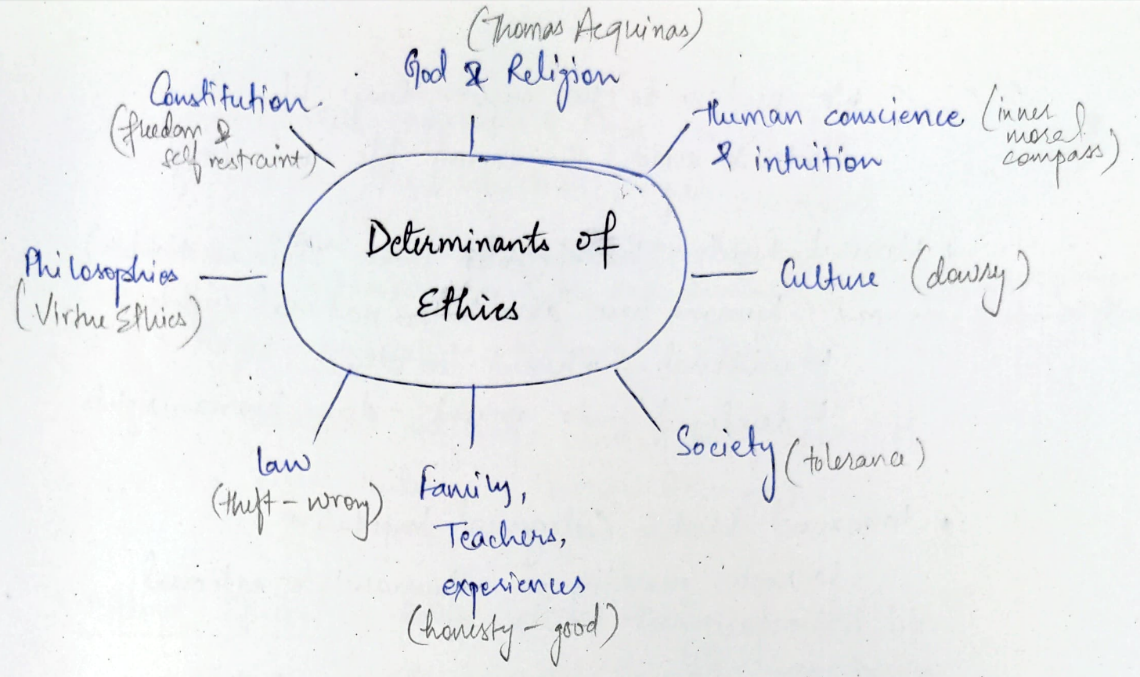
External determinants
- Family and peer groups
- Culture and religion
- Norms - Collective expectations of socially accepted practice.
- Define right or wrong behaviour
- Non-conformity to can attract sanctions
- Issues
- can deviate from what is ethical
- E.g. caste system in India
- Norms - Collective expectations of socially accepted practice.
- Principles - self evident universal truths
- E.g. fairness, truthfulness, equality, justice etc.
- E.g. GANDHI’s principles of truth and non-violence
- Ethical theories
- Education and media
- Constitution
- Professional codes
- Laws and regulations
- Law is structured system of rules and regulations enforced by an authority e.g. govt.
- Minimum expected ethical principles
- E.g. altruistic surrogacy
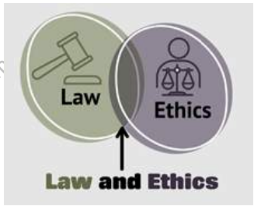
- Minimum expected ethical principles
- Law can deviate from what is ethical
- E.g. marital rape is not illegal but unethical
- Law is structured system of rules and regulations enforced by an authority e.g. govt.
-
Factors to determine ethical behaviour?
- Context matters : ethics depends on specific context and circumstances.
-
-
Values change
- Cultural difference
- E.g.
- Temporal change
- E.g. decriminalization of homosexuality
- E.g. abolition of slavery
- Individual preferences
- E.g. objectivity or empathy?
- Cultural difference
-
Values remains same
- Human dignity :
- Core ethical principles - honesty, justice, fairness, empathy
- Moral intuition :
- E.g.
-
Both perspectives are correct but the truth lies somewhere in between.
| Values | Ethics | |
|---|---|---|
| Internal guiding principles | External framework : guide behaviour in relation to environment | |
| Due to personal beliefs | Social in nature |
Consequences of Ethics in Human Action
- Consequences of ethics mean the outcome of human actions which are guided by ethical thinking. This means consequences also determine how good or bad an act is.
- For Individual
- Self respect
- Good health Well-Being
- Stronger relationships
- Access to opportunities
- Moral Guidance : to choose the right course of action
- E.g. Don’t cheat in exam instead pursue academic success by working hard
- Objective decision making
- E.g. report a colleague’s unethical behavior
- Peaceful Conflict resolution : prioritizing dialogue
- E.g. On disagreement with my brother
- For Society
- Ripple effect : creates a more just and equitable society
- Social cohesion : sense of unity and belonging
- For environment
- For governance
- Global impact
- Interconnected world : ethics transcending borders
- For Organization
- Sustainability
- E.g. Railways aim to become carbon neutral by 2030
- Conducive Work culture
- E.g. employee will honestly point out the lapses -> continuous improvement
- Retain and attract talent
- Develop leaders
- E.g. RATAN TATA
- Managing conflict of interest
- Sustainability
- E.g. justice U.U. LALIT recused himself
- E.g. RAKESH MARIA’s efforts for police reforms in Mumbai
- In resolving conflict
- Provide guiding principles for decision making
- Effective communication - open and honest dialogue
- E.g. Quarrel in marriage
- Maintain respect and courtesy
- E.g. disagreement on social media
- Mediation and negotiation
- E.g. disagreement at work
- Advocating fair outcome
- Parents on disagreement between children
- Prevent escalation
Dimensions of Ethics
- Dimensions of ethics refers to different frameworks to categorize ethics.
- Meta-Ethics : is concerned with the philosophical foundations of ethics.
- “What is the nature of moral truth?
- “How do we know what is morally right or wrong?
- Normative Ethics: focuses on prescribing what we ought to do and what is good, right, or ethical.
- What actions are morally right or wrong? What principles should guide ethical decision-making?
- Descriptive Ethics: investigates what ethical beliefs are held by different individuals and groups, and how they act ethically.
- Applied Ethics : explores how ethical principles can be applied to specific real-world problems and situations in different fields
- Business Ethics - set of ethical principles applied in business environment
- E.g. code of conduct
- Following rules and regulations
- Responsibility to consumers and employees
- Environmental Ethics
- Studies relation of human action and environment
- Highlighting ethical obligation to protect environment and sustain biodiversity
- Importance
- Emphasize moral responsibility to protect environment
- E.g. Sacred groves
- Informed decision-making on environment issues
- E.g. not using plastic bags
- Environment justice
- E.g. just climate action
- Sustainable development
- E.g. renewable energy transition
- Climate change from ethical dimension
- Climate justice :
- Common But Differentiated Responsibilities (CBDR)
- Intergenerational justice : present generation is responsible for emission but the cost will be born by future generation
- E.g. GRETA THUNBERG
- Ethics of Mitigation and Adaptation: supporting developing countries
- E.g. loss and damage fund
- Human Rights:
- Moral Responsibility of Corporations:
- Negative example
- Malaysia clearing tropical rainforest for palm oil cultivation
- Congo auctioning rainforest and peatlands to oil firms.
- Medical ethics
- 4 principles - jab-m
- Justice : distribution of healthcare in fair and equitable manner.
- Autonomy : respect for person
- Beneficence : obligation to contribute to person’s welfare
- Non-maleficence : obligation to not inflict harm on other persons.
- 4 principles - jab-m
- Political ethics
- Similar
- A political society exists for the sake of noble actions. - ARISTOTLE
- Politics without principles is a sin - GANDHI
- Different
- MACHIAVELLI - no room for ethics in politics
- HANS MORGENTHAU
- KARL MARX - politics false consciousness
- Politics without ethics
- Communalism, regionalism
- demagoguery and falsehood during elections
- Vote bank politics
- Criminalization of politics
- Russia-Ukraine
- Hate speech
- Misuse of power
- Corruption
- Politics with ethics
- Ethical leadership
- E.g. GANDHI
- Ethical governance
- Welfarism - NFSA, 2013
- Public accountability
- Internal democracy in political parties
- Democratic principles
- Free and fair elections
- Young people not joining politics
- Negative perception of politics : crime, corruption, scandals
- High entry barrier -
- lack of internal democracy in political parties
- Lack transparency in functioning of political parties
- Personal Risks and Sacrifices: time, career paths, and even personal safety.
- Lack of confidence : public speaking, lacking interpersonal skills
- Competing aspirations : political career can be long term commitment and require patience
- How to motivate them
- Address negative perception about crime and corruption
- Electoral funding reforms to reduce reliance on private doners ensuring level playing field
- Encourage constructive political debate and civil conduct
- Connect young people with old ethical politicians for mentorship and support
- Create youth forum for leadership development
- Increase transparency and accountability in functioning of political parties.
- Underline the opportunities in politics to create meaningful change.
- Similar
- Ethical implications of a new technology
- Privacy : concern regarding misuse of personal information
- Artificial intelligence, facial recognition, social media tracking, and data-driven algorithm
- Cybersecurity threats : exposing sensitive data and critical infrastructure vulnerability to cyberattacks
- Equality : Unequal access can exacerbate existing socioeconomic inequalities and limit opportunities for disadvantaged individuals.
- Discrimination : algorithms can perpetuate existing biases in society
- Job Displacement : Increased reliance on automation raises concerns about unemployment and social security of displaced workers
- Environmental Impact : e-waste raises concern regarding responsible recycling and disposal practices
- Weaponization : development of automated weapons using AI and robotics can increase potential for automated warfare
- Democratic backsliding : technologies for tracking can be used for mass surveillance raising concerns about government overreach
- Lack of regulations raises concerns about accountability and responsibility of consequences.
- Privacy : concern regarding misuse of personal information
- Bioethics - the ethics of medical and biological research.
- Business Ethics - set of ethical principles applied in business environment
- Ethical conflicts in urbanization
- Environment sustainability V/s use of resources for development
- Inequality
- Conflict of resources
- Salad bowl V/s melting pot model of society
- Individualism V/s collectivism
Ethics in Private Relationships
- Involves relationships with family and friends.
- STRETCH
- Trust
- Honesty
- Respect and consideration
- For boundaries, values, needs, self determination
- Communication and conflict resolution
- active listening, expressing thoughts and feelings honestly, and addressing conflicts constructively
- Fidelity and commitment
- Empathy and Compassion
- Responding to emotional needs
- Support and Care
- regardless of age or differences, strengthens bonds
Ethics in Public Relationships
- NOLAN COMMITTEE on standards of public life -
- I-O-SHOLA (Input-output Shola)

- Examples
- ABDUL KHAN (Pakistani nuclear scientist) - Professionally competent but unethical
- A.P.J. ABDUL KALAM - professionally competent and ethical
Human Values
-
- Honesty : holding unto facts as they are; being truthful
- E.g. Providing accurate and truthful information for RTI
- E.g. LAL BAHADUR SHASTRI resigned taken moral responsibility for a railway accident.
- E.g. Returning a mobile phone I found on road.
-
- Integrity : doing what is right all the time even if nobody is watching
- E.g. SATYENDRA DUBEY - IES officer sacrificed his life fighting against corruption.
- E.g. I acknowledge my mistakes and rectified it promptly instead of covering up.
-
- Respect : Treating others with humility and acknowledging their worth.
- DR. B.R. AMBEDKAR : respect and dignity of Dalits.
- E.g. Expansion of BRICS including 5 others members
-
- Responsibility : being accountable for one’s actions.
- E.g. SARDAR PATEL : Responsibility of integrating over 500 princely states.
- E.g. segregating waste at home according to solid waste management rules
- E.g. ISRO’s efforts in Chandrayaan-3 despite setback in Chandrayaan-2
-
- Compassion is the motivation to feel and act towards reliving the suffering of others.
- E.g. S.R. SANKARAN - Fight against bonded labour
- E.g. PARAMESWARAN IYER - destigmatizing manual scavenging
- E.g. KIRAN BEDI’s work to reform administration of Tihar Jail
-
- Empathy : Putting oneself in someone else’s shoes and understanding their feelings and experiences.
- Listening attentively to the concerns
- E.g. JACINDA ARDERN (PM of New Zealand) - Empathetic leadership
- E.g. Comforting a friend who lost his job
- Leaving a seat for elderlies in metro
-
- Fairness : impartial and just treatment, without favouritism or bias.
- E.g. 1st amendment providing reservations to SC & ST, land reform for peasants.
-
- Justice : quality of being fair, reasonable.
- E.g. P. NARAHARI - efforts in making Gwalior disabled friendly
- E.g. VAIBHAV SINGH (IFoS) efforts in restoring Himalayan forests and harvesting over 10 million litres of rainwater.
- E.g. Advocating for equal treatment between me and my sister
-
- Trustworthiness : Being honest by keeping one’s promises
- E.g. DR. A.P.J. ABDUL KALAM - Safeguarding confidential information of Nuclear program
- E.g. keeping my promise for teaching in nearby village.
-
- Trust : firm belief in the reliability of someone or something.
- How to increase trustworthiness
- Integrity and honesty
- Being truthful about my mistakes
- Keeping promises
- Adhering to deadlines and personal commitments
- Practicing empathy
- Supporting friends and colleagues in distress
- Open communication
- Respectfully resolving disagreements
- Community participation
- Volunteering for CSR activities
- Integrity and honesty
-
- Kindness : Performing acts of goodwill and care for others.
- E.g. MOTHER TERESA - dedicated her life to serving the poor and destitute.
-
- Generosity : Sharing time and resources to benefit others without expecting anything in return.
- E.g. IPS ARIF SHEIKH started Chuppi Tod Campaign for dealing with domestic violence
- E.g. India’s Vaccine Maitri Initiative delivered 100 million vaccines to over 100 countries.
- E.g. Operation Dost for earthquake relief in Turkey
- E.g. Volunteering for CSR activities.
- Indian Navy protecting Ships @Gulf of Aden
-
- Gratitude : being thankful and show appreciation foe kindness and help received.
- Expressing appreciation to colleagues
-
- Fortitude : ability to endure adversity with strong will
- E.g. NELSON MANDELA spent 27 years in prison
-
- Perseverance and Tenacity
- Consistency in doing something despite difficulty or delay in achieving success
- E.g. THOMAS EDISON
- E.g. ABRAHAM LINCOLN
- SANJUKTA PARASHAR (IPS) - dealing with Bodo militancy
-
- Commitment
- Quality of being dedicated to a cause
- PRAKASH SINGH - police reforms
- GANDHI - truth and non-violence
-
- Resilience
- the capacity to withstand or to recover quickly from difficulties; toughness
- Ability to adapt in face of crisis
- E.g. VIGNESH PHOGAT
-
- Tolerance : ability to accept diversity in beliefs without prejudice.
- E.g. Ganga-Jamuna Tehzeeb
- E.g. Sarv Dharma Sambhav (GANDHI)
- E.g. In Jainism - Anekāntavāda
-
- Objectivity : is rational way of dealing with situation in a fair manner based on facts and evidence.
- E.g. SAM MANIKSHAW - led Indo-Pak war of 1971 to decisive victory.
-
- Humility : quality of being modest, and not seeking excessive praise.
- Receptive to feedback
- E.g. VINOD RAI - Excellence in finance
-
- Patience : capacity to tolerate delay or suffering without getting angry
- E.g. THOMAS EDISON failed innumerable time before inventing light bulb.
-
- Forgiveness : is to stop feeling angry and resentful towards someone or something.
- ‘to err is man, to forgive is mankind’
-
- Courage : quality to show strength in the face of pain, danger or grief
- We become brave by doing brave acts - ARISTOTLE
- E.g. RANI GAIDINLIU at the age of 17 led CDM against British
- E.g. RANI LAXMI BAI is known for her valour
- E.g. SUBHASH CHANDRA BOSE fighting for Indian independence and leading INA.
- E.g. DURGA SHAKTI NAGPAL curbing illegal sand mining in UP
- E.g. standing up against bullying with my friend.
-
- Diligence : Working carefully and persistently to the best of one’s abilities.
- E.g. SYED AHMED KHAN though his Aligarh Movement brought religious reform
-
- Discipline - quality to behave in a controlled way involving obeying rules and standards.
-
- Loyalty : Remaining true, faithful and committed.
- E.g. EKLAVYA - cut off his thumb as guru dakshina.
- E.g. loyalty to mission of public service in face of external pressure or conflict of interest.
-
- Selflessness : give more concern to the needs and wishes of other before one’s own
- E.g. Doctors for you - working overtime during covid-19
- E.g. Red cross work in disaster relief
-
- Dedication to public service
- E.g. ARMSTRONG PAME - constructing 100 KM road in Manipur with public contribution
- E.g. E. SHREEDHARAN in construction of Delhi Metro (high standards of public service)
-
- Tech savvy
- E.g. ASHISH SINGH, DM of Indore cleared 100 acres of garbage using bio-mining.
- E.g. Using ChatGPT for creating digital library content in vernacular language.
-
- Impartiality
- E.g. T.N. SHESHAN
-
- Non partisanship
-
- Open-mindedness : Being receptive to different perspectives, ideas, and experiences without prejudice or bias.
- E.g. ATAL BIHARI VAJPAYEE - Took bus ride to Lahore for Indo-Pak peace
Role of Family | Society | Educational Institutions
In Inculcating Human Values
- Introduction
- The foundation of human values depends on role of family, society and education institutes. They shape one’s ethical understanding and moral compass.
- “The strength of a nation derives from the integrity of the home.” - CONFUCIUS
- Agents of socialization
- Family, media, school, peers
- They represent society and acts on its behalf
- Family
- Primary Socialization
- initial stages of development of fundamental values, norms and behaviors
- Role Modelling
- Children observe and emulate behaviour and action of parents
- Moral Guidance through stories, conversations
- E.g. grandmother’s mythological stories
- Transmission of Cultural and Religious Values
- E.g., touching feats of elders
- E.g., Raksha bandhan (loyalty), Tilak (courage) etc.
- Teaching Empathy and Compassion
- Mother with her selfless love
- Instill discipline and a sense of responsibility
- Emotional Support and Stability - E.g. spending quality time, sharing life stories.
- Inculcate values like kindness, patience, and forgiveness.
- Conflict Resolution Skills
- Primary Socialization
- Society
- Educational Institutions:
- discipline, respect, and fairness
- Cultural and Religious Practices
- E.g. respecting elders
- Peer influence
- E.g. friends and colleagues
- Solidarity and cooperation
- Media and social networking
- Social Institutions
- Religious organizations teaching compassion
- Legal and political systems
- Public Figures and Leader
- LiFE - PM MODI
- Educational Institutions:
- Teachers
- Role
- Value-Based Education:- teaching complex concepts in a simple way
- Role modelling
- E.g. demonstrating desirable behaviours, such as respect, kindness, and humility.
- Facilitator of critical thinking and problem-solving skills
- Developing intellectual curiosity
- Mediating Conflict and Teaching Resolution
- Positive reinforcement
- E.g. rewarding and punishment
- Mentor - provide support, advice, guidance
- Challenges
- Consider their role limited to imparting education
- E.g. lack of value education
- Temptation to have a transactional relationship
- E.g. tuitions, coaching etc.
- Discrimination based on caste, gender etc.
- Consider their role limited to imparting education
- Role
- Schools
- Structured Curriculum: Incorporates moral and ethical education.
- E.g. Jatak Kathas, Panchatantra, Ramayana
- Role Modeling : teachers must demonstrate ethical values to instill in student. Respect, honesty, fairness
- Peer Interaction : foster teamwork and empathy
- Group projects
- Extracurricular activities : promote discipline and sportsmanship
- Sports clubs
- Critical Thinking: Class room discussions, debates
- Examination - Academic values, Scientific temper, Hard work
- Develop Civic values
- engage in community service
- like teamwork, leadership, communication, cooperation
- Professionalism -
- School environment
- Imbibing constitutional morality
- E.g. NCERT - fundamental duty
- Structured Curriculum: Incorporates moral and ethical education.
- Beyond the three
- Community elders
- Leaders
- Responsible citizens
- Challenge
- Family
- Learning from Negative Family Behavior:
- Overly strict or controlling parenting styles
- Can prevent development of critical thinking
- Disregard for others : when children face neglect or abuse at home
- May lead to aggression, lack of empathy.
- Lack of Communication and Guidance:
- Society
- Prejudice : can lead to intolerance, bias, and a lack of respect for human rights.
- E.g. racial prejudice (white man’s burden theory)
- 1/4 Indian practice untouchability
- Stereotypes : preconceived notions about others
- About different religious groups
- Patriarchy
- E.g. women are weak, passive, emotional
- Unethical social structures : systems built on exploitation may remain unchallenged
- Apartheid, caste-system
- Intolerance
- E.g. rioting in Paris
- Materialism : greed and overemphasis on wealth accumulation
- CHANDA KOCHHAR and NIRAV MODI cases
- Peer Pressure and Negative Role Models:
- Media Sensationalism
- E.g., Reality shows and violent video games
- Overemphasis on Competition:
- E.g., The relentless focus on academic grades
- Cultural erosion
- Globalization and urbanization
- Prejudice : can lead to intolerance, bias, and a lack of respect for human rights.
- Educational institutions
- Competition : can promote individualism, cheating and disregard for fairness
- Indoctrination : can impose specific ideologies inhibiting full development and diverse perspective
- Harmful behaviour : due to presence of bullying, harassment.
- Family
- Conclusion
- There is no keener revelation of soul of society then the treatment given to it’s children. -NELSON MANDELA
- It is easy to build strong children than to repair broken man -FREDERICK DOUGLASS
5. Moral Thinkers and Philosophers
Lessons from the life and teaching of
- I count him braver who overcomes his desires than him who overcomes his enemies.—ARISTOTLE
- Two form of courage
- Internal - resisting desires, adhering to ethics
- External - overcoming enemies, strength to fight
- Justification for assertion
- Constant battle : desires are always present. Resisting them requires constant vigilance and self-control
- Desires of wealth, followers on social media
- Requires sacrifice and discipline: delaying gratification
- 30 minutes pizza delivery or free!
- Subjectivity : external enemies are clear, internal desires are subjective
- Knowledge or wealth?
- Moral Integrity and Virtue:
- Inner Conflict is More Personal:
- Constant battle : desires are always present. Resisting them requires constant vigilance and self-control
- Cultivating internal courage
- Self awareness
- Develop strong values : identifying our core values
- Practicing discipline
- Being accountable
- To conclude, we may say that fighting the battles within ourselves gives us more meaningful life.
- Two form of courage
- Nearly all men can withstand adversity, but if you want to test a man’s character, give him power.—ABRAHAM LINCOLN
- Why Power Tests Character:
- Power expose hidden flaws : arrogance, greed, tendency towards corruption in those susceptible to them.
- Temptations : like to bend rules, favor friends, seek personal benefit - resisting them requires strong moral character
- Change in attitude : of others can inflate ego, isolation
- Ethical Dilemmas Increase:
- Adversity Builds Resilience, Power Tests Morality:
- Counter arguments
- Power reveals potential : as a platform for positive change and leadership. It can reveal capacity for responsibility, empathy, and service to others.
- Character can be tested in other situations : such as overcoming adversity, facing loss, making difficult choice in ordinary life.
- Power as a Neutral Tool:
- To prevent
- Why Power Tests Character:
- There is enough on this earth for every one’s need but for no one’s greed. MAHATMA GANDHI.
- Meaning of statement
- Enough for needs : Earth’s resource are sufficient to meet basic needs of every human being - food water, shelter, healthcare, education.
- Not enough for greed : excessive desire for more is leading to inequality, environment degradation, conflicts
- Issues with greed
- Economic inequality
- Oxfam report
- Environmental Degradation
- Living planet report
- Criminalization of politics
- Conflict between states over influence
- USA and China
- Social exploitation
- SC, ST, Women
- Economic inequality
- Way forward
- Meaning of statement
- Which eminent personality has inspired you the most in the context of ethical conduct in life? Give the gist of his/her teachings giving specific examples, describe how you have been able to apply these teachings for your own ethical development.
- Gist of DR. KALAM’s Teachings
- Dream Big and Strive to Achieve
- from humble beginnings to becoming the President of India
- Put Passion before Possession
- finding joy in the pursuit of knowledge and service, not only material possessions.
- Only owned very few possession when he died in 2015.
- Lead with vision
- creating a culture of innovation and collaboration
- Inspired to attempt moon landing before Chandrayaan 1.
- Empathy and Compassion
- Asked DRDO officials to remove broken glasses on the walls, so that birds can perch.
- When his subordinate at DRDO couldn’t take his children to an exhibition due to work, he took them instead.
- Dream Big and Strive to Achieve
- Gist of DR. KALAM’s Teachings
- We can easily forgive a child who is afraid of the dark; the real tragedy of life is when men are afraid of the light.
- The quote highlights the tragedy of life. Children are afraid due to innocence, adults are afraid of knowledge and truth.
- Meaning of quote
- Highlight importance of embracing learning and exploration throughout life.
- While it may bring discomfort - it encourages us to embrace new knowledge.
- It criticizes resistance to change and progress
- It hinders personal growth
- Develop critical thinking
- Adults should constantly examine their beliefs and opinions
- Highlight importance of embracing learning and exploration throughout life.
- Relevance in present context
- Misinformation and fake news : echo chambers on social media
- Polarization : growing divisions between different groups
- Rapid technological progress : leading some to resist development
- E.g. Italy banned ChatGPT
- “The weak can never forgive; forgiveness is the attribute of the strong.”
- Meaning of quote
- Weak cannot forgive : holding anger and seeking revenge is sign of emotional and moral weakness
- Emotional weakness
- E.g. not letting go of anger due to quarrel
- Moral weakness
- E.g. Israel response to Hamas’ attack
- Forgiveness as Strength
- Sign of emotional intelligence
- E.g. India’s restraint post 26/11
- Opens possibility of learning
- Require Inner strength : to be willing to accept complexities beyond right or wrong.
- E.g.
- Courage to let go
- NELSON MANDELA
- Weak cannot forgive : holding anger and seeking revenge is sign of emotional and moral weakness
- Meaning of quote
- MAX WEBER said that it is not wise to apply to public administration the sort of moral and ethical norms we apply to matters of personal conscience. It is important to realise that the State bureaucracy might possess its own independent bureaucratic morality. Critically analyze this statement.
- Arguments in support
- Impartiality
- Non partisanship
- Legal rational authority - prioritizing rules, procedure over individual values and emotions
- Arguments against
- Blind obedience may lead to injustice
- The Holocaust in Nazi Germany
- Empathy and compassion
- Undermine democracy and public participation
- Red tapism in governance
- Weaken accountability of individual
- Blind obedience may lead to injustice
- Arguments in support
- Corruption causes misuse of government treasury, Administrative inefficiency and obstruction in the path of national Development. Discuss KAUTILYA’s views.
- Misuse of Government Treasury:
- Wastage of resources
- Public funds for private ends
- Favoring friends or allies
- Administrative Inefficiency
- Delay in decision making
- Inefficient implementation of policies
- Apathy towards public service
- Obstruction in National Development:
- Discourage Investment
- businesses lose faith in fair competition and transparency
- Brain drain : limits innovation and creativity
- Discourage Investment
- KAUTILYA’s Solutions
- Stringent Penalties for Misuse of Treasury
- fines and public humiliation of corrupt officials
- Recruitment based on merit, competence and ethics
- UPSC
- Surveillance
- Complex system of spies and inspectors
- System of Auditing
- Transparency
- Public participation - social audits
- Stringent Penalties for Misuse of Treasury
- Misuse of Government Treasury:
- Analyze JOHN RAWLS’s concept of social justice in the Indian context.
- JOHN RAWLS concept of social justice is about fair distribution of primary resources like wealth, opportunities and privileges in society.
- Relevance in Indian context
- Equal liberty to all : Article 19-22
- Promote freedom and dignity of all
- Equal opportunity to all :
- Affirmative action
- Equal education, healthcare, vocational skills
- Difference principle
- Social welfare policies of government
- Reducing inequality, poverty, caste-based discrimination
- Overlapping consensus
- Balance between fundamental rights and DPSP
- Equal liberty to all : Article 19-22
- Limitations
- Original position : abstract idea does not apply to individuals in society.
- Historical injustice to lower caste not accounted
- Gender justice not covered
- Rulers harmed society
- ADOLF HITLER
- NADIR SHAH
- GENGHIS KHAN
- “An unexamined life is not worth living.” – SOCRATES
- Advantages of examination
- Self awareness : about our thoughts, behaviors, and values.
- Finding purpose of life : can help articulate our goals, priorities.
- Seeking wisdom : through gaining knowledge
- Social change : critically analyzing social norms
- Limitation of over examination
- Prevent decisive actions
- Mental health : isolation, difficulty in forming relations
- Advantages of examination
- “A man is but the product of his thoughts. What he thinks, he becomes.” – M.K. GANDHI
- Role of thoughts
- Thoughts shape emotion
- Thoughts shape action
- Formation of attitude
- Source of motivation
- Form belief and values
- Individual is beyond only thoughts
- Role of actions
- Life experience
- HANNAH ARENDT thinking against totalitarianism influence by being jew in Nazi Germany
- Impact of society and culture
- Drives our aspirations
- Media and information
- Fake news can bias thoughts
- Role of thoughts
- “Where there is righteousness in the heart, there is beauty in the character. When there is beauty in the character, there is harmony in the home. When there is order in the nation, there is peace in the world.” – A.P.J. ABDUL KALAM
- Intro
- Righteousness in the Heart
- Beauty in the Character
- Harmony in the Home
- Order in the Nation
- Peace in the World
- DR. KALAM’s message reminds us that by developing righteousness in the heart, we contribute to a peaceful world
- What teachings of BUDDHA are most relevant today and why? Discuss.
- The Four Noble Truths and the Eightfold Path
- Fighting mental health issues with mindfulness
- Sustainable development
- Compassion and non-violence
- Rising instances of intolerance towards minorities and refugees
- Mindfulness and meditation
- Impermanence and letting go
- The Four Noble Truths and the Eightfold Path
- What are the main factors responsible for gender responsibility in India ? Discuss the contribution of SAVITRIBAI PHULE in this regard.
- Gender responsibility means the unequal expectation placed on men and women.
- Factors responsible
- Patriarchy : means male dominance and female subordination
- E.g. wife to obey husband
- Religious and cultural beliefs :
- E.g. female infanticide
- Lack of education and awareness
- Exacerbate gender inequality
- Patriarchy : means male dominance and female subordination
- ”Condemn none: if you can stretch out a helping hand do so. If not fold your hands, bless your brothers and let them go their own way.” – SWAMI VIVEKANAND
- Condemn none : avoid judging or criticizing others.
- Encourages us to see others with compassion and understanding.
- E.g. not to spread hate on social media
- stretch out a helping hand
- Offer support when we can
- Distribute blankets during winter
- If not fold your hands
- Don’t create obstacles for others
- Remove prejudice against women
- bless your brothers
- Even if can’t help, give blessings for success
- let them go their own way :
- respect autonomy of individuals
- If a child want to pursue his chosen career, which differs from parents expectation
- Condemn none : avoid judging or criticizing others.
- The best way to find yourself is to lose yourself in service of others .” MAHATMA GANDHI
- Finding yourself
- Self awareness
- Introspection and critical thinking
- Open communication
- How losing yourself in service leads to self discovery
- Increased empathy and understanding
- Sense of purpose and fulfillment
- Service orientation help in discovering new strength and capabilities
- E.g. leaders who emerged from grassroot level
- Motivation to achieve non-materialistic things
- Inner peace and contentment
- Service develop humility and interconnectedness of human experience
- E.g. medical professionals providing care
- Other considerations
- Maintaining ones own well-being is important - it should not come at cost of selfless service
- Selfless service should be driven by genuine compassion not for self discovery only
- Subjectivity - there are different paths for self discovery
- E.g. BUDDHA left home
- Overall, MAHATMA’s message offer a beautiful perspective about personal growth and self-discovery.
- Finding yourself
- ”A system of morality which is based on relative emotional values is a mere illusion, a thoroughly vulgar conception which has nothing sound in it and nothing true.” – SOCRATES.
- Morality based on emotions in illusion because
- Subjectivity : different people have different emotions
- Impermanence : emotions are influence by external factors
- Impulsivity : sudden burst of emotions
- Vulnerability to manipulation : can harm moral judgment
- What morality should be based on?
- Reason and logic
- Knowledge and truth
- Objectivity and consistency
- SOCRATES words remind us to critically examine the foundations of our moral framework, to help us make more informed and responsible moral decisions.
- Morality based on emotions in illusion because
- “Every work has got to pass through hundreds of difficulties before succeeding. Those that persevere will see the light, sooner or later.-SWAMI VIVEKANANDA
- Understanding the statement
- Difficulties before succeeding
- Subjectivity : success is not a smooth and easy journey
- New challenges : can overwhelm individual
- Uncertainty of outcome : demands constant work without expectation of success
- Perseverance leads to success
- Long term perspective : success may not be immediate, but it is inevitable for those who persist.
- Suggestion to remain steadfast
- Develop attitude to never give up
- Beyond perseverance
- Learning from failures
- Adapting new approach
- Seeking support and guidance
- Difficulties before succeeding
- SWAMI VIVEKANAND encourages us to embrace the inevitable difficulties in path of success and remain persistent to overcome them.
- Understanding the statement
- “We can never obtain peace in the outer world until and unless we obtain peace within ourselves.” – DALAI LAMA
- This quote by DALAI LAMA emphasize that peace within inside and peace in the outer world are interrelated and interconnected.
- Peace within ourselves means
- Self awareness :
- Letting go of anger, resentment and negative emotions
- Rational desires
- High ethical standards and following them
- Self reflection
- Mediation, yoga, spending time in nature
- Self awareness :
- Interconnectedness with the outer world
- Effective communication
- Conflict resolution
- Practicing empathy
- Forgiveness and tolerance
- The quote encourage us to find peace within ourselves, not just for us but for a more peaceful world.
- Life doesn’t make any sense without interdependence. We need each other, and the sooner we learn that, it is better for us all.” - ERIK ERIKSON
- Necessity of Interdependence
- Need for social connection in human life
- Economic prosperity
- Trade
- Ecosystem balance
- Peace and stability
- MICHAEL DOYLE - Democratic peace theory
- Widen the perspective
- Digital connectivity
- Issues with interdependence
- Unhealthy dependency
- Inequality
- Exploitation
- Necessity of Interdependence
- Ethics is knowing the difference between what you have the right to do and what is right to do.’-POTTER STEWART.
- Legal Rights vs. Moral Duties
- Doing what is legally right might not be ethically correct
- Doctors prioritizing patients welfare over legal protocols
- Tax evasion might be legally right but ethically they should pay fair taxes
- Doing what is legally right might not be ethically correct
- Importance of distinction
- Personal integrity
- E.g. returning someone’s lost mobile even when no legal obligation to do
- Social responsibility
- E.g. companies reducing carbon footprint without legal obligation
- Justice
- Ensuring fair wages even when minimum wages are met
- Accountability
- E.g. public apology for corporate mistakes
- Personal integrity
- Limitations
- Morals are subjective : prioritizing personal ethics over law can undermine the legal system
- Contextual dependency : public servants must prioritize laws
- adhering to laws is cornerstone to well functioning society
- Legal Rights vs. Moral Duties
- Judge your success by what you had to give up in order to get it.” DALAI LAMA.
- Meaning of success :
- External : wealth, fame, power
- Internal : happiness, contentment, love, compassion
- Need for sacrifice
- For external success
- may require giving time, comfort, peace of mind
- For internal success
- Give up our greed, anger, intolerance
- Overcome our own biases and prejudices
- For external success
- Challenges in application
- Setting priority : requires giving up certain things
- Subjectivity : journey of success is not smooth
- Uncertainty of outcomes
- Meaning of success :
Great Leaders
- ABRAHAM LINCOLN
- paved the way for the abolition of slavery.
- MAHATMA GANDHI
- STUV
- Sarvodaya
- Means universal uplift or progress of all
- Good of individual is contained in good of all
- Everybody’s work has same value
- Life of labour is life worth living
- Spirit of love, fraternity, truth, non-violence, equality.
- MARTIN LUTHER KING JR.
- E.g. March on Washington, “I Have a Dream”
- E.g. Montgomery Bus Boycott - led to the Supreme Court ruling that segregation on public buses was unconstitutional.
- STEVE JOBS
- Innovation, Think differently, pursuing one’s passion
- MALALA YOUSAFZAI
- Education and women’s rights even in face of adversity
- JEREMY BENTHAM
- Ethical egoism - i.e. every individual acting in his own self interest will lead to collective interest of society (aggregate model)
- JOHN RAWLS
- Theory of justice
- Original Position : individuals are not aware about their social position, talent
- Two principles of justice
- All individuals have an equal right to liberty like freedom of thought, speech, assembly
- The Difference Principle : inequalities can only be justified if they benefit the least advantaged members of society.
- Procedural justice
- Theory of justice
- AMARTYA SEN
- Capability approach
| SAVITRIBAI PHULE | - Gender responsibility |
| SAM MANIKSHAW | - to say no at right time |
| ATAL BIHARI VAJPAYEE | - Democratic spirit - Resigned on loss of confidence by 1 vote - Geet Naya Gata Hoon - Rode a bus to Lahore in 1999 for Indo-Pak peace |
| A.P.J. ABDUL KALAM <> ABDUL KHAN | Integrity |
| RATAN TATA | Ethical Capitalism, Philanthropy, Professionalism |
| BABASAHEB AMBEDKAR | Social Justice, Human Rights, Rule of Law, Empathy and Compassion |
| MAHATMA GANDHI | Integrity, Moral Courage, Humility, Leadership |
Reformers
- BUDDHA
- Four Noble Truths, Eightfold Path, Five Percept’s
- CONFUCIUS
- Benevolence, propriety, trustworthiness, wisdom, righteousness
- Golden rule - we shall do to others what we want others to do to us.
- ARISTOTLE
- eudaimonia (good spirit), Virtues(Wisdom, Courage, Temperance, Justice)
- IMMANUEL KANT
- Deontology, categorical imperative
- SWAMI VIVEKANANDA
- Spirituality, service to humanity
- GURU NANAK
- Teachings
- Ik Onkar (one god)
- Promotes religious pluralism, tolerance and fosters harmony
- Equality and social justice
- Caste based discrimination
- Selfless Service(Seva)
- Living an honest life(Kirat Karo)
- Vaand Chhako (sharing whatever god has given to you with the needy)
- Ik Onkar (one god)
- Teachings
Administrators
| Name of Civil Servants with exceptional service to the country | स्माइल | कर्म |
|---|---|---|
| ASHOK KHEMKA |  | - Recipient of Crusade against Corruption award - Integrity |
| ARMSTRONG PAME (miracle man) |  | - 100 KM road in remotest district through public contribution |
| ARUNA SUNDARARAJAN |  | - largest e-literacy project where over 1 million people are trained. |
| DURGA SHAKTI NAGPAL |  | - Illegal sand mining in UP |
| VINOD RAI |  | - Excellence in finance |
| P. NARAHARI | 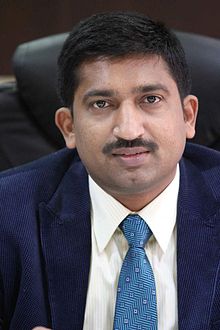 | - Made Gwalior disabled friendly - Indore cleanest city |
| DR. RAJENDRA BHARUD |  | - DC of Nandurbar, MH - Management of covid-19 |
| E. SHREEDHARAN | 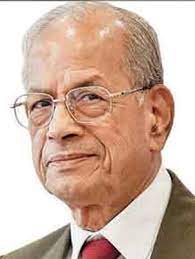 | - Metro man - Transparency, Integrity - Example of excellence in public services - E. SHREEDHARAN, led the constructing the Konkan Railway. … resulted in completing the project ahead of schedule. |
| T.N. SHESHAN | 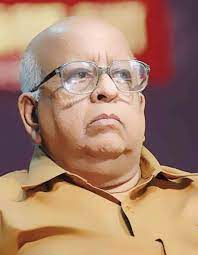 | - Electoral Reforms - Institutional reforms |
| S.R. SANKARAN | 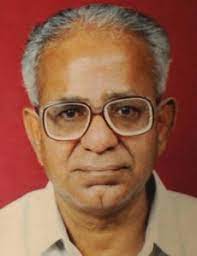 | - Fight against bonded labour - Compassion towards weaker section |
| PARAMESWARAN IYER |  | - Destigmatizing manual scavenging |
| KUNDAN KUMAR |  | - Startup zone in champaran - To create opportunities for migrant labours |
| ASHEESH SINGH |  | - Cleared 100 acres of Indore garbage - using bio mining |
| DIVYA DEVARJAN |  | - Learned Gondi to understand tribal problems (empathy) |
| ARIF SHEIKH |  | - Community policing (Amcho Baster, Amcho Police) - Chuppi tod campaign - domestic violence |
| Community and duty | - HEMALATA SISA - travelling to forest and swollen river to provide healthcare services to tribals of Niyamgiri |
1. Emotional Intelligence
Concept | Utilities
- Introduction
- “As much as 80% of adult success comes from EQ” - DANIEL GOLEMAN
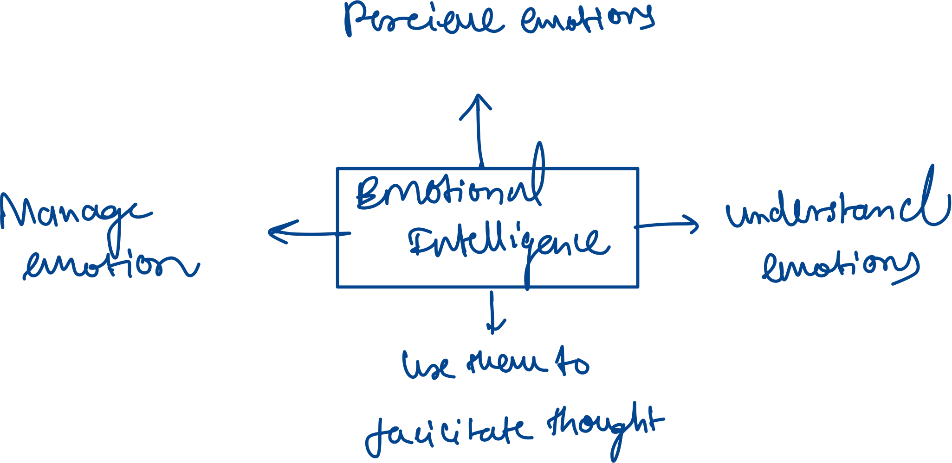
- EI is the ability recognize emotions and use them for constructive purpose.
- Intelligence is defined as the capacity of an individual to think rationally, act purposefully and deal effectively with his environment.
- TR-AP-DE

- I know that I am intelligent, because I know that I know nothing -SOCRATES
- It takes more then intelligence to act intelligently - DOSTOEVSKY
- Emotional intelligence - Sthithapragya - steady wisdom
- Emotions
- Intense feelings, favourable/unfavourable, directed at someone/something.
- Happy - feeling of contentment
- Quote
- You are punished not for your anger but by your anger. - BUDDHA
- Anger : is a strong feeling of annoyance or resentment against someone/something
- Cloud judgement of right or wrong
- Naked parade of women in Manipur
- Escalate conflict
- Israel’s response to October 7 Hamas Attack
- Prohibits rational thinking
- Peoples attacking doctors
- Overpowers other emotions
- Naxalism, Terrorism - suicide bombing
- Affects peace of mind
- Uneasiness, restlessness
- Affect interpersonal relationships
- Creates mistrust, conflict
- Prevents objective assessment
- By Clouding judgement
- Nasty decision making
- GENERAL DYER
- Cloud judgement of right or wrong
- Management of anger
- Identifying triggers
- Noticing early signs - self awareness
- Mindfulness meditation
- Channelling
- Peace and Reconciliation Commission - South Africa
- Practice forgiveness
- Bus diplomacy of VAJPAYEE
- Seek external support
- Body
- PETER SALOVEY and JOHN MAYOR - defined the term EI - PUMU
- DANIEL GOLEMAN - 5 components of emotional intelligence
- ARM(E)S
- Self awareness - Ability to recognize and understand emotions as well as their effect on others
- E.g. while having quarrel with my brother
- Self Regulation - Ability to control disruptive impulses, tendency to suspend judgment and to think before acting.
- Motivation - Passion to work for internal reasons that go beyond external rewards like money and status.
- E.g. joy of learning
- Empathy - Putting oneself in someone else’s shoes and understanding their feelings and experiences.
- Social Skills - Proficiency in managing relationships and building networks, and the ability to find common ground and to build rapport.
- Leading change, persuasiveness, expertise building

- Adaptability : adjust to changing need
- Resilience : bouncing back from setbacks
- Optimism : maintaining a positive outlook
- PETER SALOVEY and JOHN MAYOR - defined the term EI - PUMU
- Qualities of emotionally intelligent people
- Good interpersonal relations
- Improved communication
- Empathy
- Learning from mistakes
- Acting with integrity
- Reduced stress
- Feeling confident and positive
- Creativity
- Utilities of emotional intelligence
- Personal benefit
- Enhanced self awareness
- manage stress effectively, better decision making
- keep even temper in managing success and failure
- High adversity quotient
- overcome obstacles to achieve happiness
- Physical and mental Health
- Overcoming anxiety, depression, trauma, loss of dear ones
- Reduced Emotional Bias
- Think rationally
- Effective communication
- Allows to express and articulate thoughts clearly
- Conflict resolution
- By facilitating constructive dialogue
- E.g. R.N. RAVI in Naga peace accord
- Interpersonal Relationship
- builds trust and fosters deeper connections with others
- Enhanced self awareness
- Professional Benefits
- Leadership
- Create positive work environment
- Improved career prospects
- Helps to build rapport with colleagues and clients
- Enhance job performance and productivity
- By effective communication, team spirit
- Leadership
- Personal benefit
- How Emotional Intelligence can be developed?
- Self awareness : identification of root of distress and addressing it.
- Self reflection
- Practicing mindfulness, journaling
- Social awareness
- Anticipating and recognising needs and situations
- Self-Regulation - responding calmly and optimistically
- Choosing a thoughtful response
- Motivation
- Establish clear, achievable goals
- Seeking Feedback - taking constructive criticism from family, colleague, psychologist
- Course correction, self-improvement
- Practicing Empathy
- E.g. Actively Listening to others
- Invest time and effort in building relationship
- Undertaking sensitivity training or self introspection
- E.g., sensitization towards LGBTQIA+ community.
- Soft skill training
- According to 2nd ARC
- Friendly work culture
- Gives positivity
- Self expression
- Relief in case of ethical conflict; seeking help
- Having rich emotional vocabulary
- Self awareness : identification of root of distress and addressing it.
- Negative effects of having high EI?
- Emotional overload, burnout : due to constant exposure to others intense emotions
- Emotional manipulation of other for personal benefit
- E.g. HITLER used emotion to suppress reason of Germans
- Ignoring emotional signals can be counterproductive
- They act as warning signals
- Unhealthy people-pleasing tendencies
- Might lead to compromising their own need and boundaries
- Misinterpretations and over-analysis of others’ intentions
- Create conflict and miscommunication
- Limitations of emotional intelligence in resolving COC
- ”A system of morality which is based on relative emotional
- Emotional bias : emotion can still cloud the judgement
- External pressure : may overpower strong emotions or principles
- E.g. suicide bombing
- Ethical ambiguity : when there is no right or wrong answer
- Individual variability
- Some can overemphasize empathy for certain stakeholders
- Situational constraints like limited time or resources limit EI
- What prevents development of EI?
- Early Life Factors:
- Adverse childhood experiences (ACEs) like trauma, neglect, abuse, or chaotic family environments
- Lack of positive role models: absence of caregivers who show emotional intelligence
- Insecure attachment styles can impact trust and emotional understanding
- Cognitive Factors
- Mental health condition : stress, depression, autism
- Limited social interaction : prevent development of broader perspective in life
- External factors
- Limited access to resources
- Education, therapy
- Gender stereotypes
- Restricting oneself to gender roles can restrict emotional development
- External pressures
- E.g. rioting post Nahel M killing in France
- E.g. Manipulation
- E.g. Terrorism, extremism etc.
- Limited access to resources
- Early Life Factors:
- Way forward
- “The only way to change someone’s mind is to connect with them from the heart.”
- Conclusion
- EI is a tool for effective communication and peaceful coexistence with others.
- EI is a tool for effective tool to win friends and influence people.
- As DANIEL GOLEMAN says, emotional intelligence can be a valuable resource, However it should be supported by a strong moral compass and ethical reasoning.
Application of EI in Administration and Governance
- EI Administrator
- High self regard
- Maintain balance in life
- Share inspired vision
- Empower others
- Acts as change leader - challenge the status-quo
- E.g. ANIL SWARUP
- Deals effectively in adverse conditions
- E.g. RAKESH MARIA investigating 26/11 Mumbai attacks
- Stakeholder engagement and team building
- E.g. ARMSTRONG PAME - 100 km road in tribal area
- Promote ethical governance
- E.g. T.N. SHESHAN -
- Prevent misuse of discretionary powers
- E.g. ASHOK KHEMKA -
- How will I apply EI in administration
- Empathy
- To understand and address concerns of people
- Self awareness
- To recognize my bias, and take objective and rational decision
- Self regulation
- To prevent conflict by prioritizing dialogue
- Internal motivation
- To create conducive work environment for my colleagues
- Social skill
- Encourage public participation through social audits
- Empathy
- Relevance of emotional intelligence in civil services
- Fast changing social values
- Makes important to understand broader perspective
- Increasing social, economic and digital divide
- For reducing inequality in society and working for upliftment of disadvantaged people
- PARAMESWARAN IYER
- For reducing inequality in society and working for upliftment of disadvantaged people
- Demand for improved governance
- Due to democratic and republic polity
- ARIF SHEIKH
- Political pressures
- T.N. SHESHAN
- Effective decision-making
- Rationality + emotion + innovation
- DIVYA DEVARJAN
- Fast changing social values
- DIVYA DEVARJAN -
- learn tribal language(Gondi) to make personal connection
- Baster community policing
- Negative examples
- NEET aspirants made to remove innerwear (objectivity without compassion)
- IAS officer scolding teachers in school
Attitude
Content | Structure | Function
- Introduction
- Oxford dictionary defines attitude as ‘A way of thinking or feeling about something’
- Attitude is a person’s learned and enduring tendencies to behave either favourably or unfavourably towards something.
- The only disability in life is a bad attitude.” - SCOTT HAMILTON
- WINSTON CHURCHILL - ‘Attitude is a little thing that make big difference’.
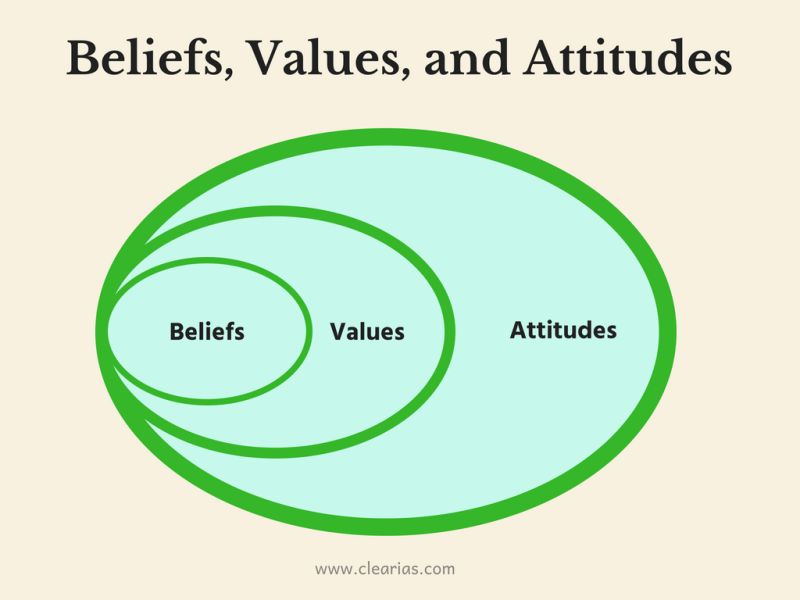
- Belief VS Attitude
- Belief is a conclusion regarding something. (cognitive)
- Attitude includes cognitive, affinitive and behavioral component.
- Attitude formation
- Direct Personal Experience:
- E.g. positive encounter with a friendly dog might create a positive attitude towards dogs in general.
- Family and Social Influence
- through implicit learning, shared values, and social norms.
- Formal Education
- by providing knowledge, critical thinking skills, and exposure to diverse perspectives.
- Media and Information
- by framing information, presenting stereotypes.
- Direct Personal Experience:
- Attitude for a civil servant
- Service Orientation:
- Putting the needs of the public above personal gain or political pressure
- Impartiality and fairness
- Treating all citizens equally
- Accountability and transparency
- Taking responsibility of action; being open to public scrutiny.
- Professionalism:
- Having necessary knowledge, skills, and experience to fulfill duties
- Integrity
- Having highest ethical standards; avoiding conflicts of interest and corruption.
- Problem-Solving attitude
- Responding effectively to challenging circumstances
- Empathy and compassion
- Service Orientation:
- Positive attitude
- Refers to optimistic frame of mind
- Positive and constructive thinking
- Self confidence; personal resilience; sense of purpose
- Growth mindset
- motivation and energy
- Mindfulness and stress management techniques
- Critical thinking and problem-solving qualities
- Necessary for innovation
- Help managing adverse circumstances
- Continuous learning
- Leads to happiness, success, self esteem
- E.g. STEPHEN HAWKING, covid-19 management
- External factors contributes to positive attitude in a person?
- Supportive work environment
- Sense of belonging and community
- Strong relationships
- Inspiring stories and role models
- Knowledge and experience
- For civil servants
- Improve Problem-Solving
- Genuine commitment to public service
- Recognizing potential impact of actions
- Continuously seeking learning opportunities
- Negative attitude - PAIRJBE
- Pessimism - consistently negative outlook
- E.g. IAS in Bihar found scolding school teacher for wearing ‘kurta’
- Arrogance - Displaying an excessive sense of superiority (Apathy, Abuse of Public office)
- E.g. IAS officer using public stadium for personal evening walks in Delhi
- E.g. POOJA KHEDKAR forging documents in UPSC exam
- Indifference - Showing lack of concern
- E.g. DM in Tripura raiding marriage parties and misbehaving with guests.
- Resistance to change - unwilling to embrace new ideas (Red Tapism)
- E.g. resistance to lateral entry
- E.g. abuse of official secrets act
- Jealousy - resentful others’ achievements
- Blaming - attributing failures to external factors
- Reward and punishment transfers
- Escapism - not accepting responsibility
- 21% bureaucrats were not responsive to social audits - Accountability Research Centre
- Always expecting failure
- Issue
- Holds us back
- Kills motivation
- Lowers self esteem and confidence
- Leads to failure
- Increase anger, doubt, frustration, dwelling on problems.
- Pessimism - consistently negative outlook
- Neutral attitude - it means being detached
- Personality trait of being indifferent/ unemotional
- Balanced (+ve)
| Democratic attitude | Bureaucratic attitude (Weberian) | |
|---|---|---|
| - Focus on public interest - inclusive, participative - Innovative - Prioritize outcomes over procedures | - Strictly follow rules and process - Priority to order and efficiency - Hierarchy and chain of command oriented - Internal procedures over citizens needs - Status quoist, risk averse | |
| Merits | - Responsive - Creativity and innovation - Public trust and legitimacy - Participation and ownership | - Consistency and predictability in decision making - Minimizes errors and corruption - Reduce discretionary powers |
| Demerits | - Slow and less efficient - Discretionary powers - Political influence and manipulation | - Inflexible to changing needs - Lack of public participation - Resistance to change - Apathy and indifference towards social cause |
- Balance between the two
- Flexible guidelines and clear rules
- exercise discretion within established framework
- Participatory decision making
- Robust accountability mechanisms to ensure fairness, transparency and ethical conduct.
- Attitude Towards Weaker Sections
- ‘Sarvodaya through Antyodaya’
- Moral attitude
- How attitude can be changed ?
- Internal ways
- Engage in critical thinking
- Self-Awareness and Reflection:
- Identify your own biases and prejudices
- Learning and knowledge
- Learning new things which challenges existing beliefs
- External
- Persuasion
- Social influence
- Mentorship and role modelling
- Seek diverse perspectives and experience
- Community engagement
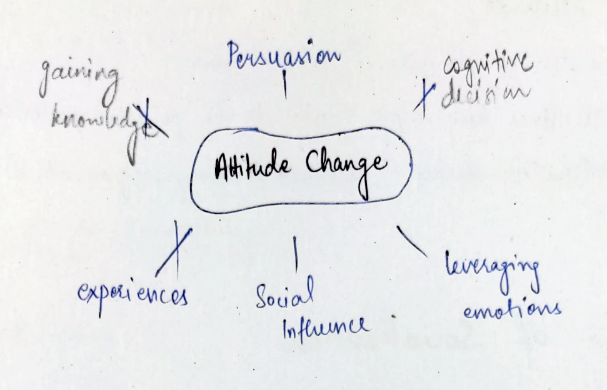
- Internal ways
- Prejudice
- Prejudice is negative preconception or attitude toward a individual or a group.
- Example - CERTS
- Racial prejudice against people of Northeast (Bezbaruah Committee)
- social stigma around working women
- SPECS
- Racism :
- Violence against blacks
- Religion
- Communalism
- Ethnicity
- Caste prejudice
- E.g. practicing untouchability
- How do remove prejudice?
- Individual Level
- Self reflection and awareness
- Critical thinking and questioning
- Education and exposure to diverse perspectives
- Societal Level:
- Increasing the inter group contact
- Interfaith dialogue
- Increasing interdependence
- Removal of mistrust
- Celebrating festivals together
- Legal and institutional reforms: promoting equality and opportunity for all
- E.g. Women Reservation Bill
- Increasing the inter group contact
- Role of media : counteract negative stereotypes and provide positive role models.
- E.g. P.T. USHA - president of IOA (breaking glass ceiling)
- Challenge Stereotypes
- E.g. MADAM CURIE - won two noble prize
- E.g. INDRA NOORI - CEO of PepsiCo
- Inclusivity
- E.g. interfaith council, multiculturalism
- Individual Level
- Conclusion
- Right attitude is needed for life of happiness and fulfillment.
Content
- Explicit Attitude
- Conscious level
- Easy to analyze and change
- Conscious level
- Implicit Attitude
- Spontaneous
- Unconscious level
- Attitude ambivalence
- Cognitive-affinitive dissonance (difference between what one thinks, and what one feels)
Structure
- Components of Attitude
- CAB Model
- Cognitive - beliefs, thoughts, and knowledge
- Affection - feelings, emotions, and preferences
- Behaviour - tendency to act in a particular way
- Attitudes may not always directly translate into behavior due to situational constraints
- CAB Model
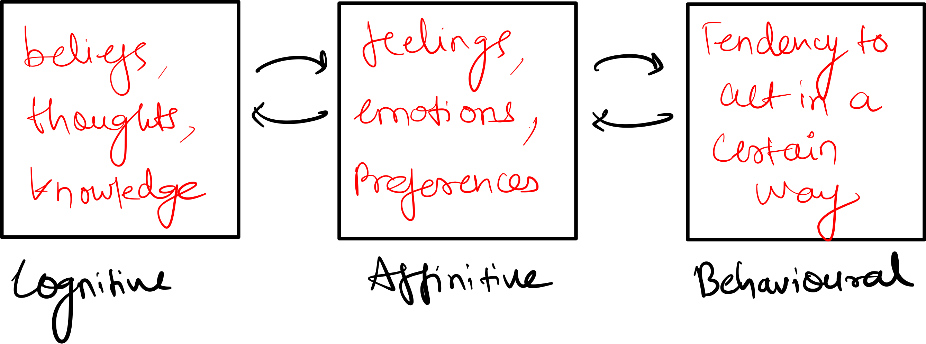
- Examples
- Positive beliefs about environmental conservation (cognitive component) ----> feels strongly about protecting the environment (affective component) ----> more likely to engage in pro-environmental activities (behavioural component).
Function - KEVM
- Knowledge function : help in understanding world around us and make judgements
- Ego defensive function - protects self-esteem and help justify our actions
- E.g. unable to understand language might lead to attitude about it’s complexity
- Issue - tends to blame external factors for negative outcomes
- E.g. refusing to take responsibility for failing
- Value-expressive function : attitude used for self expression
- E.g. negative attitude towards violence
- Motivation function : some attitude enables us to attain desired goals.
Its Influence and Relations with Thoughts | Behavior
- Introduction
- Thought are ideas or opinion produced by thinking.
- Thinking is cognitive process which involves attention, perception, reasoning and judgement in mind.
- MAHATMA GANDHI ones said, ‘A man is but the product of his thoughts. What he thinks, he becomes’
- For example - Fear, curiosity, relief.
- Behaviours are actions that can be observed.
- Hatred - intense dislike or ill will
- Attitude is predictor of behavior
- But not always - it depends on strength of attitude
- Examples
- Positive attitude leads to affirmative actions
- Negative attitude - abstaining action
- Neutral attitude - balanced/ no action
- Moral attitude - moral action
- Attitude factors predicting behaviours
- Attitude strength ( knowledge and experience leads to more strong attitudes)
- Personal relevance
- Attitude’s influence on Thoughts
- Attitudes shape the way individuals perceive events
- E.g. A job seeker with positive attitude might see failure as learning experience
- Decision-making:
- E.g. health conscious may prioritize daily workouts
- Problem-solving
- An entrepreneur with growth mindset might view challenges as opportunities to learn
- Specificity - Specific attitude we have to do something.
- Congruence - state where one’s thought, speech and action coincides
- Attitude’s influence on Behaviour
- Motivation for doing specific action
- Musicians may dedicate hours to practice
- Social interaction
- Friendly attitude leads to positive social behaviour
- Motivation for doing specific action
- People tend to behave in ways that are consistent with their attitudes.
- However, Attitudes do not always directly translate into behaviour because
- Situational constraints
- Social norms
- Conflicting attitudes
- Attitude-Behavior Feedback Loop
- When individuals engage in behaviours that are consistent with their attitudes, it reinforces and strengthens those attitudes.
- Individuals engage in behaviours that are inconsistent with their attitudes, it may lead to cognitive dissonance.
Moral Attitude
- Moral attitude is individual’s judgment regarding what is right or wrong
- Attitude towards moral lapses
- Strongly influenced by society and culture
- Generally four qualities are associated with moral attitudes
- Reverence
- Faithfulness
- Truthfulness
- Goodness
- Role
- Facilitative
- E.g. altruism, social service, etc.
- Prohibitive
- E.g. adultery, stalking, cheating, etc.
- Facilitative
Political Attitude
- Political attitude means individual’s beliefs about political matters, public policy and social issues.
- Key characteristic PPPI
- Ideological Orientation :
- E.g. Liberals, Socialists, Marxists etc.
- Policy Preferences :
- E.g. views on issues such as taxation, immigration and foreign policy.
- Other issues like economy, employment, women, inequality, caste system
- Political Participation:
- such as voting, attending rallies, joining advocacy groups, or running for office.
- Ideological Orientation :
Social Influence
- Social influence refers to ways in which individual’s attitudes, opinions, or behaviour changes in response to social environment.
- Positive role
- Learning and development : through interacting with others, observing their behaviour.
- E.g. learning language, cultural practices in childhood
- Motivation : motivated individuals can inspire us for self improvement
- Helps in building trust and functioning effectively in groups
- E.g. adhering to traffic rules ensures smooth functioning
- Cultural transmission through tradition, practices and beliefs
- Helps in preserving cultural identify and heritage
- Learning and development : through interacting with others, observing their behaviour.
- Negative role
- Spread of misinformation
- Prejudice
- Stereotype
- Manipulation
- Social insecurity
- Comparing oneself to others on social media
- Forms of social influence
- Conformity : desire for fit in
- E.g. Beti Bachao, Beti Padhao
- Compliance : acting according to expectations
- Family expectations
- E.g. Marriage, Career Choices, Lifestyles.
- Family expectations
- Internalization : adapting someone’s beliefs as our own
- Social learning : observing and imitating behaviour of others
- Conformity : desire for fit in
- Factors influencing social influence
- Peer pressure
- Healthy competition
- Social media - YouTube, TikTok
- Persuasion
- E.g. Swachhata Pakhwada
- E.g. ‘Selfie with Daughter’ campaign
- E.g. LiFE campaign
- Socialization
- Caste system - lead to inter-caste marriage, restricted social interaction.
- Cultural influence - Dressing (south - dhoti, north- kurta pajama), Marriage, Festivals - Diwali, Holi, Eid, Christmas, or Navratri.
- Authority and Leadership
- E.g. Standup initiative
- E.g. in taking covid-19 vaccines
- Community and religious leaders on religious beliefs and practices.
- Political leaders influencing voting behaviours.
- Peer pressure
- Negative
- Hate speech
- Radicalization - lone wolf attack
- Mob Vigilantism, lynching, blasphemy, Honour killings
- Measures
- Cultivating critical thinking skills
- Maintaining a healthy sense of self
- surrounding oneself with positive influences
- Consumer awareness
- E.g. ‘Jago Grahak Jago’
- Explicit disclosure
- Strict actions against misleading.
- Social influence is a double-edged sword. Understanding its complexities we can make informed choices and contribute to positive social environment
Persuasion
- Persuasion is the art to influence someone’s beliefs and opinions through communication
- To convince, encourage or motivate someone
- Positive intentions
- E.g.
- How persuasion is done?
- Ethos (establishing credibility)
- Doctor prescribing medicine
- Pathos (Emotional Appeal)
- NGOs evoking emotions for donation
- Logos (Logical Appeal)
- Mutual fund showing data to sell offerings
- Repetition :
- E.g. Viksit Bharat 2047 mission
- Social Proof (people copy the actions of others): e.g. customer reviews on amazon
- Scarcity : e.g. Flash sales and limited time deals
- Reciprocity : offering test drives for car purchase
- Ethos (establishing credibility)
- Positive Role of Persuasion
- creating positive changes in society
- Swachh Bharat Abhiyan
- Motivate individuals to embrace new ideas
- Do Boond Zindagi Ki (behavioral campaign)
- Effective communication
- Peaceful conflict resolution
- Personal development and creativity
- Beti Bachao, Beti Padhao
- creating positive changes in society
- Negative role of persuasion
- Manipulation
- fear-mongering, spreading misinformation for personal benefit
- For promoting harmful behaviors
- smoking, gambling
- Spreading prejudice : through persuasive communication.
- E.g. communalism
- Undermining critical thinking : lead to impulsive decisions
- E.g. misleading advertising, political propaganda
- Manipulation
- Effective persuasion - CGEE ( छत्तीसगढ़ में extremism extreme है)
- Understanding the audience
- Establish credibility
- Presenting logical and compelling argument
- Finding a common ground
- Sharing examples of others, open dialogue
- Emotional appeal
- Sharing stories, catchy slogans and music, humour
- Providing evidence
- Facts, data, research findings
- Commitment and consistency
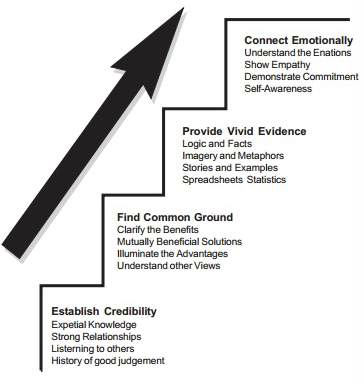
- Manipulation
- Wrong intent
- Convincing for private or illicit means or ends.
- E.g. manipulating people on religious lines
- Impact
- Persuasion should be used ethically and responsibly giving due consideration for it’s potential consequences
1. Aptitude and Foundational Values for Civil Service
- Introduction
- Aptitude is person’s inherent potential to develop certain skills, abilities, or knowledge.
- It is concerned with the future potential.
- Ability is much closer to intelligence. It is concerned with present.
- Aptitude is neither completely innate, nor completely acquired
- “Aptitude is your natural ability to do something well, but attitude is the determination to do it even better.” - LOU HOLTZ
- Aptitude and skills
- Skills acquired and constantly upgraded
- Training and learning
- Aptitude is what is there, but could be nurture
- Body
- Two types of aptitude
- Physical - physical characteristics to perform a task successfully
- E.g. strength
- Mental - mental qualities needed to perform a task successfully
- E.g. banker dealing with numbers
- Physical - physical characteristics to perform a task successfully
- Two types of aptitude
- Civil servants must have three kinds of aptitude - EMI
- Intellectual
- Think rationally, act purposely and deal effectively with his environment.
- Means oriented aptitude
- E.g. devising solutions like oxygen plants during COVID-19
- Emotional
- Effective conduct with colleagues, subordinate and public at large.
- E.g. DIVYA DEVARJAN -
- learn tribal language(Gondi) to make personal connection
- Moral
- Ensuring values like justice, empathy, fairness etc.
- E.g. IAS officers adapting schools in Odisha
- Intellectual
- Foundational Values
- End oriented
- Concerned with the goals which civil servants aims to achieve while performing their duties
- Covered by DPSP, FR’s.
- Means oriented
- Concerned with ways in which civil servant behaves or acts while performing their duty
- E.g. transparency efficiency.
- Constitutional values
- Sovereignty
- Socialism
- Secularism
- Democracy
- Republic
- Justice
- Equality
- Fraternity
- Rule of law
- Integrity
- Balance between freedom and self-restraint
- I-DOPE ( सिविल सर्वेंट कैसे होने चाहिए - DOPE)
- Integrity
- Impartiality
- Dedication to public service
- Objectivity and Rationality
- Non-partisanship
- Empathy and Compassion towards weaker sections
- Tolerance
- Anonymity
- End oriented
- Conclusion
- A strong civil servant demonstrates all of the above ethical traits in their day to day functioning.
- 2nd ARC report on Ethics in Governance suggests, Public Service Values for all public servants should be clearly defined.
Integrity
- Introduction
- Consistently thinking and doing what is right all the time.
- “Integrity is doing the right thing, even when no one is watching.” - C.S. LEWIS
- Having consistency in thought, actions, and values.
- Fundamental rule for maintaining civil servants integrity is to avoid situation that may give rise to conflict of interest.
- Against integrity
- PUJA KHEDKAR
- ABDUL KHAN - nuclear proliferation
- Recent cases of doping in sports
- KESHAB CHANDRA SEN marrying of 13 years old daughter
- Different types of integrity
- Moral Integrity
- GANDHI suspending NCM on incidence of violence in Chauri Chaura, 1922
- Professional integrity ~ Probity
- Whole team of Mission Shakti (nuclear program) kept the mission secret
- Intellectual Integrity
- Never lying on resume
- Never cheating in exam
- A doctor refusing to prescribe medication which he thinks unnecessary
- Moral Integrity
- Significance of integrity in human life - psychological/interpersonal/professional/governance/social
- Building public trust
- We trust a person who says and does the same thing
- MAHATMA GANDHI
- Foster self respect and confidence
- NELSON MANDELA
- Ethical professionalism
- E.g. RATAN TATA
- Do the right thing
- Integrity guides us to follow ethics when faced with temptation or pressure
- Personal growth
- By always being accountable and responsible
- Healthy interpersonal relationship
- Develops honesty and fidelity
- Better mental health
- Living with integrity gives a sense of inner peace and confidence.
- Prevent corruption and misuse of power
- Good governance
- Building public trust
- Integrity without knowledge
- Ineffective decisions due to lack of understanding
- E.g. Hesitancy of farmers towards organic farming
- Impractical choices based on principles alone
- E.g. Premiership of LIZ TRUSS
- Risk of exploitation
- E.g. unfair wages to women in unorganized sector
- Rigidity
- Greater harm
- Contextual ethics : emergency situations
- Need to follow moral intuition
- Ineffective decisions due to lack of understanding
- Knowledge without integrity
- Violation of ethics for personal gain
- E.g. Ransomware attack
- Harmful actions
- E.g. Hate speech
- Violation of trust
- E.g. ABDUL KHAN - Nuclear proliferation
- Violation of ethics for personal gain
- Cultivate both integrity and knowledge
- Continuous learning
- Critical thinking and fact-checking
- Openness to feedback and adaptation
- If you tell the truth, you don’t have to remember anything.
- Integrity is a value that empowers the human being
- One of the tests of integrity is complete refusal to be compromised
- “In looking for people to hire, you look for three qualities: integrity, intelligence and energy. And if they do not have the first, the other two will kill you.”
- Intelligence and energy without integrity
- Knowledge without integrity
- Corruption :
- Civil servants convicted for taking bribes
- Integrity with intelligence and energy
- Effective service delivery
- DBT schemes of government
- Protecting fundamental rights
- Threat of data privacy in age of AI
- Accountability and responsibility
- Civil servants regularly conducting social audits
- Sustainability
- Railways planning to become carbon neutral by 2030
- Effective service delivery
- Intelligence and energy without integrity
Impartiality
- Impartiality means to be unbiased and fair, and considering all perspectives in objective way.
- Decisions based on objectivity, not on bias or prejudice - E.g. carrying out official work like procurement, recruitment, distribution of resources etc., on merit alone.
- Significance
- Fairness and justice
- Preserving public trust
- Impartiality of ECI is essential for free and fair election
- Objectivity
- Recruitment by UPSC based on merit alone
- Upholding rule of law
- Wrong to encounter criminal without trials
- Prevent corruption
- CBI and ED investigations free from bias
- Effective policy formulation benefiting all stakeholders
- PM Ayushman Bharat
- Avoiding Conflicts of Interest
- Civil servant Suo-moto disclosing conflict when allocating tenders if any stakeholder share personal relationship with him
- Impartiality should always be coupled with application of conscience.
- Situational sensitivity
- Crisis management
- Refugee crisis
- Perceived lack of empathy
- Weberian rule based mindset
- PDS distribution to most vulnerable
- Rigid decision-making causing miscarriage of justice
- Situational sensitivity
- Political impartiality
- Counter - favoring ruling disposition MLAs during contract awarding
- Public impartiality
- Counter - favoring one community over other
- In conclusion, impartiality and non-partisanship are not just ideals but practical necessities for effective public service.
Non-partisanship
- Non-partisanship is political neutrality
- Civil servant doing his task without fear/favor of political party.
- The values of the administrator will flow from the constitution not from the philosophy of any political party
- Significance
- Separation of power
- Preventing politicization of bureaucracy
- Professionalism
- Appointment based on merit instead of political connection
- Protect democratic mandate
- Allocation of resource as per the parliamentary sanction
- Peaceful conflict resolution
- ECI recommendation to disqualify MP
- Public service delivery
- ANIL SWARUP dutifully implementing both RSBY and Ayushman Bharat
- Continuity in administration
- Public trust
- Separation of power
- Negative Examples
- Civil servants joining political party
- CAG - 2G Scam
- Challenges
- Politicized bureaucracy serves the narrow interest of political party in power - committed bureaucracy
- E.g. - Nazi Germany
- Politicized bureaucracy serves the narrow interest of political party in power - committed bureaucracy
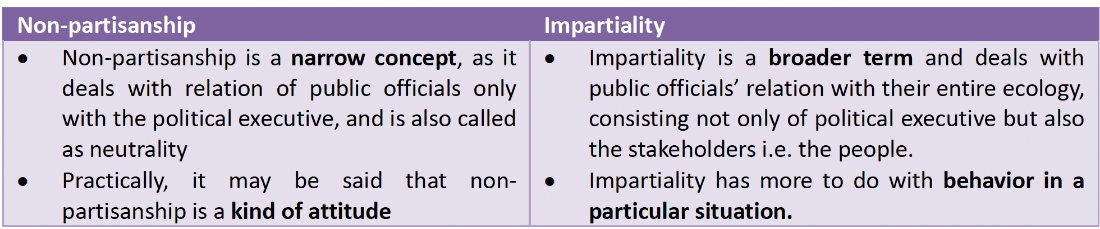
Neutrality
- Neutrality signify political impartiality of civil servants.
- Behavioral component
- Provisions under Central Civil Services Conduct Rules, 1964 and the All India Services Conduct Rules 1968
- Public servants must not take part in politics
- They must not give election fund/ assistance to any political party
- Then must not tell their preference of vote to other people
- They must not display any election symbols on his himself, vehicle or home.
- They must not participate in rallies, and demonstrations etc., without government permission.
- Types of neutrality
- Passive neutrality
- Active neutrality
Objectivity
- Objectivity means being guided by evidence.
- Objectivity is evaluating a situation in a rational and empirical way, based on facts and evidence, without any bias, personal belief, feelings or external influence.
- “Objectivity is the essence of true intelligence.” - LAO TZU
- Significance -
- Legitimacy and public trust
- Through merit based decision making
- Uphold duties of public office
- taking decisions on appointments, awarding contracts, recommending benefits etc.
- Compliance with rules and laws
- To reduce the discretions and being fair
- Legitimacy and public trust
Dedication to Public Service
- Dedication - quality to give one’s time and attention entirely to a cause
- Driven by spirit of sacrifice and sense of duty towards society and state
- I slept and dreamt that life was joy, I awoke and saw that life was service. I acted and behold, service was joy! -RABINDRA NATH TAGORE
- “The best way to find yourself is to lose yourself in the service of others.” - MAHATMA GANDHI
- IMMANUEL KANT - duty for the sense of duty
- Significance
- Personal
- Fulfillment
- Sense of self respect
- Professional
- Society
- Social Justice
- Positive and Meaningful Impact
- Inspiring others
- Without it?
- Difficult to take right judgement in ethical dilemmas
- Personal
- E.g.
- E. SHREEDHARAN
- SANJUKTA PARASHAR (IPS) - dealing with Bodo militancy
- KUNDAN KUMAR
- Nishkama Karma
- Sewa Paramo Dharma
- Duty bound ethics
- DIVYA DEVARJAN
- ASHOKA’s Dhamma
- KANT’s Categorical Imperative
- GANDHI - Duty is worship
Empathy
- Putting oneself in someone else’s shoes and understanding their feelings and experiences.
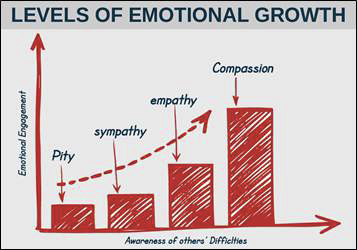
- Sympathy - understanding someone’s distress
- Empathy - feeling other’s distress
- Compassion - desire to alienate it
- Significance
- Responsiveness to citizens needs
- DIVYA DEVARJAN
- Understanding and solving problems of diverse communities
- ARMSTRONG PAME
- Humane administration
- PARAMESWARAN IYER
- Building Public Trust
- ARIF SHEIKH
- Crisis management
- DR. RAJENDRA BHARUD
- Effective Public Service Delivery
- P. NARAHARI
- Positive work environment
- KIRAN BEDI
- Making Fair and Just Decisions
- Responsiveness to citizens needs
Tolerance and Compassion Towards Weaker Section
- Compassion is the motivation to act towards reliving the suffering of others.
- Tolerance - ability to accept diverse beliefs and opinions without prejudice.
- Exercising restraint in sensitive matters
- Expressing one’s point of view in a respectful way.
- E.g. In Jainism - Anekāntavāda
- E.g. vegetarian not stopping others from eating meat.
- Significance
- Social justice and harmony
- E.g. PARAMESWARAN IYER - destigmatizing manual scavenging
- Establish mutual trust and credibility
- E.g. P. NARAHARI’s efforts in making Gwalior disabled friendly.
- Humane and accommodative administration
- E.g. KIRAN BEDI’s work to reform administration of Tihar Jail.
- Inclusive growth
- E.g. NHRC’s role in mainstreaming the concerns of transgenders, disabled, women
- Effective public service delivery
- E.g. E. SHREEDHARAN completed Konkan railways before deadline
- Peaceful conflict resolution
- Protect Democratic Values [ISAIAH BERLIN]
- Pluralism and Diversity
- Preventing Extremism
- Uphold the moral worth of every individual
- E.g. S.R. SANKARAN - Fight against bonded labour
- “especially in developing countries with paradox of modernity and tradition[F.W. RIGGS], civil servants, has to take side of the poor_.”_
- Social justice and harmony
- Example
- People coming forward to help disabled Swiggy delivery executive
- People donating hair to make wigs for cancer patients
- Sarv Dharma Sambhav
- AKBAR’s Din-i Ilahi
- Intolerance
- Biased perception, narrow view
- Racism, communism, hate speech
- Stagnation of knowledge
- Reduce compassion
- Examples of intolerance
- US Capitol Hill storming
- Oppression of Uighur Muslims in Xinjiang
- Persecution of Rohingya’s in Myanmar
- Communal Riots, Son of Soil movements in India
- Charlie Hebdo Killing
- Mob Lynching
- October 7 Hamas Attack as well as Israel’s response
- Objectivity without compassion
- Jharkhand - death due to starvation of girl due to non availability of Aadhar authentication
Anonymity
- Emphasize that permanent executive works from behind the seen
- Because of permanence of service and need of neutrality
- To practice tools of administration without bias
- Significance
- Prevents misuse and abuse of power
- Not elected - do not need public sanctions like politicians
- Focus on getting the work done, not it’s promotion
- Inhibits populist thinking, enhances welfarism
- Instills neutrality and impartiality
- E.g. drafting a welfare scheme
Leadership
- Ability to influence and guide a group of people towards a specific goal/task.
- It involves act of influence
- Qualities of a good leader
- Influence - ability to inspire and motivate others
- Good communication
- PM MODI’s call for Swachh Bharat
- People and service orientation
- MAHATMA GANDHI
- Integrity and Accountability
- LAL BAHADUR SHASTRI taking responsibility for railway accident
- Thought leadership - having a vision
- E.g. A.P.J. ABDUL KALAM
- Thoughtful response during emergencies
- E.g. KUNDAN KUMAR created startup zone in Champaran for migrants during COVID-19
- Being inclusive
- E.g. MAHATMA GANDHI
- Flexibility
- Course correction
- Emotional intelligence
- Leaders VS Administrators/Managers
- Administration is process of working with and through others to accomplish agreed goals efficiently.
- Essential role of administration - planning, organizing, leading, controlling.
- Leadership - entails envisioning mission, developing strategy, inspiring people, changing culture
- Administrators are appointed
- Ability to influence based on formal authority
- Leaders may be appointed or may emerge from a group
- Leaders can influence others to perform beyond the actions dictated by formal authority
- Managers get other people to do, leaders get other people to want to do
- Leaders have a vision and shape people around that
- Innovation, participating, course correction, criticism handling
1. Public/Civil Services Values and Ethics in Public Administration
Status | Problems
- Need for effective ethics structure
- CS are implementers of public policies, thus have significant public interaction
- Effective performance of duties
- What steps have I taken to become worthy of becoming public servant?
- Education : by constantly learning new and diverse information which allows me to consider multiple viewpoints reducing the risk of bias and limited understanding.
- Ethical reasoning : I use theories of ethics to enhance my awareness of ethical issues before society
- E.g. I believe rising intolerance towards minorities is wrong and violation of democratic spirit.
- Introspection : reflecting on what are my core ethical values and principles. Indomitable will to never compromise them
- E.g. I don’t lie or indulge in irresponsible activities
- Staying open to feedback : helps me to identify faults in my reasoning, and allows me to learn and improve.
- Practicing humility in daily life : recognizing my role as someone to help others in achieving their goals
- Environment stewardship : I have made Lifestyle for environment as integral part of my life.
- E.g. I carry cloth bags and refuse to take polyethene bags.
- Follow rules and laws
- E.g. I wear helmet while riding bike and stop at traffic signal even if nobody is watching
- Why ethics is important in public administration?
- Maintaining public trust and legitimacy
- Preventing corruption and abuse of power
- Justice and Fairness
- Upholding the rule of law and democracy
- Setting an example for society
- Protection of environment and wildlife
- Progressive social change
- Ethically right legally wrong
- Bending rule for compassion : Blood transfusion to a pregnant women during natural disaster without following procedures
- Whistleblowing :
- Civil disobedience : peaceful protest against unjust laws.
- Legally right ethically wrong
- Intentional delay : governor using pocket veto on state bills.
- Misuse of power : A police official entrusted to clear peaceful protesters use violent means without prior warning.
- Freedom of speech : misuse of fundamental right to spread hate towards other community
- “In doing a good thing, everything is permitted which is not prohibited expressly or by clear implication”. Examine the statement with suitable examples in the context of a public servant discharging his/her duties.
- Issues with such discretion
- Risk of misuse of power
- Undermines Rule of Law
- Long term harm
- Advantages of discretion
- Issues with such discretion
- In conclusion, while having good intention is essential, public servants should never operate outside the framework of established law and ethics.
- Public interest refers to the collective well-being and good of all citizens within a society
- Principles - IOSHOLA
- Procedures
- Transparency and accountability
- Public participation
- Management of conflict of interest
- Efficient public service delivery
- Professionalism
- Ethics is essential foundation for effective and responsible public administration.
Accountability and Responsibility
- Accountability means being answerable for one’s action and decisions to all stakeholders.
- E.g. LAL BAHADUR SHASTRI resigned after railway accident.
- Includes
- Answerability
- To justify one’s action
- Enforcement
- To take action in cases of omission
- Grievance redressal
- Answerability
- Responsibility - accountability to oneself based on ethical reasoning
- When accountability turns inwards
- Based on ethical reasoning
- Taking ownership of one’s actions and decisions.
- Financial accountability
- Institutions and mechanisms
- External (to citizens)- RTI, Elections, civil society, Media, Citizen’s Charters, Whistle Blowers
- Internal (within government)- system of checks and balances
- Parliament, judiciary, CIC, CVC, Lokpal, internal audits, POC Act, E-gov mechanism (Pragati, NeGP)
- How to improve accountability
- Need for citizen’s charter
- Devising standard operating procedures
- Minimizing discretion
Ethical Governance
- According to OCED, Ethical governance means good governance which is also based on certain value premise.
- Values
- Integrity
- Fairness
- social justice
- Welfarism
- Empathy
- Tolerance
- compassion towards weaker section
Strengthening of Ethical and Moral Values in Governance
- Promote transparency and accountability
- Educating public officials about ethics
- Civil servants should not accept gifts
- they should avoid conflicts of interest
- Encourage citizen participation
- Open governance initiatives
- Strengthen the rule of law
Philosophical Basis of Governance
- The philosophical basis of governance means fundamental principles about how societies should be ruled and organized.
- Virtue theory
- for developing virtuous citizenry
- PLATO and ARISTOTLE
- Divine command theory -
- ROBERT FILMER, ST. AUGUSTINE
- Social Contract Theory :
- For protecting inalienable rights of life, liberty, and property
- THOMAS HOBBES, JOHN LOCKE, and ROUSSEAU
- Utilitarianism :
- Governments job is to maximize happiness and well-being for the greatest number of people.
- JEREMY BENTHAM and JOHN STUART MILL
- Marxism -
- Human Emancipation, Egalitarianism
- Republicanism :
- civic virtue, active citizenship, and public participation in governance. -ARISTOTLE, HANNAH ARENDT, JURGEN HABERMAS
- Justice Theories
- For fair allocation of resources and opportunities
- JOHN RAWLS
Philosophical Basis of Probity
- Virtue theory
- Quality of virtuous character
- ARISTOTLE
- Deontological Ethics
- Probity means acting according to duty and one’s moral obligations.
- Social Contract Theory
- Probity is part of social contract, where individuals commit to acting honestly and with integrity in exchange for the benefits and trust provided by society.
- An administrative class that supposed to have all the qualities of gentleman-statemen as ARISTOTLE thought. (THEOPHRASTUS)
Ethical Concerns and Dilemmas
- Ethical dilemma is a situation in which an individual has to make a choice between two moral principles, making it hard to determine what is the right thing to do.
- Causes of ethical dilemmas
- Conflict of values
- Lack of clarity in policies, structures
- Conflict of interest
- Different perspectives
- Changes in society - dynamism
- Process of resolving ethical dilemma - RIE-DL
- Recognize the Dilemma:
- Identify the values and principles at stake
- Consider the potential consequence of different action on all stakeholders
- Gather Information
- Collect relevant information like - applicable laws, policies, and code of ethics.
- Research how similar dilemmas were addressed in the past
- Seek input from affected stakeholders
- Analyze Options
- Consider all possible courses of action and their potential consequences.
- Evaluate each option against your ethical principles, legal constraints
- Apply ethical theories like deontology, utilitarian, to analyze the options
- Consider what you can justify to others based on rational thinking
- Implement the Decision
- Take action to implement your chosen course of action effectively and ethically.
- Ensure transparency and accountability throughout the process
- Evaluate and Learn
- Reflect on the decision and its consequences
- Use the experience to learn for future situations and make suggestions to improve existing procedures
- Recognize the Dilemma:
- Role of innovativeness and creativity to resolve
- Understanding the problem : through multiple perspective
- P. NARAHARI
- Thinking outside the box:
- considering unconventional approaches
- ARIF SHEIKH - Chuppi Tod / community policing
- borrowing from other sectors
- JAM from NANDAN NILEKANI
- utilizing technology in innovative ways
- ASHEESH SINGH - Indore
- considering unconventional approaches
- Engaging with diverse stakeholders, experts and public at large
- DIVYA DEVARJAN
- Finding common ground
- Joint forest management
- Understanding the problem : through multiple perspective
- Suppose the Government of India is thinking of constructing a dam in a mountain valley bound by forests and inhabited by ethnic communities. What rational policy should it resort to in dealing with unforeseen contingencies
- Rational policy to consider
- Comprehensive Environmental Impact Assessment (EIA)
- Public hearing and Informed Consent
- Plan to protect culture and traditions
- Resettlement, rehabilitation and fair compensation
- Risk Mitigation and Contingency Planning:
- Natural disaster response protocol (floods, earthquakes, etc.)
- Environmental protection measures
- Establish monitoring systems
- Build local capacity
- Open communication and transparency
- Rational policy to consider
- Approach
- Consequentialist (utilitarian)
- Deontological
- Rights
- Contextualist
- Justice and fairness
- Virtue
- Common good
Government Institutions
- Ethical concerns
- Administrative discretion
- Corruption
- Administrative secrecy
- Nepotism
- Policy dilemmas
- Politicization of bureaucracy
- PAIRJEB
- Dealing with orders
- Illegal - disobey
- Questionable
- Seek clarification
- Ask to reconsider
- Seek in writing
- Approach superior’s superior
- Difference in opinion
- Obey but place reservations on record
- For further scrutiny by CAG, Judiciary
- Obey but place reservations on record
- Seek transfer or resignation
- Displays willingness to make personal sacrifice to uphold principles
- Reinforces integrity
Private Institutions
- “Organizational values always derive from individual values. Individual is the foundation of a group, a society or a country as a whole.”
- Ethical Issues in institutions
- labour practices
- Lack of fair wages
- Violation of human rights
- E.g. Employing child labour in factories
- Safety and heath standards
- Discrimination
- E.g. glass cliff, glass ceiling
- Sexual harassment
- Disregard for social security
- E.g. ELON MUSK fired 50% workforce of twitter
- Environmental impact
- Pollution and resource depletion
- Improper waste disposal and mishandling of toxic materials
- Business conduct
- False and misleading claims
- AI Washing
- Greenwashing : making false claims about environmental sustainability
- Fraud and corruption
- E.g. Sahara Scam
- Tax evasion
- E.g. Harshad Mehta Scam
- Product safety and quality
- Anti-competitive practices and monopolization
- E.g. APMC cartelization
- Amazon, Walmart etc.
- Favoritism, Nepotism and partisanship
- False and misleading claims
- labour practices
- Ethical issue of employees
- Taking undue advantages of benefits
- Travel, sick leave
- Breach of rules and regulations of the organization
- E.g. insider trading
- E.g. Moonlighting
- Sexual harassment
- Taking credit for others work
- E.g. managers not recognizing contribution of employees
- Misuse of companies resources
- Excessive leaves
- Not following instructions
- Leaking trade secrets
- Guiding principles for companies
- Respect for core human values
- Respect for local tradition
- Belief that context matters when deciding right or wrong decisions.
- Ethical Dilemmas
Ethical Issues in International Relations
- International relations
- International relations (IR) is a field that studies interactions and relationships between sovereign states and other international actors.
- Importance of ethics in international relations
- Promoting peace and security
- Peaceful conflict resolution
- India-Bangladesh border agreement
- Non-proliferation
- NPT
- Cooperation during natural/man made disaster
- 2004 Indian ocean tsunami relief
- Vaccine Maitri
- Peaceful conflict resolution
- Protecting human rights
- E.g. sanctions against Russia
- Human security
- Freedom, human rights
- Rule of law
- Following UNCLOS in South China sea
- Environment protection
- UNFCCC
- Paris agreement, Montreal Protocol
- Sovereignty and non-interference
- E.g. Sri Lanka
- Economic development
- Non predatory lending
- International institutions
- UN, ICJ
- Promoting peace and security
- Discuss the role of ethics and values in enhancing the following three major components of Comprehensive National Power(CNP)viz. human capital, soft power(culture and policies), and social harmony.
- Role of Ethics and values in increasing CNP
- Human capital
- Responsibility, integrity
- Development of skills and productive workforce
- Critical thinking
- Innovation, creativity, problem solving skills
- Fairness, inclusivity
- Promote merit, attract talent
- Soft power
- Human capital
- Role of Ethics and values in increasing CNP
- Challenges and limitations
- Subjectivity : Ethics is subject to disagreement
- Chinese don’t follow rule based international order
- Enforceability : Issue in enforcement
- States have offensive military capabilities
- National interest and principles - difficult choice
- Buying Russian oil
- Subjectivity : Ethics is subject to disagreement
- Strength, peace and security are considered to be the pillars of international relations. Elucidate.
- Strength - quality of being strong
- Importance
- Respect
- Deterrence against attack
- Defend interest
- Components of strength
- Military power
- Economic prowess
- Political influence
- Soft power
- Technological advancement
- Issues
- Arms race
- Security dilemma
- Exploit weaker nations
- Importance
- Peace - state when there is no war or civil disturbance
- Importance
- Trade
- Cultural exchange
- Protect human lives and well being
- Components
- Conflict resolution
- Reduction of poverty, inequality
- Justice
- Importance
- Security - the state of being free from danger
- Importance
- Protection from military aggression
- Protection from internal rebellion
- Terrorism and extremism
- Components
- Military
- Economic
- Environmental
- Technology
- Human security
- Freedom from hunger, disease and repression
- Importance
- Strength - quality of being strong
- ‘The will to power exists, but it can be tamed and be guided by rationality and principles of moral duty.’ Examine this statement in the context of international relations.
- Reasons for will to power
- Ethical issues before launching war
- Just War Theory -
- Self defence, protecting atrocities, preventing humanitarian crisis
- Principle of Proportionality
- To avoid unnecessary destruction
- Protecting civilians
- Non use of nuclear, chemical and biological weapons
- Just War Theory -
- Concerns
- Climate change
- Climate Justice
- Differentiated impact - Global south is most prone to natural disasters
- E.g. - Floods in Pakistan, Pacific Island countries etc.
- Poverty, inequality
- Refugee crisis
- Ethical dimensions
- Universal Declaration of Human Rights
- Article 14
- Non-Refoulement Principle
- Compassion and Empathy
- Human dignity
- Challenges
- Threat to national security
- economic strain and social unrest
- public anxieties and prejudice in accepting refugees
- Way forward
- fair and efficient asylum system
- Providing safe and dignified life
- International collaboration and responsibility-sharing
- Addressing the root cause - collective security
- Promoting Public Understanding
- combating prejudice, encouraging empathy and inclusivity
- Ethical dimensions
- Climate change
- State sponsored terrorism
- Good terrorist, bad terrorist
- Children and women rights
- Afghanistan, Iran
- Violence
- Civil liberties, Human Rights
- Genocide
- UN Convention on Genocide in December 1948 - Genocide is deliberate killing of large number of people of particular ethnicity, religion, nation, etc.
- Example
- 1933-1945 Holocaust
- 1994 - Rwanda
- 800,000 Tutsis were killed by Hutu Militia
- Cultural genocide
- Uyghur Muslims, Xinjiang China
- Organized crime
- Arms trade
- Tax heavens
- WAR
- Mankind must put an end to war before war puts an end to mankind. - JOHN KENNEDY
- When going to war is justified
- protecting innocent human life
- against external aggression
- Defending moral values
- Jus ad bellum (right to go to war) - LIC-AC-S
- Last resort : all other methods must tried first
- Right intention : the intention of war is to right a wrong
- Just cause : there must a good reason for going to war
- Right authority : only public authorities are legitimate, terrorist organizations are not
- Comparative justice - the suffering caused must be less then the suffering that exists
- Probability of success : there is no point in fighting and wasting lives if you are not going to win
- Jus in bello (law of war) - MDP
- Discrimination - act of war should not be directed at civilians
- E.g. Bucha massacre
- Minimum force - death and destruction should be limited
- E.g. strikes on civilian infrastructure
- Proportionality - the force used must be proportional to the wrong endured and to the possible good that may come
- Discrimination - act of war should not be directed at civilians
- Jus post bello
- Concerns justice after a war, including peace treaties, reconstruction, war crimes trials, and war reparations.(RT)
- The four Geneva Conventions
- Convention 1 - Protect soldiers from execution without judgement. Right to proper medical treatment and care to wounded soldiers
- Protects wounded and sick soldiers on the battlefield.
- Requires humane treatment of the wounded without discrimination.
- Mandates respect for medical personnel and facilities, including the Red Cross emblem.
- Convention 2 - Protection to shipwrecked soldiers, special protection to hospital ships.
- Extends protection to wounded, sick, and shipwrecked members of armed forces at sea.
- Similar protections as the First Convention, but applicable in maritime warfare.
- Convention 3 - Defined prisoners of war and accorded them humane treatment
- PoW must be protected against insult and public curiosity as well as act of violence or intimidation.
- Provides detailed rules on the treatment of POWs, ensuring they are treated humanely, given medical care, and not subjected to torture or degrading treatment.
- Fourth Geneva Convention (1949):
- Protects civilians during times of war, particularly in occupied territories.
- Prohibits deportation, hostage-taking, and the targeting of civilians, among other protections.
- Convention 1 - Protect soldiers from execution without judgement. Right to proper medical treatment and care to wounded soldiers
- War does not decide who is right but who is left.”
- Injustice anywhere is threat to justice everywhere
- Management of Global commons - Tragedy of commons [GARRET HARDIN]
- HAAO
- High seas
- Atmosphere
- Antarctica
- Outer space
- Ethical concerns - governance
- Way forward
- Different actions are required by different agents in different contexts to respond appropriately, humanely and ethically to the challenges of climate change.
- Taking enlightened view of balance - Panchsheel
- Commitment to multilateralism, plurality, environmentalism, fair representation of south at global stage.
- Preventing erosion of pubic trust
- Conclusion
- International relations should become positive sum game benefiting all stakeholders.
Ethical Issues in Funding
- Doners attaching conditions to funding
- IMF conditions for economic liberalisation
- Debt trapping
- E.g. on account of Sri Lanka’s failure to pay debt, China took Hambantota port on a 99-year lease.
- Lack of Transparency and Accountability
- Corruption and mismanagement of funds
- FCRA, 2010 provisions flouted by Greenpeace
- Undue influence in funding compromises the autonomy (sovereignty)
- Equatorial Guinea debt to China as much as 50% of GDP
- Environmental degradation
- Palm oil cultivation led to deforestation of tropical rainforest in Indonesia
- Extension of foreign policy
- Corruption
- Measures
- Transparency and disclosure
- Due diligence before taking funds
- Diversification across different creditors to spread risk
- Environmental, Social, and Governance (ESG) consideration
- Community and Stakeholder participation in the process
- Regular Evaluation to meet ethical criteria
Ethical Guidance
- Indian
- Dharmashastra
- Arthashastra - code of conduct and traits for ideal king.
- MG
- Western
- Virtue ethics - PLATO & ARISTOTLE - virtues - wisdom, courage, temperance, justice
- Weberian idea of bureaucratic morality
- UN code of conduct for public officials.
- Imperatives for ethical reasoning
- Accountability of administration
- Rule of law and principle of legality
- Professional integrity
- Responsiveness of civil society
- GANDHI’s Talisman
- Hierarchization of values
Laws
- Laws are rule which are enacted with due process by a competent authority
- Basic ethical standards that society expects everyone to follow
- Enforceable punishments
- E.g. POSH Act, 2013
- POCSO Act, 2012
- IPC Provisions
- Purpose - promote common good and protect individual rights
- Enacted by formal authority
- Applicable to broader population
- For specific action and situations
- Laws: Speed limits, criminal codes, tax laws.
- Matsya Nyaya
- Law of jungle
- Bigger fish eating smaller fish
- How they provide ethical guidance
- Setting boundaries of expected, permitted and prohibited actions
- E.g. mandatory social audit under MGNREGA
- Promote justice and fairness
- Act as deterrence against misconduct
- E.g. Suo moto disclosure of conflict of interest
- E.g. murder
- Adapt to evolving social values
- Altruistic surrogacy
- Help clarify the values to be used and procedure to be followed.
- Setting boundaries of expected, permitted and prohibited actions
| SEF-SOC | Ethics | Laws |
|---|---|---|
| Source | moral philosophy, personal beliefs, and societal values. | legislative bodies |
| Enforcement | Voluntarily enforced by conscience | enforced by the state |
| Flexibility | Evolve with individual and societal changes | More rigid requires formal amendments |
| Scope | Broader and subjective | Narrower and uniform |
| Objective | guide individuals toward virtuous living | maintain public order, protect rights, and punish wrongdoing |
| Consequences of Violation | social alienation or crisis of conscience | Fines, imprisonment, punishment |
| - Laws can lead to ethical change - E.g. Abolishing slavery by law - E.g. Hindu Succession Act - Abolition of Capital Punishment: | ||
| Impacts where | Ethics condition thoughts | Laws conditions actions |
| Moral ambiguity | What is unethical may not always be illegal - E.g. tax avoidance | What is legal may not always be ethical - E.g. sati unethical, but legal till 1829 - Draconian laws - preventive detention |
- Limitation
- Misinterpreted for unethical acts
- Exploiting loopholes for tax evasion
- Cannot address all possible ethical dilemmas
- Knowledge of all laws and rules is difficult
- They can sometime be in violation of civil/human rights.
- Apartheid
- Can be enforced by illegitimate authority without consent
- Rowlett Act, Salt Tax
- Misinterpreted for unethical acts
Rules
- Rules are a set of principles governing people.
- Rules and Laws
| Laws | Rules |
|---|---|
| Enacted by legislative body E.g. parliament | Can be set by individuals or organizations E.g. SEBI |
| Apply to everyone within nation | Apply to specific group E.g. employees |
| Written down in official documents | May be written but can be unwritten E.g. traditions |
| Address broader concern E.g. law and order | Address small scale concerns E.g. Central Services conduct rules , 1964 |
| Laws: Speed limits, criminal codes, tax laws. | Dress code in school |
- Role of ethics in formulating laws and rules
- Setting principles
- Enumerate ethical principles
- Ethics used in deciding penalties
- To avoid bias and prejudice
- Setting principles
| Laws | Rules |
|---|---|
| Reflect fundamental ethical principle E.g. justice, fairness, human rights | Reflect specific E.g. impartiality, political neutrality |
| Reflect cultural ethics | Reflects organisational ethics |
| Ethical laws are product of public participation | Ethical rules may involve only relevant group |
- Positive attitude
- Think creatively
- Take bold decisions
- Source of guidance
- Envolve community in decision-making process
- Negative attitude
- PAIRJEB
- Examples
- All India Services conduct Rules, 1968
- Draft public services bill,2006
Regulations
- Regulations are directives made by authorities to govern specific activities, industries, or sectors.
- They are broader then rules
- E.g. SEBI regulations
- E.g. RBI regulations
Conscience
- Conscience is inner sense of right or wrong
- Conscience is inner sense or faculty. It gives us sense of what is right or wrong.
- E.g. Justice H.R. KHANNA’s dissenting judgement in ADM Jabalpur
- Advantages of conscientious decision making
- Questions unjust laws
- ROSA PARK defiance against racial segregation in Montgomery
- Impose an obligation to be moral even in absence of laws
- Ethical AI and Biotechnology
- E.g. EDWARD SNOWDEN - whistleblowing of espionage on civilians
- Specific to individual
- Provides moral guidance in ethical dilemmas which occurs in unique situations and circumstances
- E.g. Doctor refusing to perform unnecessary surgery prescribed by hospital
- Conscience can adapt and evolve alongside societal norms and personal growth
- Laws can be outdated
- E.g. Section 377 IPC
- Not ethically correct to act on doubtful conscience
- A doubtful law does not binds
- E.g. leaking sensitive information by civil servant for transparency
- Questions unjust laws
- Limitations
- Subjectivity : May be certain, doubtful, probable
- can lead to inconsistencies and potential harm
- E.g. caste/religion based discrimination
- Prone to manipulation
- propaganda and social pressure can manipulate individual consciences
- E.g. HITLER’s propaganda
- Conscience lacks external enforcement mechanisms
- No sanctions for unconscientious acts
- E.g. underpaying workers by corporates
- Unequal application : education, reflection, and exposure to diverse perspectives makes person more conscientious
- E.g. someone in corrupt environment may not see an issue in taking bribes
- Subjectivity : May be certain, doubtful, probable
- Crisis of conscience is a internal conflict which arises when individuals core moral principles clash with their obligation.
- It’s a struggle between what you know is right and what is convenient, tempting, or expected.
- E.g. IPS officer monitoring peaceful protests, was ordered to take strict action.
- It’s a struggle between what you know is right and what is convenient, tempting, or expected.
- Incidence from personal life
- I was working on developing an application in my company. I discovered that the application has critical security flaws that may threaten the security of lakhs of users. My colleague insisted on finishing the project on the deadline regardless of the risk. This situation presents a crisis of conscience where I have to make a decision on releasing the application with security risk or raising the concern to higher-ups and refusing to release, which may cause a delay or even financial loss.
- How I resolved this?
- I raised the concern with my manager. He assured me not to worry of any retaliation and ensure that the security flaws are fixed before releasing.
- How does it manifest in public domain?
- For public servant
- Compassion v/s rules
- Helping citizens in distress bypassing rules
- Crisis situation
- Ethical v/s legal
- Whistleblowing
- Integrity v/s following orders
- Verbal orders of senior
- Compassion v/s rules
- For institutions
- Environment v/s development
- Substantive equality v/s formal equality
- Affirmative action?
- National security v/s freedom of speech and privacy
- Development v/s community rights
- For public servant
- How to resolve COC
- Recognize
- Analyze
- Self reflection and critical thinking
- Seeking clarity : asking orders in writing
- Consulting trusted people
- Having diverse perspective helps in decision making
- Prioritize values
- Reflect to your core values and take decisions accordingly
- Be prepared for consequences
- Be responsible for decisions and face the consequence with integrity and courage.
- What acts as guiding values?
- GANDHI’s Talisman
- Emotional intelligence
- Critical thinking
- Moral reasoning
- Having strong ethical foundation
- Neither conscience nor laws and regulations are foolproof guides to ethical decision-making. Ultimately, the most reliable approach likely lies in a balanced combination of both.
As a Source of Ethical Guidance
Code of Ethics | Code of Conduct
- Code of Ethics - is an aspirational document containing core ethical values, principles and ideals of the organization.
- Values which behave like general principle to guide behaviour.
- Code of Conduct - is a directional document containing specific practices and behaviour, that are followed or restricted under the organization.
- Purpose of Having Codes ?
- Minimum standard of behaviour required for all civil servants
- Moral guidance in taking decisions
- Professional standards in civil services
- Sense of accountability, responsibility and tolerance.
- Characteristics of code
- Desirable
- Feasible
- Enforceable
- Justiciable - Punishment for breach
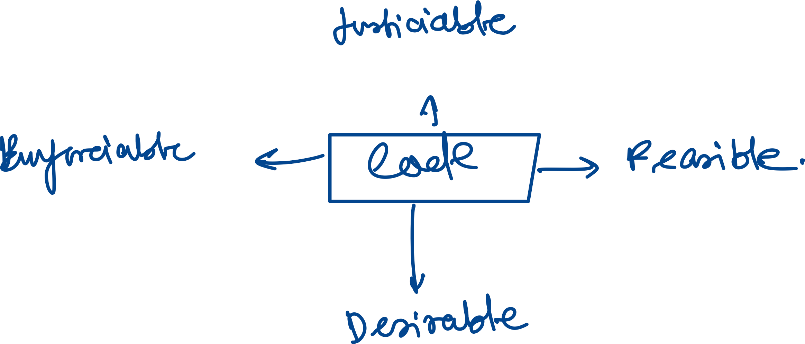
- Codes of ethics for civil servants
- Personal responsibility
- Compliance with law
- Limitation on acceptance of gift, rewards.
- Limitation on political activities
- Confidentiality
- Build public trust
- Manage conflict of interest - professionally and personally
- Public interest is supreme
- Disclose any clash of interest
- Financial prudence
- Accountability to citizen’s
- Non abuse of official position
- Issues
- No Mention/framework of code of ethics in AIS(conduct) rule 1964
| Code of Ethics | Code of Conduct |
|---|---|
| Aspirational document Contains core ethical values and principles | Directional document Contains specific practices and behaviors |
| Broad context Guide moral decision making | Narrow context For day-to-day behaviour |
| Not enforced relies on persuasion and social influence | Enforceable Attract disciplinary measures for violations |
| Designed to promote ethics Integrity, objectivity, rationality | Designed to protect wrong Corruption, giving/receiving inappropriate gifts |
| Abstract Philosophical in nature | Concrete Contains specific prescription |
| Ex. Hippocratic oath for doctors Ex. Corporate values | Ex. Medical guidelines Ex. Employee handbook |
- Public service code
- Is a comprehensive set of guidelines for governing conduct and functioning of public services.
- Key features ( 2nd ARC 10th Report)
- Public service values : IOSHOLA
- Clearly outlined code of ethics and conduct
- Provisions for punishment for transgression
- Preventive measures for malicious complaints against civil servants
- Issues in implementation
- Implementation Hurdles : Resistance from bureaucracy
- Lack of political will
- Monitoring mechanism : under limited capacity and human resources
- Rigidity : can adversely impact situational decision making
- E.g. crisis management
- Full implementation of PSC is essential to address challenges of public sector.
- Benefits of discipline
- Orderly and smooth functioning
- Because predictable environment
- Accountability and performance
- Non compliance may attract sanctions
- Teamwork
- Discipline establish trust and respect
- Efficiency
- Because of standardized procedures
- Orderly and smooth functioning
- Limitations of excessive discipline
- Can impede creativity, risk-taking
- Reduce morale and engagement
- Employee feels like cog in a machine
- Poor decision-making
- Overreliance on orders can hinder independent thinking
- Conflicts and resistance
- Excessive control and micromanagement can breed resentment
- Finding Balance
- Outcome orientation
- Allowing flexibility and encouraging ownership
- Promote autonomy in decision making
- Open communication
- Encouraging employees to voice concerns and suggesting reforms
- Outcome orientation
- In conclusion, while discipline is a valuable tool, it needs to applied thoughtfully by finding right balance.
- Both documents are essential for promoting a positive and responsible work environment
Conflict of Interest
- Conflict of interest - a situation in which a person is in a position to derive personal benefits from decisions made in official capacity.
- Types
- Financial conflict
- E.g. CHANDA KOCHHAR lending to Videocon
- Non-financial conflict
- Conflict of roles
- Official duties
- Private interests
- Public interest
- Financial conflict
- Ways it manifest in decision making
- Awarding contracts
- Policy decisions
- Resource allocation
- Conflicting responsibility
- Conflict in values
- Causes
- Conflict in moral values
- Evicting ST’s from their land due to pressure from high authority
- Family interest
- Framing policies to benefit family business
- Financial interest
- Company offering financial benefits to lobby for a policy
- Conflicting responsibility
- Civil servant given additional charges with conflicting responsibility
- E.g. mining and environment conservation portfolio
- Outside pressure
- From a political party
- Conflicting organization
- Civil servant being part of development work that has to clear trees, but also part of environmental NGO
- Lack of awareness
- Giving loans or contracts without knowing stakeholders
- Conflict in moral values
| Actual | Potential |
|---|---|
| personal interest already impacted the professional duty | Possibility of impacting |
| Ethical values are compromised | Ethical values in position to get compromised |
| Requires immediate action May involve disciplinary measures | Requires mitigation strategies E.g. recusal, disclosing, appointing neutral decision maker |
| Ex. A teacher using their school time for private tuition. | E.g. Justice U.U. LALIT recused himself from Ayodhya case because of previous involvement as a lawyer. |
| Ex. Social media influencer promoting company they have invested in. |
- How to resolve
- Identify potential COI
- Background checks
- Suo moto disclosure of COI
- Distance/Recusing oneself from apparent COI
- Seeking help of neutral third party
- Enhance objectivity
- Active oversight
- Punitive measures for non disclosure
- Identify potential COI
- Way forward
- 2nd ARC - Ethics in governance - codify conflict of interests to help civil servants to navigate them effectively.
- Organizations should codify conflict of interests to ensure ethical conduct and minimize the risk of harm.
1. Probity in Governance
- Introduction
- A government is good when it aims at well being of whole community, bad when it aim’s at it’s own good. -ARISTOTLE
- Probity - it is the quality of having strong moral principles and strictly following them. It is integrity, honesty and commitment to public good.
- Probity in governance is procedural uprightness. It means following ethics in governance and allowing actions and decisions to withstand public scrutiny.
- Need of probity in governance - REDCARPET
- Principles of probity - IO-SHOLA
- Difficulties in practicing probity in present times
- Pressure to deliver [neoliberal paradigm]
- Political fragmentation and polarization : making it difficult for public officials to act objectively and prioritize the common good over partisan interests.
- Pressure groups : lobbying activities can influence decision making that benefits broader public good.
- Social media : misinformation can cloud judgement making it harder to understand truth
- Economic pressure : financial hardship, personal ambitions can tempt public officials to compromise their principles
- Significance
- Build trust in state institutions
- E.g. ECI
- Enhancing Credibility and Legitimacy
- E.g. Social Audit mechanisms
- Upholding public trust
- E.g. RTI Act, 2005
- Leads to good governance
- E.g. T.N. SHESHAN’s in electoral reforms
- Helps in checking abuse and misuse of power and discretion
- E.g. Lokpal and Lokayukta Act of 2013 instills independent oversight over public officials
- Leads to better service delivery
- E.g. E. SHREEDHARAN commitment of time bound completion of Delhi Metro
- Fair and equitable distribution of resources
- Institutional integrity
- Promoting social welfare
- E.g.
- Societal expectation
- Develop confidence in investors
- Build trust in state institutions
- Issue in India
- lack of will, lack of discipline
- GUNNAR MYRDAL - ‘soft society’
- lack of will, lack of discipline
- Development trap - F.W. RIGGS
- Failure to provide Capacity, differential treatment, equality
- Development Decay - S. HUNTINGTON
- Political system becomes ineffective - corruption, lack of accountability, erosion of legitimacy.
- Measures
- Define Clear Ethical Standards
- Code of ethics (2nd ARC)
- Transparency and Disclosure
- RTI, Citizen’s charter
- Robust Accountability Mechanism -
- Internal Committees, CVC, CIC, Lokpal
- E-government initiatives
- PRAGATI, NeGP, Probity portal, e-HRMS 2.0 portal
- Promoting Work culture of Integrity
- Public participation
- Social audit, civil society
- Protecting whistleblowers
- Forming safe channels for reporting corruption
- Effectively enforce Code of conduct
- Biometric monitoring, lateral entry
- Define Clear Ethical Standards
- Way forward
- NCRWC ‘probity in governance
- Focus on Legal, procedural aspects
- TSR SUBRAMANIAN case - Civil service board
- NCRWC ‘probity in governance
- Conclusion
- Probity is vital ingredient for building a society where everyone can thrive.
- We should strive towards a society where probity becomes a way of life, honesty becomes a routine expectation.
Concept of Public Service
- ARISTOTLE states, “A political society exists for the sake of noble actions, not mere companionship. It embodies the theoretical concept of expanding public interest.”
- A public service is a service which is provided by the government to people living within its jurisdiction
- Key aspects of public service include:
- Commitment to the public interest
- Provision of essential services
- Service-oriented mindset
- Collaboration and partnerships
- Professionalism and competence
Citizen’s Charter
Transparency
In Government
Right To Information
Work Culture
- Work culture refers to the collective values that exist within an organization, influencing the overall work environment.
- Significance of WC
- Employee satisfaction
- Retains talent
- Productivity and performance
- E.g. spurs to go extra mile
- Build networks and team collaboration
- Based on Mutual trust
- Induce Innovation and Creativity
- Because of freedom of expression
- Conducive emotional environment at workplace
- E.g. prevent anxiety, depression
- Inclusivity and women’s safety
- Because of diversity and inclusivity
- Sustainable financial performance
- Maintain investor and shareholders confidence
- Employee satisfaction
- Work from home
- Positives
- Retention
- Bigger talent pool
- Productivity
- Telecommunication
- Negatives
- Communication gap
- Anxiety
- Mutual trust, connection and mutual purpose
- Positives
| Coercion | Undue influence |
|---|---|
| explicit threats or intimidation E.g. threat of transfer | is a form of manipulation that exploits trust E.g. familial influence to leak sensitive information for personal gains |
| overt/explicit in nature | subtle/implicit |
| Creates hostile and fear-driven work culture - Threatening to fire | can undermine fair decision-making - E.g. luring for promotion |
| Can erode trust and damage morale | can lead to biased practices, and conflicts of interest |
- Measures
- Explicit core values
- Code of ethics, code of conduct, citizen’s charter
- Improve transparency, accountability and feedback mechanisms
- Internal Complaints Committee
- Establishing system of checks
- Explicit core values
Quality of Service Delivery
- Introduction
- “The quality of a nation’s public service delivery reflects its commitment to the well-being and progress of its citizens”
- Significance
- Issues in effective public service delivery
- Mismanagement : can delay crucial services, waste resources
- Bureaucratic attitude : leads to slow decision-making
- Avg. 59 months for land acquisition
- Erosion of trust
- Not prioritize their well-being of citizens erode public trust
- Capacity constraints : lead to ineffective solutions
- Overburdened public servants have limited capacity to deal with multitude of core issues.
- Corruption :
- Secrecy
- Government Initiative
- Lokpal
- E-governance
- National e-governance plan (NGeP)
- Government e-marketplace (GeM)
- PRAGATI Initiative
- How to increase quality of service delivery?
- Focus on citizens needs
- Participatory planning and policy formulation - Kerala
- E-governance
- Establish independent regulatory mechanism
- Encouraging reward and good work
- Feedback Mechanism
- DISHA - Gujarat for tribal areas
- Social accountability
- Community scorecard - Maharashtra, AP
- Performance-based Incentives
- Social audits
- Ex - AP and Meghalaya
- Focus on citizens needs
- Balance between core issues and peripheral issues
- Prioritization : identify core issues that are most significant
- Data-driven decision-making : utilize modern tools for making informed decisions
- Open communication : with stakeholders to understand their concerns and provide solution
Utilization of Public Funds
- “The true measure of a society’s progress is how wisely and effectively it utilizes its public funds.” - JOHN F. KENNEDY
- Significance
- Reasons for underutilization
- Lengthy approval processes, red tape : due to excessive legal and compliance burden
- Inadequate planning
- Lack of Capacity
- Reasons for misutilization
- Political Interference
- Lack of accountability
- Corruption and other form of financial misconducts
- Weak Monitoring and Oversight
- Lack of Public Awareness and Participation
- Implication
- Missed Development Opportunities :
- For development goals like poverty reduction, healthcare, infrastructure development
- Loss of Public Trust and Confidence
- Limits economic growth - create vicious cycle of financial obligations
- Debt/GDP - 83%
- Missed Development Opportunities :
- Way forward
- Strengthening Financial Management system
- CAG
- Public fund management system (PFMS)
- DBT, FRBM use of JAM
- Promote citizen engagement
- Social audits
- Open government initiatives
- E-governance
- E2E E-procurement and single window administrative mechanisms
- Strengthening Financial Management system
- Conclusion
- “Utilizing public funds responsibly is a commitment to ensuring that every rupee spent delivers maximum value and benefits to the people”
Challenges of Corruption
- Introduction
- Word bank - “Corruption is the abuse of public funds or office for private or political gains.”
- According to 2nd ARC 4th Report - Corruption is a manifestation of the failure of the ethics and value system in society.
- According to Transparency International, India was 85 among 180 countries in the corruption perception index 2022.
- I sincerely believe in the words of DR. A.P.J. ABDUL KALAM. Corruption which is misuse of public office or position for personal gain is manifestation of erosion of ethics. For a society to become corruption free ethical development is of paramount importance.
- Causes of corruption
- Institutional
- Lack of Transparency and accountability
- Coal and Fodder Scam
- Weak law enforcement : does not create legal deterrence
- GUNNAR MYRDAL - calling India as ‘Soft State’
- Over centralisation of administrative system
- Legacy of colonial rule
- Unregulated electoral funding
- electoral bonds provisions without public disclosure
- Lack of Transparency and accountability
- Individual
- Greed and Self-Interest
- The Panama Papers leak exposed tax evasions
- Erosion of ethical values
- Corruption to bypass bureaucratic hurdles and obtain essential resources.
- Greed and Self-Interest
- Societal acceptance : considers corruption as way of doing things
- E.g. bribing RTO officials to expedite process is considered necessary
- Systemic and Structural Issues:
- weak institutions, inadequate legal frameworks, and poor enforcement of laws.
- Institutional
- Impact
- Erosion of Public Trust
- Undermine legitimacy of government
- Weaken democratic processes
- Impaired public service delivery
- Health, education, infrastructure development
- Criminalization of politics
- E.g. 43% criminal records; 29% serious charges - PRS Research
- Vohra committee report highlight P-B-C nexus
- Environment degradation
- illegal exploitation of natural resources, unauthorized construction
- Economic inequality
- E.g. 10% have 80% wealth - Oxfam
- Discourage Investment
- E.g. 85/180 in corruption perception index
- Undermine fair competition
- E.g. monopolization, license raj
- Loss of morale and motivation
- Discourage honest public servants
- Erosion of Public Trust
- Two types
- small level - people are forced to pay for the job otherwise entitled - plays bigger role in perception formation of corrupt country.
- E.g. bribe taken by police in passport verification
- high level - where affluent and powerful people get substantial gain as an act of corruption
- E.g. 2G Scam
- small level - people are forced to pay for the job otherwise entitled - plays bigger role in perception formation of corrupt country.
- Government measures
- RTI Act, 2005
- Issue : huge backlog, delay in reply, limited Suo-moto disclosure
- Solutions : adherence to time limit; digitization of information
- Prevention of corruption act, 1988
- Issue : huge backlog of cases in CAT
- Solution : time bound clearance of cases; efficient enforcement
- Lokpal Act, 2013
- Issue - appointment, functioning and capacity
- Solution - reducing dependence for funds, functions and functionaries
- Code of conduct
- Issue - poor enforcement mechanisms
- Solution - monitoring and disciplinary action for transgression
- Active Media
- Issue : lack of investigative journalism; lack of protection
- Solution : freedom of press; measures against retaliation by government
- RTI Act, 2005
- Benami transactions prohibition amendment act, 2016
- Citizen charter, Social Audit
- Open governance initiative - PAHAL, DBT, PRAGATI Portal
- Way Forward
- Value based education
- Ramamurthy committee - emphasize moral education in schools
- Transparency and accountability
- Lokpal, Social Audits, Citizens Charter
- Strengthening POA Act, 1988
- 2nd ARC suggests to include
- Abuse of authority
- Obstruction of justice
- 2nd ARC suggests to include
- E-governance
- E.g. - E-Auctions, DBT, Cashless transaction etc.
- Whistle blower’s protection
- Ensuring confidentiality
- Cover corporate whistleblowers
- Time bound grievance redressal mechanism
- E.g. RTI Act
- Administrative reforms
- In training, posting, transfers.
- International cooperation to fight transnational corruption
- United Nations Convention against Corruption (UNCAC)
- E.g. M-Pesa in African Countries
- Empowering CBI
- granting greater autonomy, resources, and investigative powers
- Regulatory frameworks
- Code of ethics and code of conduct
- Administrative decentralization with proper monitoring checks and balances
- Work culture of Integrity
- Ethical and spiritual training sessions
- Primary socialisation
- Teaching ethical values in parenting
- Value based education
- Conclusion
- By addressing the causes and implementing solutions, we can move towards a society where ethical conduct prevails.
- Corruption thrives in the shadows of secrecy. Shedding light on it is our collective responsibility
Whistleblowing
- Introduction
- Whistleblowing means exposes wrongdoing or corruption within a organisation or system.
- Examples
- SATYENDRA DUBEY, an IES officer
- exposed corruption and illegal activities in NH2 construction
- tragically lost his life
- MANJUNATH SHANMUGAM
- exposed the large-scale adulteration of petrol
- murdered in 2005 by the petrol pump owner
- EDWARD SNOWDEN
- Exposed NSA collection of personal data of citizens
- Led to termination of program under USA Freedom Act
- SATYENDRA DUBEY, an IES officer
- Challenges for whistle-blowers
- Lack of Protections against retaliation
- Face consequences like job loss, demotion, or harassment
- Lack of legal protection
- Deters whistleblowers to expose wrongdoings
- Limited Anonymity
- Lead to social stigma
- Reputational Damage
- character assassination, marginalization by co-workers
- Emotional and Psychological Impact - mental health, anxiety, and trauma.
- Lack of Protections against retaliation
- Measures
- Whistleblower protection laws
- Whistleblower Protection Act, 2014
- Confidential Reporting Channels
- E.g. Reform Lokpal
- Public appreciation
- Crusade against corruption awards
- Independent Oversight and Investigation
- E.g. CVC, CBI
- International Collaboration
- E.g. MNC misconduct
- Promoting conducive work environment
- E-office
- Dedication to public service
- Whistleblower protection laws
- Conclusion
- NEERAJ DUTTA Case, 2022
Corporate Governance
- Corporate governance refers to the system of rules, practices, and processes by which companies are directed and controlled.
- “Good corporate governance is about leadership, integrity, and responsibility, all working together for the benefit of stakeholders.” - WARREN BUFFETT

- Ethical cooperate governance
- Cooperate social responsibility
- ITC is operating around 2500 learning centers.
- Adopting Fair market practices
- Refraining from anti competitive activities
- Unilever’s “Sustainable Living Plan”
- Addressing environmental concern
- Railways - carbon neutral by 2030
- Strict adherence to laws and regulation
- Code of conduct
- Respecting diversity and promoting inclusivity
- TATA’s plan for LGBT+ inclusion in workforce
- Cooperate social responsibility
- Efficient cooperate governance
- Competent leaders and efficient teams
- NARAYAN MURTHY - Infosys
- Risk management
- HDFC Bank risk management framework
- Innovation and technology
- Reliance Jio in 4G rollout
- Efficient resource utilisation
- Apple - using recycled aluminium
- Competent leaders and efficient teams
- Issues
- Social
- Discrimination
- 5% women CEO’s in India(Deloitte)
- Sexism in workplace
- False and misleading claims
- Volkswagen’s emission scandal
- Discrimination
- Governance
- Nepotism and favoritism
- E.g. Satyam and Sahara scandal
- Unfair market practices
- E.g. Sun Pharma Insider Trading Case
- Poor risk management
- E.g. Nirav Modi case - PNB
- Lack of internal audit, statutory audit
- E.g. CHANDA KOCHHAR - ICICI
- Anti competitive practices : predatory pricing
- E.g. e-commerce like Amazon, Flipkart
- Nepotism and favoritism
- Environment pollution
- E.g. mining and thermal power
- Social
- Measures
- Stakeholder participation - Ownership and control to shareholders
- Ethical leadership
- Independent BOD
- Inclusivity
- E.g. Norway mandated 40% board representation to other genders
- Checks and balances
- To prevent misuse and abuse of powers and information
- Grievance redressal mechanism
- Compassionate capitalism
- NARAYAN MURTHY
- Conclusion
- Good cooperate governance can ensure sustainable growth which entails planet, people and profit.

Corporate Social Responsibility
- Corporate Social Responsibility (CSR) refers to the ethical obligation of companies to contribute to societal welfare beyond their profit motives.
- “CSR is not a mere gesture, but a way of doing business responsibly and sustainably.” -NARAYANA MURTHY
- Mandate
- The CSR concept in India is governed by Section 135 of the Companies Act, 2013.
- mandates companies with net profit greater than 5 crore to contribute 2% average profit for last 3 years.
- Or, If a company’s net worth is Rs. 500 crore
- Or, If Companies with an annual turnover of Rs. 1000 crore
- The CSR concept in India is governed by Section 135 of the Companies Act, 2013.
- Cooperate ethics
- GANDHI’s Trusteeship Model
- Economic Survey - Ethical wealth creation
- Example
- Negative
- Bhopal Gas Tragedy - Union Carbide
- Large scale deforestation for production of Palm oil.
- Toxic cough syrup allegedly killed 70 children’s in Gambia
- Positive
- TATA - Compassionate capitalism
- Patent pooling
- Taj employees evacuating hostages during 26/11
- Village transformation mission Maharashtra - Deutsche Bank, Tata Trust, HUL
- Apple’s commitment to be carbon neutral by 2030
- Mahindra’s “Rise for Good” initiative
- Unilever’s “Project Shakti”
- Negative
- In contemporary world, corporate sector’s contribution in generating wealth and employment is increasing. In doing so, they are bringing in unprecedented onslaught on the climate, environmental sustainability and living conditions of human beings. In this background, do you Responsibility (CSR) is efficient and sufficient enough to fulfill the social roles and responsibilities needed in the corporate work mandated? Critically examine.
- Effectiveness of CSR
- Positive Impact on communities
- Enhance companies reputation
- Employee engagement
- Limitations and criticism
- Effectiveness of CSR
- Positive role of CSR
- Benefits
- Makes companies more profitable
- Enhanced Brand Image
- Tata Group high reputation
- Customer Loyalty and Retention
- Employee Engagement and Productivity
- Positive work culture
- Makes them sustainable
- Resilience in long term
- Reduce the intergenerational inequality
- Promote inclusive growth
- Build social capital
- E.g. Tata Group
- Reduce the carbon footprint and capacity building for sustainable long term business.
- Short term pain on profits but fruitful dividends for years to come.
- Issues
- Skewed expense : 44% towards education and only 6% towards poverty and hunger
- Geographical Bias : Maharashtra and Karnataka almost account for 60% of CSR funds.
- Greenwashing CSR activities
- E.g. H&M’s environment scorecard
- Sportswashing
- E.g. FIFA world cup 2022, Qatar
- Short term and ad-hoc plans
- Lack of accountability
- Corporate - NGO nexus
- Way forward
- Bottom up approach -
- Due diligence, disclosure norms
- Social impact assessment
- CSR -> CSV (Creating social value)
- Uday Kotak Committee
- Conclusion
- Following recommendations of NARAYAN MURTHY Committee, CSR can pave way for compassionate capitalism.
- As HENRY DAVID THOREAU said - “Goodness is the only investment that never fails”.
Social Capital
-
Social capital refers to the networks, norms, and trust that exist within a community
-
Improve governance
-
Conflict of interest
- Register the details
- Restrict the involvement
- Recruit the 3rd party
- Remove the person
- Relinquish one the intention
- Resign as last resort
-
Measure
- Immediate action
- Action that will bear fruit in long term
- Extrapolating with inclusion of others having similar issues
- Prevention measures
- Detention measures
-
Point of Contacts
- Departmental bodies
- Organizational bodies
- State level bodies
- National level bodies
- Grievance redressal mechanism - ombudsman (Lokpal Lokayuktas)
-
When a law is justified
- Appropriate authority
- Common good
- Physically and morally possible
- Conform to natural law
- Without favor or ill will
-
Line फ़ेक के मारो
- A Humane approach is more reformatory and effective then a purely retributive approach.
-
Alternative to layoff
- Job sharing
- Part time work
- Voluntary layoff
- Approved leave without payoff
- Severance package
Case Studies Framework
Ethical dillemma
| Public institutions | |
|---|---|
| Integrity | Objectivity | Empathy | Accountability | Huge Profit (any gains) | Professional pressure (political pressure) | Confidentiality | Career Advancement | |
| Personal Values (FORTH COMING JUDICIAL) | Professional Ethics <> unjustified order of superior |
| Personal values | Seniors directives |
| Transparency | Accountability | confidentiality | security |
| Self Preservation | Integrity | conscientiousness |
| Individual consequentialism | State consequentialism, society consequentialism |
| Individual’s Interest | Public interest <> Sectarian Interest |
| Loyalty to family | Loyalty to profession |
| Social Justice | Development [Development trap] |
| Environmentalism | Development |
| Strict enforcement | Compassionate governance |
| Competing accountability towards dept vs society | |
| Moral duty | Fear of retaliation |
| Compassion | Objectivity |
| Compassion | Accountability |
| Fairness | Precedent |
| Legal adherence | Moral duty |
| Humanitarian aspect | public interest | Laws and Rules [legal positivism] |
| Conscience | Rule and Laws |
| Constitutional principles | Social morality [Prismatic societies] |
| Efficiency | Accountability | Responsibility | accuracy |
| Deontology (procedure) | Utilitarianism (outcome) |
| Means | Ends |
| Private institutions | |
| Business Interest | Profit | Social <> Environmental Responsibilities |
| Economic growth | Equity | Environment |
| Employee welfare | Labour practices |
| - fair compensation, working conditions | |
| work-life balance | cost-cutting measures |
| Transparency | competitive edge |
| Following regulation | finding back door escape clauses |
| Consumer rights | product safety |
| disclosure of potential risks | product safety, quality |
| consumer rights and public trust. | ethical marketing practices |
| protecting proprietary information | fostering creativity with knowledge-sharing |
| short term motive (output) | Long term sustainability (productivity) |
| Others | |
| Financial constraint | Needs of … (mention deontological ethics) |
| Self preservation | Justice |
- Truth vs. Career
- Justice vs. Expediency
- Moral integrity vs. Complicity
- Professionalism vs. Self-Promotion:
- Bureaucratic Anonymity vs. Public Presence:
- Transparency vs. Security:
- Public Service vs. Personal Ambitions:
- Violation of the rights of …
- Conflict of Interest
- Sustainable business practice
- Maintaining trust and credibility
- Bribery and corruption
- Neglect of public welfare
- GANDHI’s 7 sins (WPKCSRP)
- Wealth without work
- Pleasure without consciousness
- Knowledge without character
- Commerce without morality
- Science without humanity
- Religion without sacrifice
- Politics without principles
- Antithetical to creating a egalitarian society
- Antithetical to constitutional values
- Article फ़लाना धीमका
- Principles of natural justice
- Whistleblower Protection
- journalistic integrity
- Applied ethics
- Against conduct rules, 1964
- Rule 3(1) - unbecoming of member of service
- Breach of confidentiality
- Poverty, inequality and discrimination
- Fairness, transparency, justice
- Proportionality principle
- Between different values of public administration
- Political motivations rather than sound economic or social reasons.
- Ethical issues
- Integrity Violation
- Corruption
- Neglect of Duty
- Injustice
- Abuse of Power
- Ethical issues in social media
- Privacy Violation
- Cyberbullying
- Psychological impact on mental health
- Ethicality of retaliation
- Permanent digital footprint
- Private Institutions
- conflicts of interest, accurate financial reporting, and ethical decision-making
- Supply chain ethics
- Ensuring responsible sourcing, fair trade, and preventing human rights abuses.
- Preventing weaponization
- Labour law violation
- Data privacy
- leveraging data for business purposes while respecting privacy rights
- Intellectual property and innovation
- Conflict between 3 factors
- Profit
- Society
- Environment
- Introductions
- Article 36 - duty of state to implement DPSP, ----
- Subject matter :
- Conclusion
- balancing ethical principles with practical considerations
-
Stakeholders -
- Level analysis
-
Dimensions - SPECIALTY
| Option |
|---|
| Comply |
| Refuse |
| Ignore |
| Report |
| Resign in Protest |
| Seek/Solicit Advice from (trusted colleagues | friends | seniors | legal expert | psychological) |
| Seek Transfer |
4. Raise Awareness round. - Recommend an independent inquiry - Take time to reflect - Internal audit - Public apology - Leak the information anonymously - Engage with civil society |
| Alternative measures - Dialogue, mediation, - negotiation - to find a middle ground |
| Merit | Demerit |
|---|
| Flow words good - JUSTIFIED |
| 1. Justified |
| 2. Upheld |
| 3. Supported |
| 4. Sustained |
| 5. Endorsed |
| 6. Confirmed Integrity |
| 7. Reinforced |
| 8. Maintained objectivity |
| 9. Validated |
| 10. Backed |
| 11. Preserved probity |
| 12. Affirmed |
| Flow words bad - JUSTIFIED |
| 1. Jeopardized |
| 2. Undermined institutional integrity |
| 3. Unreliability |
| 4. Undercut |
| 5. Subverted |
| 6. Sabotaged |
| 7. Impaired |
| 8. Fragility |
| 9. Eroded public trust |
| 10. Degraded |
| 11. Diminished |
| 12. Disrupted |
| 13. Deteriorated |
| 14. Endangered |
| 15. Weakened democratic functioning |
| 16. Compromised |
| 17. Abandoned |
| Personal benefit / consequences |
| Professional benefit / consequences |
| Collegiality compromised |
| Justice denied |
| Integrity |
| Right Precedence |
| Crisis of conscience |
| Loss of credibility and self-respect |
| Accountability |
| Transparency and impartiality |
| Abdicating my responsibility |
| Dereliction of my duty |
| Avoiding Confrontation |
| Undermines my credibility |
| Adhering to rules |
| Delay | dilatory |
| Unsympathetic |
| Leaving Vulnerable to abuse and exploitation |
| Not address humanitarian aspects of the case |
| Not addressing unethical behavior |
| Means of last resort |
| No other credible alternative |
| Zero sum game |
| Violation of mutual consent |
| Good books of seniors | mentors |
| Escalation of conflict |
| Risk of suppression |
- Bring ignominy to organisation
Special words
- Upholds Nolan principles of public life
- Against code of ethics/conduct
- Violate Utilitarian principle
- Consequential principle
- Contextual ethics
- Violate GANDHI’s Talisman
- KAUTILYA’s Matsya Nyaya
- Law-based ethics
- Ethical voluntarism
- Desert ethics
- Ethics of entitlement [ROBERT NOZICK]
- Virtue ethics
- Antithetical to constitutional values
- Article …
- Violate law
- …
- Against C.S. Conduct Rules, 1964
- Rule 3(1) - unbecoming of member of service
- Such quid pro quo is violation of public trust.
- plead plausible deniability
- Categorical imperative
- avoids extreme decisions
- mitigates future risks
- BUDDHA’s Middle Path
- Aristotelian golden mean
- Distributive justice
- Democratic values
- Constitutional morality
- Social contract
- Clear conscience
- BUDDHA’s Madhyam Marg (middle path)
- Stakeholder capitalism
- Compassionate capitalism
- Swaraj
- Sarvodaya
- Swadeshi
- Satyagraha
- Non violence
- Trusteeship
- Overlapping consensus
- Civic sense
- Bhakti saints like …
- Principle of subsidiarity
- Virtue in action
- Justice through functional specialization
- Teleology of ethical governance
- creating a race to the bottom
- Tragedy of commons (GARRET HARDIN)
- Environmental Impact Assessment | (EIA), Social Impact Assessment (SIA).
-
Course of action
- Conscience test - अंतरात्मा की आवाज़
- Mirror test - Is this the kind of person you want to become
- Publicity test - will it be right in public knowledge?
- Seek Whistleblower Protection [approach higher authorities or CVC]
-
Body
- Least favored options - write first
- Most favored or suggested options - write last
-
Conclusion
- Address systemic issue (work culture, internal audit, social audit)
- Long term Visionary and action plan
- Conflict of interest
- Register the details
- Restrict the involvement
- Recruit the 3rd party
- Remove the person
- Relinquish one the intention
- Resign as last resort
- Measure
- Immediate action
- Action that will bear fruit in long term
- Extrapolating with inclusion of others having similar issues
- Prevention measures
- Detention measures
- Point of Contacts
- Departmental bodies
- Organizational bodies
- State level bodies
- National level bodies
- Grievance redressal mechanism - ombudsman (Lokpal Lokayuktas)
- When a law is justified
- Appropriate authority
- Common good
- Physically and morally possible
- Conform to natural law
- Without favor or ill will
- Line फ़ेक के मारो
- A Humane approach is more reformatory and effective then a purely retributive approach.
- Alternative to layoff
- Job sharing
- Part time work
- Voluntary layoff
- Approved leave without payoff
- Severance package
Vocab
| 1st/2nd/3rd Point of Contact/support |
| Attitudinal change |
| Anti-corruption agency |
| Breach of trust |
| Counseling |
| Conduct rules |
| Conflict resolution training |
| Communication skills |
| Compliance |
| Cumulative effect |
| Divide and rule |
| Emotional Support |
| Ethical conduct is not just about achieving tangible outcomes |
| Feedback mechanism |
| Favouritism |
| Fairness and proportionality |
| Human Resources |
| Impartial, honest and objective assessment |
| Integrity of the process |
| Informed decision |
| Inventory management system |
| Internal audits |
| Involve the community in the decision-making process |
| Law enforcement agencies ( |
| Leadership development |
| Morale and Motivation |
| Meditation |
| Memoirs |
| Merit based process |
| Populist polices |
| Policy paralysis |
| Psychological support |
| Professional attitude |
| Public interest |
| Rulebook |
| Reputation and integrity of the company/dept |
| Maintain rule of law |
| Speak up |
| Social impact assessment |
| Stress management techniques |
| Severance package |
| Setting boundaries |
| Therapy |
| Top down approach <> Bottom up approach |
| Procedural justice |
| Resource egalitarianism |
| Undermine my authority as the head |
| Siphoning |