- Confucius -> CONFUCIUS
- Amartya Sen -> AMARTYA SEN -```markdown
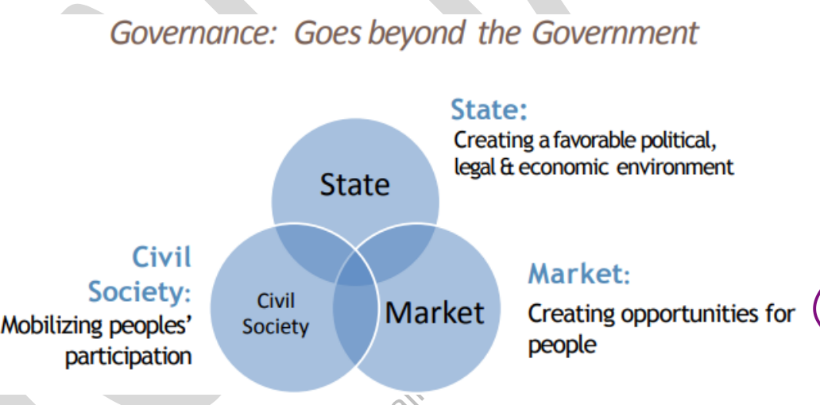
Governance
- Introduction
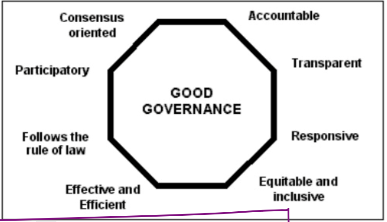
- UNDP defines governance as “The exercise of economic, political and administrative authority in management of country’s affairs.”
- “Good governance is the foundation for progress, prosperity, and a just society.” - KOFI ANNAN
- Quotes
- No state becomes great by dwarfing it’s own people. -MILL
- Governance include
- Government institutions
- civil society organizations
- private sector entities
- Good Governance
- Aspects - as per UNITED NATIONS DEVELOPMENT PROGRAM (UNDP)

- REDCARPET
- Responsible
- Efficient, Effective, Evidence Based
- Democratic
- Consensus Based - Legitimate
- Accountability
- Rule Based
- Participatory
- Equitable
- Transparent
- Barriers
- Pre conditions
- How to ensure
- Minimum government, Maximum governance
- Office automation
- Data analytics, AI and ML
- Bureaucratic hurdles
- Aspects - as per UNITED NATIONS DEVELOPMENT PROGRAM (UNDP)
- Government initiatives
- Trust based governance
- Paperless governance
- JAN VISHWAS BILL
- PRASHASAN GAON KI ORE 2022
- Good Governance Index
- Trust based governance
- Conclusion
- सबका साथ सबका विकास सबका विश्वास सबका प्रयास
- Righteousness is the foundation stone of peace and good governance. -CONFUCIUS
- Simple, moral, accountable, responsive, transparent (SMART) governance
Government policies: Issues & Suggestions
- General Issues
- FLUX
- Freebies
- Leakages and misappropriations
- Underutilization
- Exclusion and Inclusion Errors
- Culture of impunity
- Administrative apathy
- Conflict of interest
- FLUX
- General suggestions
- Rationalization of government spending
- Targeted and agile delivery
- Focus on capacity building
- Direct benefit Transfers
- Presently 315 schemes of 53 ministries are under DBT, saved 2.23 lakh crores.
- Advantages
- Targeted and efficient delivery
- minimizes the chances of diversion or misappropriation of funds.
- Reduced leakages: benefits reach the intended beneficiaries directly
- Transparency and Accountability
- Reduced Administrative Burden and cost saving by removing intermediate red tape
- Financial inclusion: encourage beneficiaries to maintain bank accounts
- Flexibility and Choice
- Data for Policy Planning
- evidence-based policy planning, program evaluation, and targeted interventions.
- Targeted and efficient delivery
- Limitation
- Digital divide: lack of digital literacy
- Exclusion errors: especially of some vulnerable sections
- Inadequate internet connectivity
- Power supply issues
- Technical glitches
- Lack of financial literacy
- Limited access to formal banking services
- Capacity constraints - administrative infrastructure, data management, monitoring, and grievance redressal.
- Trigger inflation
- Unfair market practices - hoarding and storage
- Sectors
- Poverty
- Hunger
- Health and Well Being
- Education
- Gender
- Clean water and sanitation
- Energy
- Decent Work and Economy growth
- MGNREGS
- SKILL INDIA
- Industries, Infrastructure and Innovation
- DIGITAL INDIA
- STARTUP INDIA
- Inequality
- PM जन धन योजना - Financial Inclusion
- STAND UP INDIA
- Cities and communities
- SMART CITY
- स्वछ भारत अभियान
- Production and consumption
- MAKE IN INDIA
- Climate action
- Life below water
- Life on land
- Peace, justice and institutions
Development Process and Development Industry
- Introduction
- PROF. AMARTYA SEN says, development means ‘expansion of human freedoms’, i.e. enhancement of the capacity of individuals to fully lead the ‘kind of lives they value’.
- Economic goals and social goals
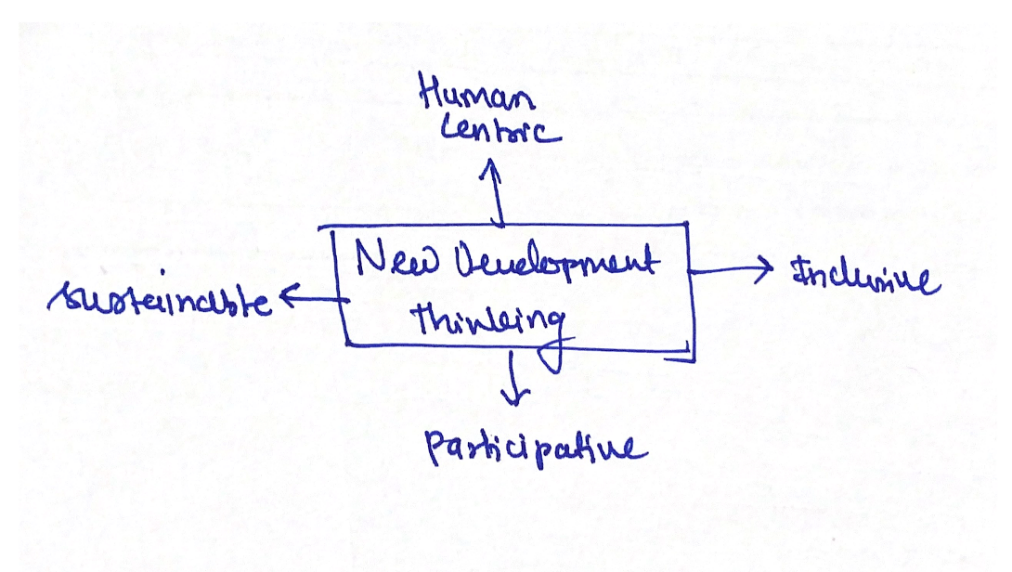
- New development thinking - HIPS
- Human centric
- Inclusive
- Participatory
- Sustainable
- Issues with doner dependency in development
- Top-Down Approach: sideline local needs and governance
- Alignment with Donor Priorities rather then community needs
- E.g. overemphasis on health and education by NGOs in India
- create a dependency syndrome preventing them to become self-reliant
- Sustainability challenge when the funding period ends
- E.g. halted infrastructural projects
- Focus on quantifiable results could overlook qualitative aspects of community development
- Advantage of doner agencies
- Provide essential resource that would be otherwise unavailable
- E.g. funding for infra projects by WORLD BANK
- Bring in expertise and innovative approaches
- E.g. advanced agricultural techniques by SWADESH FOUNDATION
- Flexible approach that might be unconventional for government agencies
- NGO PRATHAM “Teaching at the Right Level” approach effectiveness in improving literacy
- Act as a catalyst encouraging further investment and participation from other stakeholders
- Targeted delivery: focus on specific issues or populations
- NGO GOONJ addressing poverty through redistribution of urban waste
- Fill the governance gap
- Relief work during natural disasters - RED CROSS
- Provide essential resource that would be otherwise unavailable
- Way forward
- Promote collaboration between all stakeholders
- Local capacity building in technical expertise and project execution
- Prioritizing local needs
- Various Civil society organisation and their Role
- They are voluntary, not-for-profit organisations, for promoting public welfare and social cause.
- E.g. NGO, SHG, Philanthropic organisation etc.
- They are voluntary, not-for-profit organisations, for promoting public welfare and social cause.
- NGO
- NGO’s are voluntary, not-for-profit organisations, which functions independently of the government for promoting public welfare and social cause
- E.g. PRATHAM, GIVEINDIA, NAZ FOUNDATION
- NGO’s are voluntary, not-for-profit organisations, which functions independently of the government for promoting public welfare and social cause
- Role
- Social welfare and development
- NGO PRATHAM - ASER report
- TEACH INDIA movement
- CARE INDIA - Senior citizens
- GIVEINDIA
- NAZ FOUNDATION - Social Justice
- BETTER LIFE FOUNDATION - Rural development
- Policy advocacy
- Environmental concerns
- VANSHAKTI NGO
- Adapted blockchain technology to ensure trees planted are not reassigned.
- VANSHAKTI NGO
- Disaster Relief and Humanitarian Assistance
- RED CROSS
- Partners in good governance
- Managing operations during COVID-19 - DOCTORS FOR YOU
- Empowering backward sections
- SWADESH FOUNDATION - farming techniques, cost saving methods
- Innovation and novelty
- E.g. AKSHAYPATRA developed chapati machines for mid day meal program.
- Citizens participation
- INDIA AGAINST CORRUPTION - ANNA HAZARE
- Need based working
- GOONJ - sanitary pads to rural women
- Safety valve
- International cooperation
- UNICEF, UNPF, WB, AMNESTY INTERNATIONAL
- Hold government accountable
- RIGHT TO INFORMATION (RTI) movement led to RTI ACT, 2005
- Social welfare and development
- Issues - FAL
- Top-Down approach
- Limited scale and reach compared to government programs
- Reliance on funding from external doners can limit their independence
- Lack of Transparency & Accountability
- 10% of which submit balance sheets
- Accreditation
- Only 2% NGO registered
- Engage in corrupt activities
- Only 10% file ITR
- Threat to national interest and Security
- PINJARA TOD - involvement in CAA Riots
- GREENPEACE led protest against KUNDANKULAM nuclear plant
- MERCY CORPS fuelled extremism in North east
- Corporate - NGO nexus: Tax evasion
- Shell NGOs
- Financial mismanagement of funds
- FCRA, 2010 violation by AMNESTY INTERNATIONAL
- Information warfare -
- (NSA AJIT DOVAL - New frontier of warfare)
- Mushrooming in urban clusters
- SHILU AO COMMITTEE REPORT
- Political objectives, vested interests
- Adhoc working - lacks continuity in service delivery
- Way forward
- Social stock exchange - ISHAAT HUSSAIN COMMITTEE
- S VIJAY KUMAR COMMITTEE
- Social Impact Auditing
- Regulation of NGO
- Use IT
- NITI AAYOG to oversee the interface between NGO and government
- Government support - National policy on voluntary sector
- Regulatory methods to check politicization and criminalization of NGOs
- Need for independent audits
- Non interference in sovereign matters
- Conclusion
- 2ND ARC REPORT terms NGO as ‘partners in good governance’
- Microfinance refers to practice of providing small, affordable credit without any collateral to poor to start a business or invest in income generating activities.
- SHG
- A self-help group (SHG) is a small, voluntary, and economically homogeneous group, who come together to collectively address their socio-economic challenges.
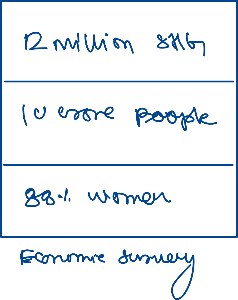
- 12 Million SHGs, 10 crore people, 88% women - ECONOMIC SURVEY
- Benefits
- Empower women through
- Financial independence; collective strength enabling them to voice concerns
- Leadership and skill development
- Making informed choices, take control of their lives, decision on family planning and reproductive health
- Social Support - against domestic violence, dowry, child marriage etc.
- MISSION SHAKTI - SHG
- Skill development
- E.g. SEWA by ELA BHATT provide training in various trades
- Poverty Alleviation and Sustainable Development
- JAY AMBE SHG - promoting small enterprise like canteens, tailoring units, handicraft
- Health and nutritional awareness
- NFHS 5 - 50% reduction in maternal mortality and 33% reduction in IMR
- Financial Inclusion
- Access to credit, and financial services
- Encourage regular savings among members
- Only 4% bad loans
- Social security: SHG help members to access life insurance, health insurance, enrol in pension schemes
- Economic Empowerment
- E.g. KUDUMBASHREE - pooling savings and offering microloans
- Women Entrepreneurship
- E.g. ‘LAKHPATI DIDI’ scheme
- E.g. LIJJAT PAPAD
- Diversify sources of income for resilience
- Market linkages
- Break patriarchy
- Grassroots Governance and Community Development
- Leadership development
- KUDUMBASHREE in Kerala has seen women SHG members becoming elected in PRI elections
- Investment in income generating activities
- Empower women through
- Challenges
- Social Barriers
- patriarchal mindset, Social norms, gender inequality, caste-based discrimination
- Regional disparities
- 60% poor in north India - only accounts for 20% loans
- Administration - Lack of professional management
- Poor maintenance of records
- Social Barriers
- Financial -
- Higher interest rates - 12-13%
- Financial literacy - 56% people in rural areas don’t have any knowledge of finance.
- 45% of all SHG have not got formal credit at all
- Lacks sustainability: especially in maintaining financial discipline
- of all SHG formed, only 35% survived after 3 years of foundation -NABARD report
- Measures
- MALEGAM COMMITTEE - provide microfinancing to SHGs fastest way for poverty alleviation.
- MFIs’ gross Non-Performing Assets (NPA) is 2.7% (FY23)
- MALEGAM COMMITTEE - provide microfinancing to SHGs fastest way for poverty alleviation.
- SHG bank linkage program (S K KALIA Committee)
- NATIONAL MISSION FOR EMPOWERMENT OF WOMEN (NMEW)
- महिला किसान सशक्तिकरण परियोजना (MKSP)
- DEENDAYAL ANTYODAYA YOJNA - NATIONAL RURAL LIVELIHOODS MISSION (DAY-NRLM)
- STARTUP VILLAGE ENTREPRENEURSHIP PROGRAM (SVEP)
- Priority sector lending
- Need for regulatory mechanism
- Conclusion
- GANDHI believed concept of ‘self-help’, SHGs in this regard are instrumental making ‘gram-swaraj’ a reality.
- Individuals, Groups and Associations
- Cooperatives
- Cooperatives are voluntary association which unite together for promoting their socio-economic needs based on democratic control.
- 8 lakh cooperatives involving 30 crore people across the country
- Cooperatives
- Types of Cooperatives - CHAMP
- Need - PSD- GCP
- Economic Empowerment: collective bargaining power; access to credit
- Cooperative banks and credit unions offer low-interest loans
- Poverty alleviation and inclusive growth
- AMUL helped millions of small dairy farmer
- Self help and mutual assistance
- Housing cooperatives
- Risk sharing and collective security
- crop insurance schemes or collective savings funds
- Community development
- Improve mutual trust and social cohesion

- Economic Empowerment: collective bargaining power; access to credit
- Constitutional provision - 97TH CAA
- Article 19(c) - freedom to form cooperative societies
- Article 43B - voluntary formation, autonomous functioning, democratic control, professional management.
- Section IX-B - cooperative societies
- Examples -
- AMUL, IFFCO, and LIJJAT PAPAD,
- PUNJAB AND MAHARASHTRA COOPERATIVE (PMC) BANK.
- Sugar cooperatives
- Issues and challenges
- Lack of professional management result in mismanagement of resources.
- Political interference in the operations undermine autonomy and democratic functioning
- Financial mismanagement and corruption
- Limited access to capital hampers growth and sustainability
- Low levels of member participation and engagement
- Slow adoption of modern technology and digital tools
- Inability to compete / poor marketing strategies
- Way forward
- FPOs
- Chinese commune model
- BRAHM PRAKASH COMMITTEE
- Cooperative ombudsman
- Conclusion
- Holistic vision of development that is “community-led, community managed and local resource-based” process, instead of a “government-led, bureaucracy-managed and expert-guided” development enterprise.

E-Governance
- Introduction
- UNESCO defines E-governance as services made available to citizens through leveraging ICTs to facilitates efficient, transparent and accountable delivery of public services and information to citizens.
- “E-governance is not a luxury; it is a necessity in today’s digital world, it enable government to adapt and serve the citizens effectively”
- E.g. COWIN Portal
- “use value” of information refers to the practical benefits that citizens and businesses can derive from the information made available through e-governance.
- Models
- Government to Business (G2B)
- SWIFT - single window interface for trade, online application and services.
- ONDC - open network for digital commerce
- GOVERNMENT E-MARKETPLACE (GeM)
- Government to Citizens (G2C)
- DIGI LOCKER
- E-filing of taxes
- UMANG - unified mobile application for national governance
- Integrate over 1200 government services
- FASTag System has made the toll crossing sustainable.
- NeGP 2.0 or MISSION E-KRANTI
- COWIN Platform
- Government to Business (G2B)
- Government to Employees (G2E)
- Attendance, Salaries, Service issues
- PF, EPF, NPS Etc.
- e-HRMS 2.0 portal - Electronic Human Resource Management System
- e-Office for paperless workflows
- Attendance, Salaries, Service issues
- Government to government (G2G)
- GATISHAKTI
- NITI AAYOG Platform
- INDIA ENTERPRISE ARCHITECTURE (IndEA) by MeitY
- PUBLIC FINANCIAL MANAGEMENT SYSTEM (PFMS)
- Legislature
- NeVA - NATIONAL E-VIDHAN APPLICATION
- Judiciary
- JustIS Mobile App - court and case management
- E-COURTS MISSION mode projects (7000 crore budget outlay)
- FASTER system - fast and secure transmission of electronic records
- SUVAS - supreme court vidhik anuvaad software - translate judgements into regional language.
- NATIONAL JUDICIAL DATA GRID
- DIGITAL SUPREME COURT REPORTS (Digi SCR)
- Benefits | Applications -
- Increased Accessibility and availability
- DIGI LOCKER
- Reduced Corruption
- DBT transfers using JAM Trinity
- Improved Efficiency
- UPI payments
- Inclusive: available to all
- 700 million active Indians
- Crisis management
- E.g., NAVTEX during disaster by NDMA;
- Provides agility in development
- E.g. COWIN portal developed during COVID-19
- Timely Implementation, Continuous performance monitoring
- PRAGATI initiative
- Institutional capacity
- AAROGYA SETU
- Grievance redressal
- My grievance app, Twitter Seva initiative
- E.g. INTELLIGENT GRIEVANCE MONITORING SYSTEM (IGMS) 2.0
- Citizen engagement
- MyGov app: various options like ‘Do’, ‘Discuss’, ‘Poll’, ‘Talk’, ‘Blog’
- Improve decision-making through relevant information
- enhance the delivery of public services
- promotes transparency and accountability
- Status of digital economy
- Increased internet penetration
- Over 800 million active internet users
- Growth of digital payments
- UPI transactions exceeding 1 billion per day
- E-commerce boom
- E-commerce market projected to reach $350 billion by 2026
- E- governance
- JAM and e-governance platforms
- Startup ecosystem
- India is now home to 110 startup unicorns like OLA, ZOMATO, NYKAA
- Increased internet penetration
- Challenges
- Digital divide
- 44% per cent of the rural population uses the Internet compared to 75 per cent of their urban counterparts - NFHS-5
- Digital illiteracy
- NSSO survey for 15-24 age group 2022 a. 1/5 can send email (1/2 in urban) b. 1/16 can use Excel (1/5 in urban)
- Digital divide
- Cybersecurity concerns
- Privacy issues
- E.g. Social profiling
- Data security
- Informed consent
- Gender gap
- 75 percent male adult have phones, while only 51 percent of the female have the same.
- Lack of availability in vernacular languages
- Elderly, disabled, and illiterate individuals face challenges
- User friendly interface
- Elderly people finds JEEVAN PRAMAN difficult to use
- Inadequate infrastructure like unreliable electricity supply, limited broadband connectivity
- Data accuracy and reliability
- Algorithmic bias
- Measures
- DIGITAL INDIA PROGRAMME (Umbrella programme for e-Governance initiatives)
- Nine Pillars of Digital India Programme
- Broadband Highways:
- Universal Access to Mobile Connectivity:
- Public Internet Access Programme:
- e-Governance:
- e-Kranti:
- Information for All:
- Electronics Manufacturing:
- IT for Jobs:
- Early Harvest Programmes:
- Nine Pillars of Digital India Programme
- NATIONAL E-GOVERNANCE PLAN (NeGP)
- Bridging digital divide
- E.g. BHARATNET
- 2.5 Lakh Gram Panchayats connected via optical fibre
- E.g. GRAMNET
- E.g. NATIONAL OPTICAL FIBRE NETWORK
- E.g. DIGITAL INDIA MISSION
- E.g. BHARATNET
- PM-GDISHA for digital literacy
- e-KRANTI for e-Governance
- Localized content to overcome language barrier
- BHASHINI APP
- Affordable services - e.g. low cost broadband
- Public access points - e.g. digital kiosks in Panchayat offices
- DIGITAL PERSONAL DATA PROTECTION ACT, 2023
- 2ND ARC 11TH REPORT - Promoting E-governance
- National Enterprise architecture
- Interoperability
- Protecting Critical Information Infrastructure
- Incentivize E-Governance
- Awareness
- Capacity building, training, infrastructure development
- DIGITAL INDIA PROGRAMME (Umbrella programme for e-Governance initiatives)
- BN SRI KRISHNA COMMISSION, AP SHAH COMMITTEE, PUTTASWAMY JUDGEMENT
- Successes
- Potentials
- Conclusion
- The beauty of e-governance is that a few keystrokes can bring smiles on a million faces.
- E-Governance is the way for proactive pro-people good governance (P2G2). -PM NARENDRA MODI
Citizen’s Charter
- Introduction
- According to 2ND ARC, Citizen Charter is public statement that outlines the rights, expectations, and standards of service that citizens can expect from a public agency.
- Importance
- Empowered citizens through information
- Example - JAN SOOCHANA PORTAL of Rajasthan Govt.
- Outline entitlements of citizens
- Efficient and effective Service delivery system
- Example - Water quality standards
- Time bound delivery of services
- E.g. AHMEDABAD JAN SEVA KENDRA
- Reduced corruption
- E.g. HYDERABAD METRO WATER SUPPLY BOARD
- Increased public trust
- Grievances redressal mechanism
- Good governance
- Empowered citizens through information
- Six principles - VAST-QC
- Quality: Improving the quality of services;
- Choice: Wherever possible; between different service providers
- Standards: Specifying what to expect and how to act if standards are not met;
- Value: For the taxpayers’ money;
- Accountability: Individuals and Organizations;
- Transparency: Rules/Procedures/Schemes/Grievances.

- Limitations
- Bureaucratic resistance
- E.g. reluctance to update
- Not legally binding
- One size fits all approach - Uniform charter
- Rarely updated
- Minimal consultation with stakeholders
- E.g. - NGO, Civil Society etc.
- lack of awareness among citizens
- Due to poor advertisement
- Limited training of the employees on importance and implementation of Charter
- Lack of accountability mechanism
- Lack of monitoring and evaluation
- Bureaucratic resistance
- Measures
- Agile approach:
- Grievance redressal system within department
- 126TH LAW COMMISSION REPORT
- Set Specific, Realistic, and Measurable Standards
- Implementing enforceable accountability mechanisms
- 2ND ARC 12TH REPORT on citizen centric administration - Seven step model for citizen centricity
- Tailor made
- Publication in vernacular language
- Increase awareness
- Sevottam Model
- The model was suggested by 2ND ARC in its 12th report Citizen centric administration.
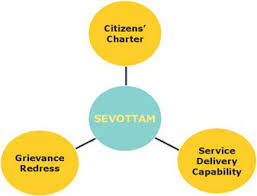
- Components
- Features
- Conclusion
- Forming Citizen Charter based on SEVOTTAM MODEL (2ND ARC) is crucial for citizen centric public services.
Transparency and Accountability
- Introduction
- Accountability is the quality of being answerable for ones actions and decisions.
- Transparency is the quality of being open to public scrutiny
- According to 2ND ARC, transparency means bi-directional information flow.
- Suo-moto disclosure, soliciting citizen feedback
- Significance
- Build accountability and trust in public offices
- E.g. live telecasting of Supreme Court proceeding
- Preventing corruption
- E.g. online tender allocation
- Inclusive decision making process
- E.g. Rajasthan Government JAN SOOCHANA PORTAL
- Ensures GG
- E.g. RTI ACT 2005
- Rationality and objectivity in decision-making
- Leads to public participation for better decisions
- Build accountability and trust in public offices
- Issues
- Corruption (antidote - transparency and accountability)
- India at 85 rank in corruption perception index -2022
- “PANAMA PAPERS” leaks
- OFFICIAL SECRETS ACT (2ARC - should be repealed)
- Lack of proactive disclosure of information
- Political parties, judiciary
- Not under RTI ambit
- Backlog
- CIC, CVC - dysfunctional
- Corruption (antidote - transparency and accountability)
- Means to achieve
- Individual accountability
- meeting performance targets
- adhering to ethical standards
- avoiding any misuse of power or resources.
- Collective accountability
- Delivering on mandate
- Achieving service goals
- Upholding public trust
- Online Grievance Redressal Systems
- CPGRAMS
- Individual accountability
- Legal measure
- Establishing clear laws, codes of conduct, performance standards
- Independent oversight bodies -
- Ombudsman - LOKPAL AND LOKAYUKTA
- Transparency - RTI
- Performance Management Systems
- Setting clear performance goals
- Performance-based rewards and sanctions
- Regular performance reviews
- Citizens participation
- Social audits
- Citizens charter
- Public hearings
- JAN SUNWAI (public hearings) in Rajasthan by MKSS
- Participatory Budgeting
- Whistle blowers protection
- Stakeholder engagement
- Freedom of press
- Civil society
- Technology
- E-government
- Performance dashboards
- Regular internal and external audits
- Parliamentary controls - question hour, debates
- Independent judiciary
- Social Audit
- Examination of government program through active involvement of beneficiaries. It involves comparing the official records with actual ground realities.
- E.g. SWARAJ ABHIYAN social audits
- Examination of government program through active involvement of beneficiaries. It involves comparing the official records with actual ground realities.
- Advantages
- Financial propriety and prudence
- Performance
- CAG has prescribed standards for conducting social audits for PRI
- Accountability
- Mandatory social audit under MGNREGA and NFSA
- Transparency
- In Rajasthan, MKSS performing social audit - Provides collective platform - JANTA KA MANCH
- Prevention of Corruption
- Andhra Pradesh - Social audits detected leakages of 2.4 crores
- Rule of Law
- Preventing Discrimination
- SC - Social audits to be done by independent societies
- Public participation - Janbhagidaari
- MEGHALAYA PUBLIC SERVICES SOCIAL AUDIT ACT
- Participatory governance
- Idea of “Hamara paisa, hamara hisab”
- Objective and rational decisions
- Adherence to principles of public life [NOLAN COMMITTEE]
- Challenges
- Not applicable to all programs
- No oversight authority
- Bureaucratic and political interference
- Lack of administrative and political will
- 33% of politicians and 21% bureaucrats were not responsive to social audits - ACCOUNTABILITY RESEARCH CENTRE
- Lack of laws and institutional backing
- Capacity and awareness
- Delay
- Sporadic and ad hoc auditing by NGOs or CSO
- Way forward
- Independent civil society participation
- Regular social audits [2ND ARC suggest every 6 months]
- Adhering to CAG prescription
- Inclusivity
- Committee consisting of women, SC,ST
- Implementing SC recommendation in SWARAJ ABHIYAN CASE - 2016 can make social audit effective tool for democratic accountability.
- Whistle-blower protection bill
- The LAW COMMISSION in 2001, had recommended that, in order to eliminate corruption, a law to protect whistle-blowers was necessary.
- Lokpal and Lokayuktas Act
- Media - (GS3)
- Way forward
- RTI section 4(1) - Suo Moto Disclosure of information
- Open-data policy
- Pro-active information sharing
- Social audits - जन सुनवाई
- जन भागीदारी - public participation
- Conclusion
- Public information belongs to the public and the public’s business should be done in public
- Finding the right balance between transparency and efficiency is crucial for good governance.
Right to Information Act, 2005
- Introduction -
- “RTI is the master key to Good Governance” - 2ND ARC 1ST REPORT
- Important provisions
- Section 4(1)(b) - Suo motu disclosure
- Section 5 - PIO
- Section 6 - prescribe simple procedure for obtaining Information
- Section 6(3) - Transfer within 5 days.
- Section 7 - disposal of RTI application
- 30/48
- 7(8) - reasons for rejection needs to be communicated
- 7(9) - only in stipulated form
- Section 8 - exemptions from disclosure - 8(1)(a), 8(1)(j)
- Section 20 - Penalties
- Significance
- Public awareness
- Section 26 mandate RTI education by government
- Time bound disposal
- Section 7 - information must be provided within 30 days
- Facilitates transparency
- Section 4(1) - Suo-moto disclosure
- Accountability of officials to citizens
- Led to unveiling of 2G SCAM, COMMONWEALTH SCAM
- Check on Corruption
- E.g., ADARSH SOCIETY SCAM
- Broadens accountability
- From traditional checks and balances of legislature and judiciary by providing citizens direct means
- From paternalistic to participatory:
- AISHWARYA a 10-yr old school girl used RTI to garbage dump cleared in Lucknow.
- Citizen centric
- Empowers citizens
- E.g. MAHENDRA DUBE - RTI for BPL Families to be covered under NFSA in Ratnapur, MH
- Public awareness
- Empowers Civil society, media and stakeholders to have RTI within stipulated time frame.
- MKSS (MAZDOOR KISAN SHAKTI SANGHA) - led movement for RTI in Rajasthan.
- Challenges
- Diluted autonomy:
- The RTI (Amendment) Act, 2019 increase executive control
- Lack of awareness
- As per government survey Only 15% of respondent were aware of RTI Act.
- Threat to life RTI Activist and whistleblowers
- E.g. SATYENDRA DUBEY tragically lost his life
- CIC
- Allegation of political interference
- Lack of autonomy
- Government
- Misused by public officials
- Section 6(3) (buck passing) and Section 7(9) (stipulated form)
- Pendency of appeals
- RAAG (RTI ASSESSMENT AND ANALYSIS GROUP) Report - 5 million RTI application every year.
- Lack of standard forms
- MH and Orissa - have prescribed it.
- Poor Record management and infrastructure
- User guides नहीं है
- Inconvenient Payments channel
- PIO’s and AA’s - कम है और गम्मो है
- Misused by public officials
- RTI as a double-edged sword
- Frivolous overuse: Obstructing the functioning
- Freedom but judicial use!
- Non serious application can be avoided, prioritization of application
- Increased compliance requirements add to already heavy workload of officials
- Impacts productivity and work-life balance
- Diluted autonomy:
- Official Secrets Act, 1923
- Disadvantages
- Secrecy: Sections 8 and 9 of the RTI Act allows exemptions from disclosure
- Vague provisions: like safety or interest of the State which are open ended
- Misinterpretation: threatens freedom of press
- Advantages
- National security: prevent potential misuse of information by foreign powers
- Diplomacy: help government maintain strategic partnerships without sharing confidential details
- Internal Security: protect classified information about military capabilities, and critical infrastructure
- Recommendations
- 2ND ARC - repeal OSA adding provisions in NATIONAL SECURITY ACT, 1980
- The definition of “secret” needs to be clearly defined in the OSA
- Disadvantages
- Recent amendments
- Change in term - central govt will determine (earlier it was 6 yrs or <65 age)
- Salaries - central govt will determine (earlier = ECI)
- Appointment - CG will determine (earlier committee PM, Minister, LoO)
- Impact on autonomy and independence
- Make them more susceptible to government influence.
- Variations in remuneration could impact their credibility
- Could deter them taking integral decision that aggravate government
- Perception of political influence can undermine public trust in RTI mechanism
- Counterarguments
- government argues amendments provide necessary flexibility to allow adjustment as per changing needs
- Independent service and renumeration condition rather then fixing to ECI
- Way forward
- Section 26 - citizen awareness program
- JANKARI CALL CENTER In Bihar
- Contempt power to CIC, SIC
- Filling up vacant posts as directed in ANJALI BHARDWAJ CASE (2019)
- Political parties under RTI
- Refusal of RTI with independent review - checks and balances (2ND ARC)
- 2ND ARC 1ST REPORT on RTI
- Abolish OFFICIAL SECRECY ACT, 1923
- Government privileges in EVIDENCE ACT should be amended
- Constitute SIC
- Oath of Secrecy
- 126TH LAW COMMISSION RECOMMENDATION
- Protect whistle blowers
- Training, SOP’s, Code and conduct rules
- Improve civil society, media and citizenry
- Train NGO - ‘train the trainer’ program - Assam
- Upgrade infrastructure
- Indexing, cataloging, orderly storage, Quick TAT.
- Work culture of integrity
- Empower PIO’s and AA’s for Suo moto disclosure
- Adopting technology for efficient RTI handling
- Section 26 - citizen awareness program
- Conclusion
- Information is to democracy, what oxygen is to human body. Recommendations of 2ND ARC should be implemented in letter and spirit.
Civil Services
- Introduction
- They are vital for the government to function, it is regarded as the ‘steel frame’ of the administration in India.
- What do you mean by public servant?
- An individual working in government organization who is responsible for serving the public good.
- Its not just holding a government job; it is about dedicating oneself for the well-being and development of society.
- Constitutional provisions
- 309. Recruitment and conditions of service of persons serving the Union or a State
-
- Dismissal, removal or reduction in rank of persons employed in civil capacities under the Union or a State
-
- All-India services
-
- Public Service Commissions for the Union and for the States.
- Legal Framework
- CENTRAL CIVIL SERVICES (CONDUCT) RULES, 1964
- Rule 3(1) - unbecoming of member of service
- ALL INDIA SERVICES (CONDUCT) RULES, 1968
- Rule 7 - No member of the service can criticize government policies
- CENTRAL CIVIL SERVICES (CONDUCT) RULES, 1964
- Attributes of good civil servant - WEBERIAN MODEL
- FRESH
- Formal
- Responsible and Rule based
- Expertise
- Sensitive and specialization
- Hierarchical
- FRESH
- Issues
- People - PAIRJEB
- Secrecy
- E.g. OFFICIAL SECRETS ACT
- Status quoist mentality
- E.g. resistance to lateral entry
- Lack of professionalism
- E.g. DM in Tripura
- Erosion of values and ethics
- E.g. DM in Bihar was observed scolding teacher for wearing ‘kurta pajama’
- E.g. PUJA KHEDKAR used fake Ids to get into IAS
- Lack of Whistleblower Protection
- E.g. SATYENDRA DUBEY tragically lost his life
- Elitist in nature
- E.g. IAS officer using public stadium for personal evening walks in Delhi
- Reward and punishment transfers
- E.g. Delhi, Mumbai; Northeast, Ladakh
- Secrecy
- Process
- Political-bureaucratic-criminal nexus (VOHRA COMMITTEE)
- Bureaucratic delays
- E.g. NHAI officers taken 9 years in constructing govt building.
- One size fits all approach
- Bribery and corruption
- Red tapism
- Indifference - lack of compassion
- Leaking official information
- Power
- Arbitrary and whimsical transfers
- Systemic inconsistencies in promotion
- Practical problems
- Subjectivity
- ANNUAL CONFIDENTIAL REPORT (ACR) reports are not transparent
- Can led to bias judgement; targeting specific individuals
- Overburdened
- Even sincere civil servants are unable to fulfill every responsibility
- Subjectivity
- People - PAIRJEB
- Expected role of public servant
- Upholding public interest
- Building public trust
- Follow rule of law
- Upholding democratic principles
- Impartiality
- High ethical standards
- Encourage citizen’s participation
- Lateral entry
- Arguments in support
- Expertise: bring specialist and domain-experts for complex challenge like CC, technology, and public health.
- Efficiency: private sector professionals are accustomed to fast-paced environments and results-oriented work.
- Diversity: can spark innovation and develop creative solution to policy approaches
- Addressing Scarcity of Talent: take best talent regardless of their career path.
- Compensate for staff shortages (BASWAN COMMITTEE)
- Arguments against
- May lack institutional knowledge and understanding of internal procedures, can take significant time and resources to acclimatize.
- Potentially short circuiting social justice provisions
- concerns about bias and potential for corruption when recruiting.
- Compromise on neutrality and non-partisanship
- conflicts with the core values
- Traditional civil servants prioritize values such as public service, empathy, compassion. While Lateral entrant may have different focus on profit and efficiency.
- Disruption of Internal Hierarchy: Concerns exist about potential resentment and friction with career civil servants.
- Way forward
- sending government officials in private sector on deputation [1ST ARC]
- merit-based promotions
- Arguments in support
- Role of civil services in democracy - COPY (CCCC, D)
- Implement public policy
- E.g. social welfare
- Public order maintenance
- Agents for socio-economic change
- Facilitate democratic processes
- E.g. elections
- Crisis management
- Regulatory Compliance:
- E.g. environmental protection, public health, and consumer rights.
- Continuity of administration with change in governments and political instability
- Implement public policy
- Reforms -
- Professionalisation with Stability of Tenure & Competition
- TRS SUBRAMANIAN CASE
- Outcome Orientation
- MISSION KARMYOGI
- Promoting Public Service Values & Ethics
- Probity portal
- Specialized training
- iGOT platform - integrated government online training
- Merit based promotion
- SPARROW Portal - electronic filling of PAR
- Performance Management System
- That includes clear metrics and individual goals
- Preventing political Interference
- Civil services board - HOTA COMMITTEE
- Bringing domain experts
- E.g. NANDAN NILEKANI’S appointment to rollout AADHAR
- E.g. climate change negotiations, Cyber security
- E.g. Diplomats (PILLAI COMMITTEE)
- Work culture
- E-office
- Recommendation overruled should be recorded in writing
- 2ND ARC 4TH REPORT - EIG
- Grievance redressal monitoring system
- CENTRALIZED PUBLIC GRIEVANCE REDRESS AND MONITORING SYSTEM (CPGRAMS)
- Professionalisation with Stability of Tenure & Competition
- Training and capacity development
- MISSION KARMYOGI - NATIONAL PROGRAMME FOR CIVIL SERVICES CAPACITY BUILDING (NPCSCB)
- Transition from karmchari to karmyogi
- Individual Responsibility
- Rule based to role based
- Emphasis on on-site learning in complementing off-side learning
- My iGOT - targeted training course
- MISSION KARMYOGI - NATIONAL PROGRAMME FOR CIVIL SERVICES CAPACITY BUILDING (NPCSCB)
- Strengthening whistle blowers protection regime
- Conclusion
- Thus, there is need to build emotionally intelligent civil services in the spirit of SEVOTTAM MODEL proposed by 2ND ARC.
- Civil servants are agent of socio-economic change responsible for delivering the welfare policies.
- Good civil services ensure that the pillars of good governance are deeply and firmly entrenched.
- svasmai svalpaṃ samājāya sarvasvaṃ (A little bit for yourself and everything for others).

Social Justice
- Introduction
- The judgement in MENAKA GANDHI CASE has panned the way for a liberal interpretation of Article 21 encompassing all the rights necessary for living a dignified life.
- Body
- Conclusion
- Article 51A to develop the scientific temper, humanism and the spirit of inquiry and reform
Welfare schemes
For vulnerable sections Performance Life Cycle (Planning, implementation, Monitoring, Evaluation)
- Welfare schemes refers to programs of government to provide free or subsidized services to those who are socio-economically deprived.
- Conclusion
- Article 39 provides for State to secure a social order for the promotion of welfare of the people
- ATAL VAYO ABHYUDAY YOJANA (AVYAY) - doubling farer
- Positive discrimination
- Addressing Historical Injustices:
- Reservation policies in education and employment for SCs and STs
- Ensuring Inclusive Growth
- BETI BACHAO, BETI PADHAO scheme to address gender disparities
- Promoting Social Equity
- AYUSHMAN BHARAT scheme providing health coverage to poor and vulnerable
- Empowering Marginalized Groups
- PRADHAN MANTRI AWAS YOJANA (PMAY) providing affordable housing
- Promoting tribal development
- VAN DHAN YOJNA
- Addressing Historical Injustices:
- Negative discrimination
- Perceived Reverse Discrimination
- Backlash against reservation policies
- Implementation Inefficiencies like corruption, misallocation of resources, red tape.
- PDS system
- create dependency syndrome: beneficiaries not seeking self-sustaining opportunities
- offering free electricity or water supply for farmer
- Undermines merit and kill individual motivation
- Reinforce identity-based divisions
- Perceived Reverse Discrimination
- Issues Affecting Performance of welfare schemes
- Lack of Awareness: PMAY, NSAP do not often reach all intended beneficiaries
- Limited Beneficiary Involvement in policy process - from planning to evaluation
- Poor implementation and monitoring: leads to inefficiencies and corruption
- PDS diversions
- Lack of effective utilization of resources
- Limited specific targeting of social and regional disparities
- Lack of accountability and transparency
- Corruption and bureaucratic inefficiencies
- Strategies for improving performance
- Participatory planning
- KERALA PUBLIC PLANNING PROGRAM
- Local capacity building
- MAHILA SHAKTI KENDRA scheme
- Public awareness
- Government campaigns similar to JAN DHAN YOJANA and AYUSHMAN BHARAT.
- Community monitoring and evaluation
- Social audits under MGNREGA
- Partnering with NGOs and CSO
- AKSHAYPATRA role in MID DAY MEAL SCHEME
Protection and betterment of
Vulnerable sections
Mechanisms Bodies Institutions Laws
- Introduction
- Democracy is not rule of majority but the protection of minority - ALBERT CAMUS
- Measures
- Involving NGO’s and civil societies organization
- Conclusion
- Article 39A provides for equal justice and free legal aid to the poor and vulnerable section of the society.
- As we embrace the benefits of the digital age, let us heed the words of MAHATMA GANDHI: ‘The true measure of any society can be found in how it treats its most vulnerable members.’
- Article 46 - The State shall promote with special care the educational and economic interests of the weaker sections of the people
Issues relating to development and management of
Social sector | Services
- Role of multilevel planning
- Cost-Effectiveness:
- Better allocation of resources: targeting local needs
- reduce administrative cost: MGNREGA administration to Gram Panchayats
- Remove implementation blockages:
- Through localized decision-making: e.g. SWACHH BHARAT MISSION
- Sense of ownership at local level: Social Audits
- Responsive to Change: role of municipalities managing healthcare during COVID-19 pandemic
- Local participation
- E.g. PRIs
- Enhance accountability and transparency:
- Cost-Effectiveness:
- Challenges
- Capacity and skills at local level to plan and implement projects
- Undertake training program in financial management and project planning
- Decentralization of financial autonomy
- E.g. 14TH and 15TH FINANCE COMMISSION increased share of state to about 40%
- effective coordination between different levels requires alignment of goals, strategies and resources which can be challenging due to different priorities and interests
- Establishing institutional mechanism like INTER-STATE COUNCIL; COMMISSION FOR PRI
- Strong political will and support at all levels of government
- Ensuring sustainability and scalability
- Duplication of efforts at local level
- Decentralization of corruption [MANI SHANKAR IYER COMMITTEE]
- Socio-cultural barriers: caste and gender based discrimination
- Capacity and skills at local level to plan and implement projects
- Importance of service sector cooperation
- Promote integrated development approach to address multifaceted challenges
- E.g. integration of Education and Social programs like BETI BACHAO BETI PADHAO
- lead to better utilization of resources reducing duplication efforts
- PPPs leverage private sector efficiency and innovation with public sector oversight and equity.
- Collaborations between different service sector like health, education and employment address interconnected challenges. E.g. NATIONAL RURAL HEALTH MISSION (NRHM)
- NGOs and Civil Society bridge gap between services and community needs
- collaboration encourages innovation and knowledge sharing
- ATAL INNOVATION MISSION (AIM)
- Collaboration ensure developmental initiatives are inclusive and reflect the needs and aspirations of the people they serve
- Enhance capacity and skills of stakeholders
- Programs like SKILL INDIA
- Promote integrated development approach to address multifaceted challenges
Elderlies
- Introduction
- According to Census 2011, there are about 8.6% elderlies in India.
- Currently comprise a little over 10% of population, i.e. about 104 million.
- Issues
- Rapid aging -
- WHO 20.3% by 2050
- Health Problem: chronic illnesses such as diabetes, hypertension, cataract
- 75% elderlies suffer from chronic disease like hypertension, diabetes, cataract etc.(ICMR)
- Mobility Issues: difficult in performing daily tasks
- Mental health: issues such as depression, anxiety
- Social Isolation
- Elder abuse, including physical, emotional, and financial abuse
- HELPAGE INDIA study - about 50% of elderly reportedly faced abuse
- Lack of awareness
- Less then 25% knew about government schemes
- Lack of social security
- 78% of the elderly population survives without a pension
- Access to healthcare due to physical limitations, transportation, financial constraints
- Feminization of old age -
- 1065/1000
- Ruralization of old age
- Rapid aging -
- Way Forward
- Health - Mobile diagnostic vehicle, geriatric care
- Financial support (Article 41)
- PMVVY, SENIOR AGEING GROWTH ENGINE (SAGE) initiative
- Encourage Civil society participation
- GOOD FELLOWS NGO
- Technological
- JEEVAN PRAMAN APP
- Contribution opportunities
- SENIOR ABLE CITIZENS FOR RE-EMPLOYMENT IN DIGNITY (SACRED) portal
- Caring for senior citizen should be practiced as common community service
- E.g. Swiss ‘Time Bank’ concept
- Promote In-Situ Aging
- Family - PRANAM ACT (Assam)
- Increase Awareness of Schemes
- RASHTRIYA VAYOSHRI YOJNA
- age-friendly infrastructure
- ACCESSIBLE INDIA CAMPAIGN (Sugamya Bharat Abhiyaan)
- Introduction of SHG model for elderly (AGRASR)
- Laws
- NATIONAL POLICY FOR SENIOR CITIZENS
- NATIONAL SOCIAL ASSISTANCE PROGRAM
- MAINTENANCE AND WELFARE OF PARENTS AND SENIOR CITIZENS ACT
- VAYOSHRESHTHA SAMMAN;
- RASHTRIYA VAYOSHRI YOJANA etc.
- Conclusion
- Article 41 ensures the right to public assistance is cases of old age, sickness and disablement
SC
- Introduction
- 1,109 castes, 16.6% of Population
- A-341
- Institutions
- NATIONAL COMMISSION FOR SCHEDULED CASTES - A-338
- Laws
- THE PROTECTION OF CIVIL RIGHTS ACT
- THE SCHEDULED CASTES AND THE SCHEDULED TRIBES (PREVENTION OF ATROCITIES) ACT
- Issues
- Poverty
- About 31.5% living below the poverty line as per the NITI AAYOG 2015-16 report.
- Lower literacy rates
- 66.1% for SCs compared to the national average of 78% (Census 2011).
- Unemployment: due to job market discrimination and lack of skills
- Caste Discrimination
- Segregation in villages
- Social Exclusion
- from social functions, public spaces, and community activities
- Caste based violence
- NCRB - 9.5% rise in violence against Dalits.
- E.g. SIDDHI urination incident
- Access to Justice
- Lower conviction rates in cases of violence and discrimination against SCs.
- Inadequate housing facilities
- Slum-dwelling conditions in urban areas
- Poverty
- Manual scavenging
- MANUAL SCAVENGING ACT 2013
- NCRB - 97.25% manual scavengers are SCs

- RASHTRIYA GARIMA ABHIYAN
- NAMASTE SCHEME - NATIONAL ACTION FOR MECHANIZED SANITATION ECOSYSTEM
- SELF-EMPLOYMENT SCHEME FOR REHABILITATION OF MANUAL SCAVENGERS (SRMS)
- MANUAL SCAVENGING ACT 2013
ST
- Introduction
- 8.6%, 705 scheduled tribes
- 75 PVTG in India
- Tribal districts account for 59.61 of forest on only 33.63 per cent of the total geographical area.
- Literacy in ST - 56% (Census 2011)
- Laws
- FOREST RIGHTS ACT
- PESA ACT
- SCST ACT,1989
- Constitutional provisions
- Article 244 (fifth and sixth schedule areas - tribal advisory council), article 23,29,30,46
- 330- seats reserved in Lok Sabha
- 332 - seats reservation in Legislative assembly
- 243D - seats reserved in panchayats
- 371 A to 371 H-special provisions in states with significant tribal populations. customary laws are allowed for certain practices.
- Institutions
- NATIONAL COMMISSION FOR SCHEDULED TRIBES - A-338A
- Mechanisms
- EKLAVYA MODEL SCHOOL INITIATIVE
- PM VAN DHAN YOJNA
- GRAMEEN UDYAMI SCHEME
- AADI MOHOTSAV - celebrating tribal culture
- Bodies
- TRIFED to improve income of tribals
- Madhya Pradesh - 21.1%
- Bhil, Gond, Kol
- Tourism
- Tribal circuit
- SWADESH DARSHAN scheme
- BHURIA COMMITTEE - recommended PESA ACT, 1996
- XAXA COMMITTEE - Tribal welfare
- Power to gram Sabha in case of land acquisition
- Rehab in natural forest and not forest of concrete
- LOKUR Committee - criteria for defining new community as scheduled tribe
- UN DHEBAR COMMISSION - welfare of PVTG
- PVTG are group having primitive traits, geographical isolation, low literacy, zero to negative population growth rate and backwardness.
- Hunting and pre-agricultural level of technology for food.
- IDATE COMMISSION report for welfare of NTs, SNTs, and DNTs.
- SCHEME FOR ECONOMIC EMPOWERMENT OF DNTs (SEED)
- Constitution of DEVELOPMENT AND WELFARE BOARD FOR DNTs, SNTs &NTs (DWBDNCs) in 2019.
- Government schemes
- PRADHAN MANTRI ADI ADARSH GRAM YOJANA (PMAAGY)
- Improving the infrastructure in vital sectors like health, education, connectivity and livelihood
- Pradhan Mantri PVTG Development Mission
- PM JANMAN (PM- JANJATI ADIVASI NYAYA MAHA ABHIYAN)
- EKLAVYA MODEL RESIDENTIAL SCHOOLS
- PRADHAN MANTRI ADI ADARSH GRAM YOJANA (PMAAGY)
- SCHEME FOR ECONOMIC EMPOWERMENT OF DNTs (SEED)
Other Backward Castes
- President under Article 342A specify Socially and Educationally backward classes.
- MANDAL COMMISSION, 1980 - to identify OBC and suggest reservation for them
- NATIONAL COMMISSION FOR BACKWARD CASTES - A-338B
- RAM NANDAN PRASAD COMMITTEE - 1993
- Identify creamy layer
- JUSTICE ROHINI SINGH COMMITTEE - OBC Subcategorization - 2017
- Economically weaker section (EWS)
- SINHO COMMISSION,2010
- Total 31 Cr - 5 Cr only in General
- EWS for extending welfare measures only
- SINHO COMMISSION,2010
- KAKA KELKAR - first backward class commission
- Alarmed by rise in casteism due to reservation
Minorities
- Institutions
- NATIONAL COMMISSION FOR MINORITIES
- NATIONAL COMMISSION FOR RELIGIOUS AND LINGUISTIC MINORITIES
- Constitutional provisions
- Article 29 - Right to ‘conserve’ its ‘distinct language, script or culture’.
- Article 30 - Right of minorities to establish and administer educational institutions.
- Article 347 - Special provision relating to the language spoken by a section of the population of any State.
- Article 350 - Provision for a Special Officer for Linguistic Minorities and his duties.
- Article 350 A - Provision for facilities for instruction in mother-tongue at the primary stage.
- Bezbaruah Committee
- Concerns for people for northeast (ethnic minorities)
- RANGANATH MISRA COMMISSION - backwardness in religious and linguistic minorities
- SACCHAR COMMITTEE
- Inclusive development of Muslims in India
- 4% Muslims are graduate
- 2% in AIS
- Inclusive development of Muslims in India
- Government schemes
- MAULANA AZAD NATIONAL FELLOWSHIP
- NAI UDAAN: financial assistance clearing preliminary examination
- BEGUM HAZRAT MAHAL NATIONAL SCHOLARSHIP
- USTTAD Scheme
PwD
- Introduction
- PwDs in India is close to 2.68 crores (2.2% of the population - Census 2011)
- Mechanisms
- Laws
- RIGHTS OF THE PERSONS WITH DISABILITIES ACT, 2016
- broadens the definition of disability including 21 types of disabilities.
- Reservation of 4% in Government jobs
- Reservation of 5% in higher education institution
- Mandates the creation of a barrier-free environment and accessibility in transport and buildings.
- THE REHABILITATION COUNCIL OF INDIA ACT
- THE PERSONS WITH DISABILITIES (EQUAL OPPORTUNITIES, PROTECTION OF RIGHTS AND FULL PARTICIPATION) ACT, 1995 (PwD Act)
- Chief Commissioner for Persons with Disabilities
- MENTAL RETARDATION AND MULTIPLE DISABILITIES ACT
- THE NATIONAL TRUST FOR WELFARE OF PERSONS WITH AUTISM, CEREBRAL PALSY, MENTAL RETARDATION AND MULTIPLE DISABILITIES ACT
- RIGHTS OF THE PERSONS WITH DISABILITIES ACT, 2016
- Issue
- lack of accessible physical infrastructure and transportation
- Lack of ramps, elevators, tactile paths for the visually impaired
- Lack of Sensitization
- government offices remain inaccessible to PwD
- General public awareness about problems of PwD is low
- leading to social stigma and discrimination.
- lack of accessible physical infrastructure and transportation
- Way forward
- Awareness and training programs
- ACCESSIBLE INDIA CAMPAIGN
- Celebrating inclusivity
- E.g. PURPLE FEST
- Leveraging technology
- SUGAMYA BHARAT APP
- Scholarship for students with disabilities
- NATIONAL ACTION PLAN FOR SKILL TRAINING FOR PwDs
- DEENDAYAL DISABLED REHABILITATION SCHEME
- Accessible Infrastructure Development
- E.g. P NARAHARI made Gwalior disabled friendly
- Joint collaboration with NGOs and Civil Societies
- Awareness and training programs
- Conclusion
- Society is like a chain, weakest link is as important as the strongest link (JOHN RAWLS)
Homeless
- GAMBHIR COMMITTEE
- GHAR – GO HOME AND RE-UNITE (Portal for Restoration and Repatriation of Child)
Undertrials
- NCRB
- PSI Report
- Prison Occupancy increased to 130%
- 80% undertrials - justice delayed is justice denied
- PSI Report
- Way forward
- 268TH LAW COMMISSION REPORT
- Enacting Bail Act
- Separate fast track courts
- Open prisons
- 273RD LAW COMMISSION REPORT
- Police reforms
- Prison reforms
- DK BASU CASE
- Preventive measures against custodial violence
- Guidelines for arrest
- Treatment of Detainees in custody
- ALL INDIA COMMITTEE ON JAIL REFORMS (MULLA COMMITTEE) 1980
- 268TH LAW COMMISSION REPORT
LGBTQ+
- NALSA JUDGEMENT
- NAVTEJ JOHAR JUDGEMENT
- GAURI SAVANT - Trans-Rights Activist
- Issues
- legalization of same-sex marriages
- Right to Parenthood and Family (Article 21)
- E.g. adoption laws, inheritance
- Denied social rights
- E.g. health insurance, and social security (Article 14)
- social stigma leads to their marginalization and exclusion
- prejudices and stereotypes
- E.g. impact access to education, employment, healthcare
- Same sex marriage
- Introduction
- Recognition Under SPECIAL MARRIAGE ACT (SMA) 1954 and making the law gender-neutral.
- Introduction
- Why demanding?
- Government pensions and medical benefit
- Right to property or inheritance
- Joint adoption
- Right to take emergency medical decision
- Arguments in Favor
- Article 21
- Arguments in Against
- Way forward
- Socio-political sensitization
- E.g. evoking traditional openness of Indian culture
- E.g., SHIKHANDI in Mahabharata.
- Policy support for progressive realization of rights
- Fundamental duties: common brotherhood: complete acceptance of LGBTQIA+.
- CONVENTION FOR RIGHTS OF CHILD (CRC)
- Socio-political sensitization
- Measures
- “Prayatna” project, a livelihood and enterprise training program for Transgender people
- TRANSGENDER PERSONS (PROTECTION OF RIGHTS) ACT, 2019
- SMILE (Support for Marginalised Individuals for Livelihood and Enterprise)
- GARIMA GREH: A Shelter Home for Transgender Persons.
- National Portal for Transgender Persons by MoSJE
- Conclusion
Children
- Introduction
- There is no keener revelation of soul of society then the treatment given to it’s children. -NELSON MANDELA
- Issues
- U5MR - 35/1000
- Online sexual exploitation and abuse (OCSEA)
- TK VISHWANATHAN COMMITTEE
- Children’s don’t speak up (either not aware or are afraid)
- 53% subjected to abuse. 90% times, a known person is involved.
- Low rate of reporting
- reporting rate only 6%
- Child marriage
- NFHS-5 - 23% women get married before 18.
- Crime against children
- Rose by four times in last decade -NCRB
- Child labour
- Census 2011: At 10 million, India has highest child labour in the world.
- Orphaned
- 1.2 lakh children lost one or more parent during covid -The LANCET study
- Impact on socialization of children due to Mobile Phone
- Negative Impacts:
- Limited development of social skills such as empathy, communication, and conflict resolution.
- Weakened Parent-Child Bond
- Reduced Emotional Intelligence
- Increased Screen Dependency
- More aggressive and impulsive tendencies
- Attention Deficits
- Sleep Disruptions and risks associated with Sedentary behavior
- Difficulty in developing Peer relationships
- Potential dangers like Cyberbullying and Online Predators
- Negative Impacts:
- Positive Impacts of mindful use
- Educational Tools
- Facilitate communication and connection with far away family and friends
- Learning collaboration and teamwork skills
- Creativity development
- Balance
- Age-Appropriate Content
- Quality Family time
- Prioritize Physical Interaction
- Legislations
- CENTRAL ADOPTION RESOURCE AGENCY (CARA)
- THE PROHIBITION OF CHILD MARRIAGE ACT
- CHILD LABOUR PROHIBITION ACT 2016
- JUVENILE JUSTICE (CARE AND PROTECTION OF CHILDREN) ACT
- THE PROTECTION OF CHILDREN FROM SEXUAL OFFENCES (POCSO) ACT
- Aims - to prevent sexual assault, sexual harassment and pornography of children under age of 18.
- Features - GRTCCP
- Comprehensive protection for children: sexual abuse, harassment, child pornography.
- Gender neutral
- Mandatory reporting: Offence to not report an abuse
- Special courts for speedy trials
- No time limit for reporting abuse
- Right to compensation to victims
- Confidentiality of victims identity
- Periodic police verification, background check - employees working with children
- Issues
- Blanket criminalisation of consensual sex
- E.g. romantic relationships
- Focus on accused rather then victim
- Lack of focus on rehabilitation and compensation
- Perpetuate Patriarchy
- E.g. limits women’s agency to make their own decision
- Large part of offences registered under CrPC
- Only 10% women in police force
- Inhumane medical examination (banned - two finger test)
- Issues with investigation (fixed deadline resulting into submission of reports lacking evidence)
- Sex education
- Blanket criminalisation of consensual sex
- Recommendations | measures
- PENCiL (PLATFORM FOR EFFECTIVE ENFORCEMENT FOR NO CHILD LABOUR) Portal
- GURUPAD SWAMI COMMITTEE - Child labour
- NATIONAL CHILD LABOUR PROJECT (NCLP) SCHEME
- JAYA JAITLEY COMMITTEE - suggested to increase the minimum age of marriage - 21.
- JAIRAM RAMESH COMMITTEE - Child sexual abuse
- Proactive monitoring, mandatory reporting
- BACHPAN BACHAO ANDOLAN (Save the Childhood Movement)
- Conclusion
- Article 39 states that children should be given opportunities and facilities to develop in a healthy manner.
- Article 45 - State shall endeavour to provide early childhood care and education for all children
Health
- Introduction
- As per WHO, Health is a state of complete physical, mental, and social well-being, and not merely the absence of disease.
- “Of the forms of injustice, inequality in healthcare is the most shocking and inhumane.” -MARTIN LUTHER KING JR
- Malnutrition - Undernutrition(1,2,3,5), Overweight
- Life expectancy - 1947 - 32 yrs, 2023 - 70 yrs
- PHC 1951 - 725, 2022 - 30045 (data source - PIB)
- National Family Health Survey - 5
- Undernourishment - 15% - भूखे
- Shunting - 35.5% - टिंगे
- Wasting - 19.3% - कमजोर
- Mortality - 35/1000 - टपक गये
- Underweight - 32.1% - दुबले
- Anemia in women - 57%
- NATIONAL INDICATOR FRAMEWORK progress report 2024
- neonatal mortality ratio - 20/live lakh births
- India’s Performance on Various Health Indicators
- GLOBAL HUNGER INDEX - 107/121 (Indicators 1-4)
- Issues with health sector in India
- Mushrooming in urban clusters
- 68% in Urban areas where 31% population live
- Rural areas has four times less doctors than urban areas
- Want of resource allocation
- India spends 1.3% of GDP on health while it is 2.9% for China and 3.6% for South Africa
- WHO norm is 3%
- Absence of preventive care
- 7% spending of preventive care and 52% on curative care
- WORLD BANK -> 6% of India’s GDP is lost every year due to preventable illness and mortality.
- High out of pocket expenditure
- 45-54% (NFHS-5)
- Health induced poverty
- 6 crore Indians fall BPL due to catastrophic expenditure on health every year.
- Infrastructure
- Bed to population ratio 0.5:1000, WHO recommended 3.5:1000
- One PHC for 25 villages
- Lack of doctors and nurses
- Doc population ratio: 0.7 per 1000 people as opposed to WHO recommended 2.5 doctors per 1,000 people.
- 1.7 nurses per 1000, WHO recommends 3 per 1000
- 60% PHC in India have only 1 doctor and 5% have none -ES
- Climate change induced health issues.
- Mushrooming in urban clusters
- Issues
- Age-related Diseases
- cardiovascular diseases, diabetes, cancer.
- Chronic Diseases
- Obesity, hypertension, and respiratory conditions.
- Mental Health Disorders
- depression, anxiety
- Lifestyle-related Health Issues
- unhealthy diets, tobacco use, and substance abuse, sedentary behavior.
- Age-related Diseases
- Importance of Primary Healthcare
- Accessibility to Healthcare Services: especially in rural and remote areas
- Affordability:
- E.g. AYUSHMAN BHARAT JAN AAROGYA KENDRA
- Greater acceptance in community
- Communication in local language and strong trust
- Preventive Healthcare through hygiene awareness, vaccination, nutrition
- Facilitate early detection and timely treatment
- E.g. regular checkup for diabetes, hypertension, tuberculosis
- Focus on Maternal and Child Health
- JANANI SURAKSHA YOJANA (JSY)
- Improve Geriatric Care
- Potential challenges
- Adequate funding and resource allocation
- shortage of doctors and nurses
- lack the necessary infrastructure like hospital buildings, medical equipment, dispensaries
- Low levels of health literacy
- Universal Health Coverage
- “No society, can legitimately call itself civilised if a sick person is denied medical aid because of lack of means.”
- ASTANA DECLARATION - Primary Health Care
- Maternal & Adolescent Health
- Issues
- Maternal mortality - 97/lakh live births (RGI)
- 2nd only after Nigeria.
- Anemia
- 57% women
- Undernourishment
- 33% women
- Lack of LDR (labour, delivery and recovery) facilities
- 21% births still take place outside formal facility.
- Inadequate Prenatal and Postnatal Care facilities like health check-ups, nutritional support, and education on healthy practices during and after pregnancy
- Limited access to reproductive health and Family Planning services
- Gender biases and patriarchy
- Mental Health issues during pregnancy like postpartum depression
- Maternal mortality - 97/lakh live births (RGI)
- Issues
- Government initiatives
- MISSION UTKARSH: control anemia using Ayurvedic interventions
- JANANI SHISHU SURAKSHA KARYAKRAM (JSSK)
- JANANI SURAKSHA YOJNA
- PM MATRU VANDANA YOJNA
- Awareness campaigns
- MAA campaign
- Geriatric care
- Importance
- Aging Population: By 2050, the number of people aged 60 and over is expected to double
- Older adults often suffer from chronic diseases that require continuous care
- Increasing mental health issues such as depression and dementia
- Faces social exclusion
- Providing palliative care and end-of-life support is essential for maintaining dignity and comfort in final stages of life.
- Importance
- Child Health
- Malnutrition; Stunting; Wasting; Anemia; Micronutrient Deficiencies; Obesity; Breastfeeding
- Diarrheal Diseases; Pneumonia; Measles; Tuberculosis; Malaria; Mental Health
- RASHTRIYA BAL SWASTHYA KARYAKRAM (RBSK)
- Digital Health: means use of digital technologies for healthcare purposes
- Mobile health (mHealth)
- Health information technology (IT): e.g CoWIN Portal
- Telemedicine and telehealth
- e-SANJEEVANI
- SAKSHAM - online learning portal for healthcare professionals
- Artificial intelligence (AI) and machine learning
- AYUSHMAN BHARAT DIGITAL MISSION (ABDM)
- Over 618 million Unique Health IDs (ABHA IDs) have been generated.
- Mental health
- 150 million affected in India - NATIONAL MENTAL HEALTH SURVEY
- 50 million Children dealing with mental health problem (WHO)
- Issues -
- Biological: neurochemical imbalances
- Psychological: trauma, stress, and emotional abuse
- Social:
- Social isolation, discrimination, and poor family dynamics
- Rapid aging
- Economic
- Cultural factors
- Trivialization of issue
- Perceived as lack of discipline or willpower
- Social stigma: individuals living in denial or hiding mental illness
- Associated with superstitious beliefs
- Environmental:
- Suicides
- Highest number of teenage suicide in India- WHO
- NCRB- 1.71 lakh people died by suicide in 2022
- 41% suicides are by people under age of 30
- Healthcare gaps
- Lack of adequate resources
- 0.06% of medical budget spent on mental health
- Lack of trained professionals
- 9000 psychiatrists for 1.3 B people
- Policy gaps
- Lack of adequate attention
- Measures
- Combating mental health stigma
- ARE YOU OK project
- Public Awareness
- REACH OUT CAMPAIGN
- Promoting healthy lifestyles like regular exercise, balanced diets
- Community-Based Approaches
- Kerala’s ‘Thalir’ program
- School and Workplace Interventions
- Promoting work-life balance
- Policy measures
- NATIONAL MENTAL HEALTH PROGRAMME (NMHP)
- MENTAL HEALTHCARE ACT, 2017
- Investment and infrastructure
- AYUSHMAN AROGYA MANDIRS
- Combating mental health stigma
- Antimicrobial Resistance
- Antimicrobial Resistance (AMR) occurs when bacteria, viruses, fungi and parasites change over time and no longer respond to medicines making infections harder to treat and increasing the risk of disease spread, severe illness and death.
- Nearly 700,000 people die of AMR every year.
- Causes
- Overuse and Misuse of Antibiotics
- Inadequate Dosage and Duration
- Self-Medication
- Antibiotics Consumption in Food-Animals: as growth promoters in poultry
- Measures
- GLOBAL ACTION PLAN ON ANTIMICROBIAL RESISTANCE (GAP)
- NATIONAL ACTION PLAN ON ANTIMICROBIAL RESISTANCE (NAP-AMR)
- OPERATION AMRITH (Antimicrobial Resistance Intervention for Total Health) by Kerala Government
- Disease Burden in India
- Immunisation programs
- UNIVERSAL IMMUNIZATION PROGRAMME (UIP)
- free vaccines against polio, measles, tetanus, and hepatitis B. (76.4% - NFHS-5)
- PULSE POLIO IMMUNIZATION:
- MISSION INDRADHANUSH:
- COVID-19 VACCINATION DRIVE
- eVIN (Electronic Vaccine Intelligence Network): vaccine supply chain management
- UNIVERSAL IMMUNIZATION PROGRAMME (UIP)
- Immunisation programs
- Measures to Ensure Good Health Outcomes | Government Initiatives
- Empower Anganwadi Centres (AWCs)
- MISSION SAKSHAM AANGANWADI
- Empowering frontline workers
- e.g. ASHA workers
- Localized community based approach
- E.g. using SHG, NGO, CSO etc.
- Social accountability
- ROGI KALYAN SAMITI management committee
- Increasing spending on healthcare
- India spend only 1.3% of it’s GDP on healthcare -> 2%
- 8% of GSDP - 15TH FC
- Preventive care
- sustainable life styles(LIFE); reducing consumption of tobacco/alcohol etc. (Article 47)
- Adoption of indigenous system
- AYUSH medicines
- Public private partnership
- 15TH FC
- Infrastructure
- AYUSHMAN BHARAT HEALTH INFRASTRUCTURE MISSION (PM- ABHIM).
- BHORE COMMITTEE (1946) on Healthcare reforms
- Setting up PHC
- Setting up AIIMS
- Primary healthcare
- Integrated PHC Centres (Brazil Model)
- Administrative
- Comprehensive digital healthcare ecosystem - citizen centric and holistic coverage.
- NATIONAL RURAL HEALTH MISSION
- Legislative
- RIGHT TO HEALTH CARE ACT, 2022 of Rajasthan
- Technical
- Tele-Health - tele consultation, tele nursing, tele surgery, tele ICU.
- Electronic health records
- TELE-MANAS Mobile App - for mental well-being
- Research and development
- Joint public private medical research and cooperation
- Tackling malnutrition
- Nutrition targeting
- Food fortification techniques can be used
- E.g. Salt with iodine
- E.g. rice with vitamin B12, zinc etc.
- External supplements
- Iron tablets, folic acid tablets
- Biotechnology
- Single cell proteins(SCP)
- TPDS
- MISSION POSHAN 2.0
- ICDS
- ASHA workers
- MISSION INDRADHANUSH (immunization of children’s)
- JANANI SURAKSHA YOJANA (JSY)
- SWACHH BHARAT MISSION
- Promoting health tracking
- Smart health wearable device
- Integrated disease surveillance program
- Health Insurance expansion
- AB-PMJAY - “leave no one behind.”
- provides a health cover of Rs 500,000 (Rs 5 Lakh) to 550 million (55 crore)
- facilitated 70 million (7 crore) treatments worth US$ 11.2 Billion (Rs 89,000 crore).
- AB-PMJAY - “leave no one behind.”
- NATIONAL HEALTH POLICY
- National Health Mission (NHM)
- AB Digital Mission
- National Digital Health Mission (NDHM)
- Jan Arogya Setu App and COWIN Platform
- AYUSHMAN BHARAT - PRADHAN MANTRI JAN AROGYA YOJANA (AB-PMJAY)
- To achieve the vision of UNIVERSAL HEALTH COVERAGE (UHC)
- 1,50,000 Health & Wellness Centres (HWCs)
- NATIONAL HEALTH AUTHORITY (NHA)
- AYUSHMAN BHARAT HEALTH INFRASTRUCTURE MISSION (ABHIM)
- AYUSHMAN BHARAT DIGITAL MISSION (ABDM)
- VAM
- UN ONE HEALTH approach
- Medicine coverage
- Preventive medicine
- Curative medicine
- Social medicine
- SRINATH REDDY COMMITTEE recommendation on universal heath care should be implemented
- UN ONE HEALTH approach
- Conclusion
- ‘Kuposhan-Mukt Bharat’ (SDG2)
- Sarve Santu Niramaya (SDG3)
- Article 47 - Duty of the State to raise the level of nutrition and the standard of living and to improve public health.


Education
- Introduction
- Article 21A - Right to education -The State shall provide free and compulsory education to all children of the age of six to fourteen years.
- Education is what remains after one has forgotten what one has learnt in school -ALBERT EINSTEIN
- Education is the most powerful weapon you can use to change the world -NELSON MANDELA
- Status of Literacy in India
- ASER Report - NGO PRATHAM - 2022
- School enrolment - 98.4%
- 98% of girls are enrolled in school
- India has 25% uneducated people
- Shift away from private schools to government schools.
- ASER Report - NGO PRATHAM - 2022
- UNICEF (for world)
- 2/3rd of 10 year old are unable to read and understand a simple text
- $17 Trillion in lifetime earnings are the learning losses due to COVID-19, majority for girls.
- 1947 - 17% literacy, 2023 - 78%
- gross enrolment ratio at higher secondary - 57.6%
- Education Structure in India
- AISHE report by MoE
- Challenges Faced by Education Sector in India
- Pandemic impact
- Some 24 crore children have missed school for over a year
- Digital Divide
- Only 30% schools have computer facilities -Education ministry
- 77% children have no access to online instruction
- Digital illiteracy
- 61% urban digital literacy - 25% rural digital literacy
- Poor education attainment
- Quality of education programs
- Class five students cant read class 2 books -ASER report
- Pandemic impact
- Poor teaching pedagogy - not focused on research, industry-academia linkage, vocational education
- Inadequate teachers and their training
- 9 lakh teacher vacancies and 4 lakh on contract in schools. -NITI AAYOG
- 50% vacancies in higher education
- Inequalities
- Only 46% private schools participate in admitting EWS students
- Huge dropout numbers
- Lack of availability of higher education in vernacular language.
- Article - 350A - Facilities for instruction in mother-tongue at primary stage.
- Article 351 - Directive for development of the Hindi language.
- Progress towards 3 language formula as suggested by ‘KOTHARI COMMISSION’
- Higher education
- Only 8/400 universities in QS world university rankings
- Quality
- Outdated curriculum
- Teacher quality
- Rote learning
- Research
- Low research funding
- Brain drain: Talented researchers often migrate
- Limited industry-academia collaboration
- Governance
- Political interference
- Favoritism and bias
- Poor infrastructure
- 13 % have fulfilled norms outlined by RTE ACT, 2009
- RTE, 2009
- Aims to provide free and compulsory education to children aged 6 to 14 years in India.
- Article 21A
- Inadequacies of RTE, 2009
- Inadequate Incentive to ensure consistent school attendance and engagement
- Lack of awareness about importance of education among parents and communities
- E.g. specially in communities with lower socio-economic conditions
- Quality of education is poor which diminish perceived value
- poor student-teacher ratios; inadequate infrastructure in government schools
- High drop-out rate in rural and backward communities
- due to factors like child labor, early marriage, and lack of interest
- Limited parental involvement in a child’s education.
- PTM seldom happens
- Weak monitoring and accountability
- Teachers absence; mismanagement of school resources
- Social barrier due to caste and gender discrimination
- Insufficient teacher training and motivation
- Recommendation
- Community meeting; engaging Gram Sabha to spread awareness
- BALIKA SAMRIDDHI YOJANA; mid-day meal schemes; conditional cash transfers to incentive education
- Teacher training program; better school facilities; updated teaching material
- after-school programs; vocational training to reduce dropout rates
- Regular parent-teacher meetings
- Community oversight committees; transparent reporting mechanism
- Competitive salaries, professional development opportunities; fostering work culture of learning for teacher motivation and training
- Government Initiatives | Measures
- School Education
- PM POSHAN 2.0
- PM SHRI SCHOOLS
- BETI BACHAO BETI PADHAO
- NATIONAL CURRICULUM FOR EARLY CHILDHOOD CARE AND EDUCATION 2024 titled ‘Aadharshila,’
- School Education
- Higher education
- UNNAT BHARAT ABHIYAN
- Digital education - MOOC courses
- E-PATHSHALA
- PM eVIDYA
- DIKSHA (Student, teachers, parents)
- THE NATIONAL INITIATIVE FOR PROFICIENCY IN READING WITH UNDERSTANDING AND NUMERACY (NIPUN) BHARAT
- NEP 2020
- Target
- 100% GER at education by 2030
- 50% GER at higher education by 2035 (current 26%)
- Achieving all objectives by 2040
- Significance and Features
- Early Childhood Care and Education (ECCE):
- Provisioning for universal access by 2030.
- School education
- Proposes a new curricular structure - (5(3 aanganwadi, 2 preparatory)+3+3+4) to replace the existing 10+2 system.
- Open and Distance Learning (ODL) programs
- Tracking students through councillors and well trained social workers
- Experiential learning, arts-integrated, sports, hands-on learning
- Light but tight oversight - diluted board exams (could be taken twice a year)
- Introducing contemporary subjects - AI, ML etc.
- Flexible 3 language formula
- Higher education
- Multi-disciplinary approach and imparting holistic education.
- Multiple entry-exit, Academic bank of credit
- Confluence of education and skills
- Realization of the goal of SKILL INDIA MISSION
- HIGHER EDUCATION COMMISSION OF INDIA (HECI)
- YASHPAL COMMITTEE -
- Curricular Reform with focus on essential knowledge and understanding
- Teacher Education and Training
- NATIONAL PROFESSIONAL STANDARDS FOR TEACHERS (NPST)
- DIKSHA Platform
- Use of Technology
- SWAYAM, virtual labs, e-content, online learning assessment, NATIONAL EDUCATION TECHNOLOGY FORUM (NETF)
- Assessment Reforms
- NATIONAL ASSESSMENT CENTER under MoE - PARAKH (performance assessment, review, analysis of knowledge for holistic development)
- Vocational Education
- Mother tongue up to 8 years of education
- NTA - NATIONAL TESTING AGENCY
- NIPUN Bharat
- Inline with SDG #4 of Quality Education
- Target
-
Recent Development
- National Curriculum framework - credit based system for school education
- Allowing foreign universities in India
- Prevent outflow of capital by students studying abroad, domestic capacity building
- UGC regulation
- Potential challenges
- Effective implementation of such wide reforms is questioned
- Inadequate funding
- Teacher training and recruitment process requires substantial improvements
- Digital divide
- Inclusivity and equity
- Continuous monitoring and evaluating the impact of reforms is essential.
- The push for digital libraries, teacher training, and emphasis on innovative pedagogy are seen as game-changers if implemented well. (Budget 2023-24)
- ANUVADINI AI based App - translates Engineering, medical, etc material.
- Initiatives to boost R&D in India
- ANUSANDHAN NATIONAL RESEARCH FOUNDATION (NRF) ACT, 2023.
- IMPACTING RESEARCH INNOVATION AND TECHNOLOGY (IMPRINT) INDIA
- FUND FOR IMPROVEMENT OF S&T INFRASTRUCTURE (FIST) SCHEME
- PROMOTION OF UNIVERSITY RESEARCH AND SCIENTIFIC EXCELLENCE (PURSE)
- SERB-POWER (Promoting Opportunities for Women in Exploratory Research)
- Impact of digital initiatives on India’s educational sector
- Increased Access to education
- Online learning platforms like SWAYAM and Diksha allow students in remote areas or with limited access to quality education from experienced teachers.
- Flexibility: Anytime, Anywhere Learning
- 24/7 availability enable students to learn at their own pace and convenience
- Interactive Content: like games and animations make learning more engaging fostering deeper understanding
- PM eVidya, E-Pathashala
- Personalized Learning: learning platforms can personalize content and difficulty levels based on students profile.
- E.g. Apps like TOPPR offer personalized learning experience
- Online Teacher Training and resources: keep them updated with changing curriculums
- NISHTHA (National Initiative for School Heads’ and Teachers’ Holistic Advancement)
- Sharing of Best Practices
- E.g. UDISE+ (Unified District Information System for Education Plus)
- Increased Access to education
- Virtual classrooms partially address the teacher shortage in rural areas
- E.g. Apps like BYJU’S, KHAN ACADEMY
- Improved administrative efficiency of schools
- SCHOOL MANAGEMENT INFORMATION SYSTEM (SMIS) can track attendance, assessments, etc.
- Financing Education
- Country spent 4.64% of its total GDP on education in according to the Economic Survey.
- Education linkage with skill development
- Education provides the fundamental knowledge base essential for acquiring specialized skills.
- STEM education for technical skills in engineering sector
- Vocational training in educational curriculum bridges gap between theoretical knowledge and practical education
- Education fosters a culture of continuous learning that helps in continuous skill development with changing demands
- education integrate technology
- Ensure quality and consistency of skills imparted
- Education provides the fundamental knowledge base essential for acquiring specialized skills.
- Way forward / Reforms Required
- Experiential Learning Approach
- Implementation of NATIONAL EDUCATION POLICY
- Regulatory body - HIGHER EDUCATION COMMISSION OF INDIA (HECI) need to be established ASAP.
- Education-Employment Corridor
- Reducing the Language Barrier
- Using AI for vernacular language content
- Whole of government approach - education, skill and labour.
- zero-rejection policy in schools (PwD - 1.7% children’s)
- Principle of Leave No One Behind (LNOB) - SDG#4
- Adopting Minimum Levels of Learning (MLoL) framework
- Reducing digital divide
- PM-WANI
- NATIONAL DIGITAL LITERACY MISSION
- TAPAS MAJUMDAR COMMITTEE

- 6% GDP on education
- SUBRAMANIAN PANEL REPORT
- An INDIAN EDUCATION SERVICE (IES) under Ministry of Education
- 6% of GDP
- RAMAMURTHY COMMITTEE
- Imparting value education
- Conclusion
- Education is the most powerful weapon which you can use to change the world -NELSON MANDELA
Human Resources
- Need For Skill Development
- Challenges in Skilling Landscape in India
- Shortcomings of Current Skill Development Initiatives
- Skill Development Initiatives
- Reforms Required
- Improving Primary and Secondary Education
- Implementation of the NEW EDUCATION POLICY (NEP) 2020
- Vocational Training and Skill Development
- PMKVY, Apprenticeship Schemes, DIGI SAKSHAM YOJNA
- Universal Health Coverage
- AYUSHMAN BHARAT scheme
- Nutrition and Sanitation Programs
- Example: SWACHH BHARAT ABHIYAN
- Job Creation
- Example: MAKE IN INDIA initiative
- Support Entrepreneurship
- Example: STARTUP INDIA initiative
- Inclusive Policies for Marginalized Groups
- Example: STAND-UP INDIA scheme
- Gender Equality in Workforce
- Example: Initiatives like the MATERNITY BENEFIT (AMENDMENT) ACT, 2017
- Digital Infrastructure and Connectivity
- Example: BHARATNET
- Quality Physical Infrastructure
- E.g. GATISHAKTI MASTER PLAN
- Boosting Research and Development
- Example: ATAL INNOVATION MISSION
- Lifelong Learning Programs
- Example: NATIONAL LITERACY MISSION
- Reskilling and Upskilling Initiative
- Example: SKILL INDIA MISSION
- Improving Primary and Secondary Education
- Government initiatives to improve quality of life
- Social security - 30 crore enrolments PMSBY (PRADHAN MANTRI SURAKSHA BIMA YOJANA), 49 lakh enrolments under PM-SYM (PRADHAN MANTRI SHRAM YOGI MAANDHAN)
- Education - 14500 PM SHRI Schools to be setup
- Livelihood security - 6.5 crore households offered MGNREGS works in FY23
- Skill development - 13 lakh candidates trained under DDU-GKY (DEEN DAYAL UPADHYAYA GRAMEEN KAUSHALYA YOJANA)
- Infrastructure - All weather roads - 7.2 Lakh Km road constructed PMGSY
- Clean cooking fuel - 11 crore LPG connections under PMUY
- Sanitation and drinking water - 11 crore tap water connections under JJM (JAL JEEVAN MISSION)
- Electricity - 2.9 crore rural households electrified under SAUBHAGYA
- Housing for all - 2.1 crore houses constructed under PMAY
Poverty and Hunger
- Introduction
- NITI AAYOG’s multi-dimensional poverty index 2023, 11.29% of the population was below the poverty line
- 25 crore people have escaped poverty
- Global poverty has reversed its trend in the aftermath of COVID-19 and war in Ukraine.
- MPI 2023
- Staggering 415 million people out of poverty within a span of 15 years.
- 18.7% remains vulnerable to falling back in poverty
| Indicator (CSN-HD) | 2005 | 2023 |
|---|---|---|
| MPI | 55% | 16.4% |
| Cooking fuel | 53% | 14% |
| Sanitation | 50% | 11.3% |
| Nutrition | 44% | 15% |
| Housing | 44% | 14% |
| Drinking water | 16% | 3% |
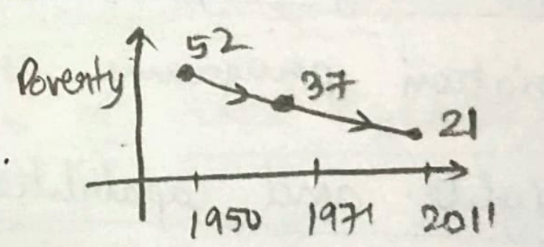
- Meaning
- Poverty is profound deprivation in well being, feeling of helplessness, powerlessness and lack of opportunities to grow and develop capacities, lack of security.
- Estimation
- Consumption expenditure
- DANDEKAR AND RATH, ALAGH, LAKDAWALA, TENDULKAR, RANGARAJAN COMMITTEES
- Consumption expenditure
- Multidimensional Poverty Index Report
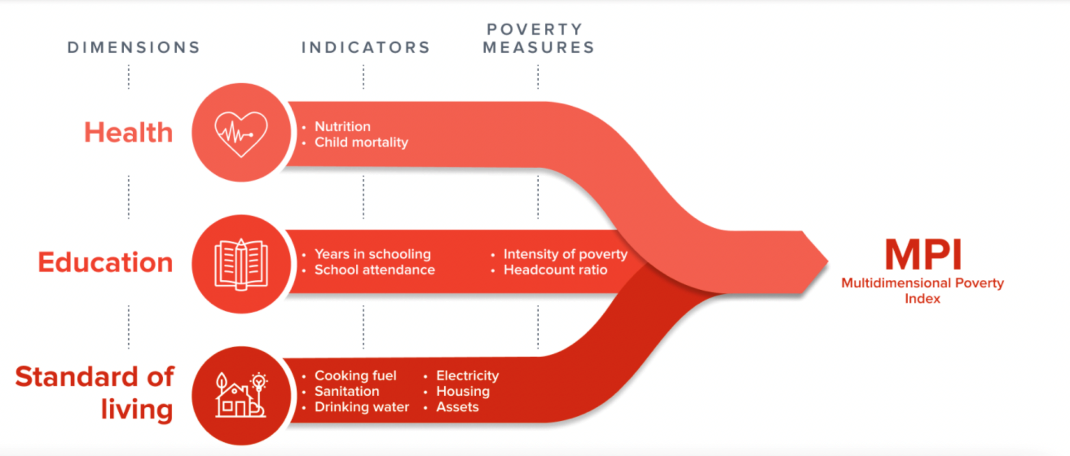
- High-WAGES
- NITI AAYOG Index add - Antenatal care, Bank Account
- Incidence of Poverty (Headcount Ratio): The proportion of the population that is multidimensionally poor.
- Intensity of Poverty: The average number of deprivations each poor person experiences.
- Key findings
- Global trends: 1.3 billion people are multidimensionally poor, substantially concentrated in Sub-Saharan Africa and South Asia.
- Significant disparities in poverty across regions, countries and within countries: stark difference between UP and Bihar and Kerala and Tamil Nadu
- Policy Recommendations
- comprehensive strategies including nutrition programs, educational support, and basic infrastructure like clean water and sanitation
- Targeted interventions in specific areas and regions
- Regular monitoring and evaluation to track progress and make necessary course correction
- focus on building resilience against pandemics, natural disasters, and economic downturns.
- Social security nets, disaster preparedness, and economic diversification
- Issue of clean drinking water
- India has 18 percent of the world’s population, but only 4 percent of its water resources, making it among the most water-stressed in the world.
- more than 600 million people facing acute water shortages.
- Reasons - over exploitation, uneven distribution, water pollution, poor infrastructure, climate change, inefficient practices
- Initiatives -
- NATIONAL WATER MISSION (NWM),
- JAL JEEVAN MISSION (JJM)
- ATAL BHUJAL YOJANA (ABHY)
- THE ATAL MISSION FOR REJUVENATION AND URBAN TRANSFORMATION (AMRUT)
- NAMAMI GANGE PROGRAMME
- Interlinking of Rivers (ILR) - NATIONAL PERSPECTIVE PLAN (NPP)
- Relation between Poverty & Hunger
- Magnitude & Trends of Poverty & Hunger
- Growing divergence
- GLOBAL HUNGER INDEX, MPI
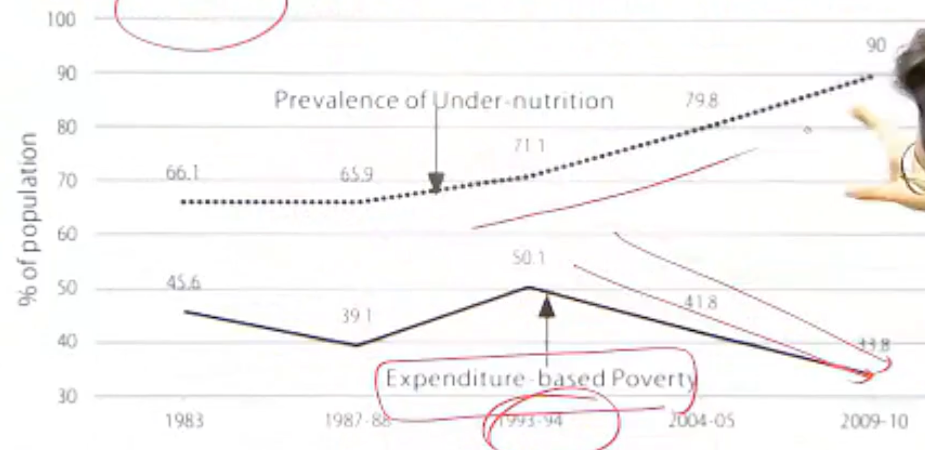
- Reasons for growing divergence
- Inequality
- Food inflation
- limited availability of diverse food items
- lack of awareness about proper nutrition
- Growing divergence
- Distribution of Poverty & Hunger
- Causes of Poverty & Hunger
- Landlessness
- Unemployment
- Large joint families
- Illiteracy
- Poor health/ malnutrition
- Child labour
- Feminization of women - women’s participation
- Lack of vocational skills
- Cost/Impact of Poverty & Malnutrition
- SDGs
- Food and nutrition insecurity - a consequence of structural inequities
- Constraints in Reducing Poverty & Hunger
- Measure Taken to Reduce Poverty & Hunger
- Government policies
- Growth oriented approach (50s - 60s)
- Issue is benefits of growth have not trickled down to the poor
- By means of work generation (61 + 3rd FYP)
- Rural employment generation program
- PM ROZGAR YOJNA (PMRY)
- Aimed at creating both self employment and wage employment
- Minimum basic amenities to the poor
- PDS - NFSA
- MGNREGS
- PM POSHAN
- National social assistance program
- Promotion of SHG’s
- DEENDAYAL ANTYODAYA YOJANA-NATIONAL RURAL LIVELIHOOD MISSION (DAY-NRLM)
- PRADHAN MANTRI UJJWALA YOJANA (PMUY) (2016)
- GRAM SWAROZGAR YOJNA
- PRADHAN MANTRI GARIB KALYAN ANN YOJANA (PMGKAY)
- Cover 67% of the country’s population
- subsidized Rice, wheat and coarse grains issued at Central Issue Price (CIP) of Rs.3, Rs.2 and Rs.1
- Growth oriented approach (50s - 60s)
- Government Programs
- Rural
- ANTYODAYA AANA YOJNA
- INTEGRATED RURAL DEVELOPMENT PROGRAMME
- PM GARMIN AAWAS YOJNA
- Urban
- PM AAWAS YOJNA - Urban
- NATIONAL URBAN LIVELIHOODS MISSION
- Rural
- NATIONAL FOOD SECURITY ACT
- Rice fortification
- Aadhar seeding
- MID-DAY MEAL SCHEME
- PRADHAN MANTRI POSHAN SHAKTI NIRMAN (PM POSHAN)
- PRADHAN MANTRI MATRU VANDANA YOJANA or PMMVY
- NGO and SHG
- P. SAINATH - Journalist worked on Rural Distress, Farmer’s suicide.
- MGNREGA
- Introduced as a social measure that guarantees “the right to work”, MRD
- Objective
- Employment generation
- Creation of sustainable assets
- Increase in agricultural wages
- Empowerment of women
- Upliftment of marginalized sections - SCs and STs
- Reduction in distressed migration
- Reduction in rural poverty
- Financial inclusion of poor
- Social audit
- Example - Meghalaya’s Public Services Social Audit Act
- Electronic fund management system, geo-tagging of assets and a national mobile monitoring system (NMMS) are technological interventions.
Inequality
- Indicators for inequality
- Gini index - 35.7 (WB)
- OXFAM inequality report -
Hunger
- Introduction
- Hunger - Unavailability of safe, sufficient and nutritious food
- Hidden hunger - micronutrient deficiency
- Hunger is a silent assassin as it creates an army of sick personnel -WHO
- Indexes
- Global hunger index
- India ranked 107/121
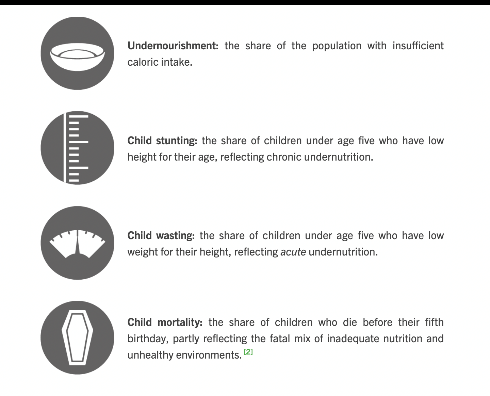
- Global hunger index
- Causes for Hunger in India
- Poverty
- Food Insecurity
- Public Distribution System (PDS), Mid-Day Meal Scheme, and Integrated Child Development Services (ICDS)
- Limited only to availability of cereals
- Poor Agricultural Practices and Infrastructure
- Climate Change
- Lack of awareness regarding prenatal, neonatal, postnatal care
- E.g. breastfeeding
- Measures | Government Initiatives
- Direct Nutrient Provision
- Mid-day meals (MISSION POSHAN 2.0), ICDS
- Micronutrient Supplementation:
- 57% women are anemic - providing iron and folic acid tablets - Schools, Aanganwadi
- Food fortification
- Vitamin D with Rice
- Salt with iodine
- Therapeutic Feeding
- Ready-to-Use Therapeutic Food (RUTF) to address Acute Malnutrition
- Diverse diets
- E.g. pulses, eggs, milk etc.
- E.g. Tamilnadu: breakfast scheme to tackle nutrition deficiency
- Technology
- Biotechnology - improve nutritional profile e.g. Single cell proteins
- Legislative measures
- NFSA, 2013
- Government schemes
- SAKSHAM ANGANWADI AND POSHAN 2.0 (MISSION POSHAN 2.0)
- INTEGRATED CHILD DEVELOPMENT PROGRAMME (ICDP)
- PM GARIB KALYAN AANA YOJNA
- Behavioral nudging
- POSHAN VATIKAS
- WASH Practices
- Leave no one behind approach
- Nutrition-sensitive interventions (addressing the underlying factors)
- Family Planning: delaying pregnancy and reproductive health
- Women-empowerment: BETI-BACHAO-BETI-PADHAO can reduce malnutrition in women
- Nutrition-sensitive agriculture
- Millets - 40% grown in India only
- Horticulture
- Pulses and fisheries
- Water, Sanitation, and Hygiene (WASH) programs
- SWACHH BHARAT MISSION and JAL JEEVAN MISSION
- Social Protection Program
- PDS
- Income and Livelihood Support
- MGNREGA, DAY-NRLM
- Direct Nutrient Provision
- Conclusion
- सर्वे संतु निरामया
- SDG 2