Art and Culture
Friday, 14 October 2022 10:12 PM
-
Symbolism
- Religious
- Cultural
-
Contemporary Examples
- Bali Jatra festival in Odissa
- Ankor wat temple of Cambodia
- Kashi Tamil Sangamam
- Ek Bharat Shrestha Bharat Program
- Charaideo Moidams of assam
-
The Gupta and Chola periods are often regarded as golden ages in Indian history.
ART AND CULTURE
-
Introduction
- Art: the expression and application of human creative skill and imagination.
- It constitutes of visual arts like painting, sculpture, architecture and performing arts like music, dance, drama.
- India enjoyed historical and civilizational linkages with Central Asia through the Silk Route from 3rd century BC onwards.
- Culture: the customs, arts, social institutions, and achievements of group of people regarded collectively.
-
Body
- Dimensions of Art and Culture - PLATFORMED
- Philosophy
- Painting
- Pottery
- Literature
- Language
- Architecture
- TCPS
- Temple and Sculptures
- Cave
- Pillars
- Stupa
- Rock cut
- FM
- Forts
- Mosques
- Indo-gothic
- TCPS
- Music
- Dance
- Drama
- AR-DMPL
- Architecture and sculpture
- Religion and philosophy
- Dance, drama
- Music
- Painting, pottery
- Language and literature
- Dimensions of Art and Culture - PLATFORMED
-
Reasons for Safeguarding Indian Art Heritage
- Reflect cultural identity, values and tradition of India
- Tourism: attract tourist and contribute to local economy and generate employment opportunities
- Educational value: serves as resource to help scholars and students to understand past
- Reflect civilizational legacy
-
Challenges in safeguarding Indian Art Heritage
- Urbanization and development
- Globalization
- Pollution and environmental degradation
- Example: The Taj Mahal faces severe discoloration
- Neglect and lack of maintenance
- Illicit Trafficking and Theft
-
Measures to safeguard Indian Art Heritage
- Antiquities and Art Treasures Act, 1972 to prevent illegal trafficking of art.
- Digitization: National Digital Library of India
- Establishing and upgrading museums and galleries
- Incorporating in education curriculum
- International collaboration: UNESCO World Heritage Site status
- Financial support by government
-
Conclusion
- Article 49 - obligation of the State to protect
- monuments and
- places and
- objects of national importance from spoilation.
- Evolution in the vivid imagination and magnificence ….
- ….. transcended the barriers of regions and boundaries and created integrated ‘Indian subcontinent culture’.
- Article 51A(f) of constitution enshrines fundamental duty of all citizens to value and preserve the rich heritage of our composite culture.
- In art all other countries are paupers, India is the only millionaire - MARK TWAIN
- Article 49 - obligation of the State to protect
BHAKTI & SUFI MOVEMENTS
-
Introduction
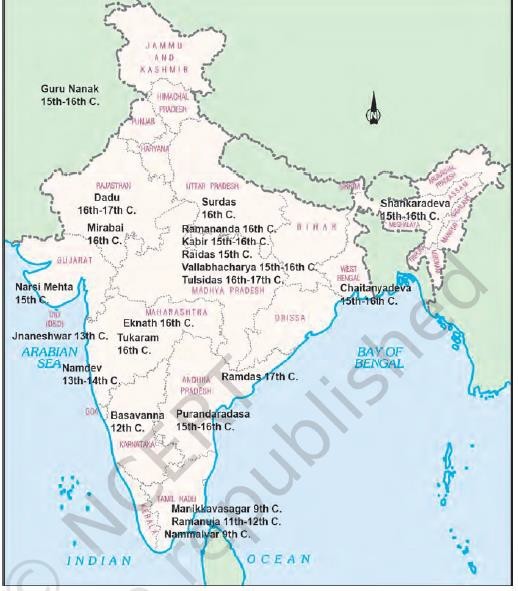
- Bhakti movement began in South India in 7th Century AD that turned from religious doctrine into a popular movement for equality around the country.
-
Spread of Bhakti and Sufi Movements
- Began in the 7th Century AD in the state of Tamil Nadu.
- Alwars (अल्वर) (devotee of Lord Vishnu)
- Prabhandam (प्रबंदम) and Prabhandakavyams (प्रबंध काव्यम)
- Nayannar (नयनारस) (devotee of Lord Shiva)
- Tevaram (तेवारम) and Thevacrams (तेवाक्रमस)
- Alwars (अल्वर) (devotee of Lord Vishnu)
- 8th century - ADI SHANKRACHARYA - Advait Vedanta
- 11th Century - RAMANUJACHARYA - Vishisht Advaitvada
- MADHAV ACHARYA - Dvaitvada
- 12th Century AD - BASAVANNA - Lingayats (Veershaiva)
- JAYADEVA (12 century A.D.) - last great name in Sanskrit poetry - Gitagovinda
- 13th Century - Vari Varkari of Pandharpur
- Gyandev, Namdev and Tukaram
- Began in the 7th Century AD in the state of Tamil Nadu.
-
North India
- Saguna (सगुण) bhakti
- Tulsidas, Surdas, Meerabai, Shakardev, etc
- Nirguna (निर्गुण) Bhakti
- Kabir (Bijak, Doha), Guru Nanak (15th -16th Century)
- Saguna (सगुण) bhakti
-
Sufi Movement:
- Silsilah
- Chishti
- Khwaja Muinuddin Chishti
- Khanqah in Ajmer
- Suhrawadi
- Bahauddin Zakariya
- Punjab and Multan
- Nakshabandi
- Khwaja Bahauddin Naqshbandi
- Orthodox
- Chishti
- Bashara (बाशरा) - They believe in the Islamic law Shariat (those who have वास्ता)
- Besara (बेशरा) - They did not believe in Shariat
- Silsilah
-
Women Poets of Bhakti
- Andal (अंदाल) (An Alwar saint)
- Karaikkal Ammaiyar - devotee of shiva - Nayannar
-
RAMANANDA was the first Bhakti saint to use ‘Hindi’ for propagating his message.
-
-
Nature of Bhakti Movement
- Professed devotion to god
- Example: Mirabai’s poems to Lord Krishna.
- Local Language
- Example: Kabir’s couplets in Hindi
- Focused on simple lifestyle
- Example: Narsi Mehta’s Vaishnav Janto
- Social Reform: against caste system.
- Example: Basavanna advocated for casteless society
- Egalitarian
- Universal ideals of tolerance and pluralism
- Example: Guru Nanak’s hymns emphasized universal brotherhood and equality.
- Amalgamation with the folk culture
- Used music, folklore, drama for spreading message
- Secular, Non-sectarian
- Example: Sant Tukaram’s abhangas in Marathi
- Participation of women
- Andal
- Promoted ethical conduct - humility, compassion, honesty to attain salvation
- Example: The teachings of Chaitanya Mahaprabhu
- Professed devotion to god
-
Contribution to Indian Culture
- Pluralism and diversity
- Kabir resonate with both Hindu and Muslim spiritual themes
- Enriched Indian literature in various languages
- Promoted local languages
- Example: The works of Surdas in Braj Bhasha
- Musical development: Influenced classical and folk music traditions
- Example: The compositions of Tulsidas in the Ramcharitmanas
- Social Reforms
- Challenged caste-based discrimination and patriarchal norms
- Inspired festivals and tradition
- Example: Janmashtami celebrations influenced by Bhakti traditions
- Inspired temple architecture and sculptures
- Example: The Vitthala Temple in Hampi
- Development of philosophical thought
- Ramanuja and Madhva expanded on Vedanta philosophy with a focus on devotion.
- Pluralism and diversity
-
Challenges faced
- Orthodox resistance
- Example: Hindu priests resisted anti-caste rhetoric of Bhakti saints.
- Their ideas were integrated into social structure without transformation
- Example: Bhakti concept of devotion influenced Hinduism, but without changing ritual practices
- Localized impact
- Focused on individual and its relationship with god
- Orthodox resistance
-
Conclusion
- Bhakti movement set a spiritual discourse of indian culture transcending the barriers of caste, gender, religion in worship through devotion.
RELIGION AND PHILOSOPHY
-
Introduction
- Shramana tradition emerged as non-Vedic religious movement rejecting ritualism.
-
Buddhism
- Buddha
- Buddha dictated to choose a moderate ascetic lifestyle as opposed to Jainism’s lifestyle of extreme austerity.
-
First Buddhist Council: 483 BC, Rajgriha, Ajatshatru presided by Buddhist monk Mahakahsyap. (RAM)
- Sutta Pitaka - original teachings of Buddha - given by Ananda
- Vinaya Pitaka - rules for monks - given by Upali
-
Second Buddhist Council: 383 BC at Vaishali, Kalahoska, presided by Buddhist monk Sabakami. (VKS)
- division of Buddhism into two sects:
- Sthavirvadins / Thervadas - orthodox
- Mahasamghika - liberal
- division of Buddhism into two sects:
-
Third Buddhist Council - 250 BC at Pataliputra, Ashoka, Mogaliputta Tissa (PAM)
- Ashoka recognized Theravada (थेरवद) as the original version of Buddhism.
- compilation of Abhidhammpitaka (अभिधम्मपिटक) which is a philosophical interpretation of Buddha’s teachings.
- He sent his son Mahendra and daughter Sanghamitra to Sri Lanka to spread Buddhism.
-
Early Buddhist sects which emerged between 3rd and 4th Buddhist councils
-
Fourth Buddhist Council - 78 AD at Kundalvana (कुंडलवन) in Kashmir, Kanishka, presided by Vasumitra and sub-presided by Aswaghosh. (KVA)
- compilation of an encyclopaedia of Buddhism Mahavibhasha
- Buddhism got divided into two formal sects - Hinayana (Sautrāntikas) and Mahayana (Sarvāstivādins)
- Mahayana won the debate
-
Hinayana
-
Mahayana
- Bodhisattvas
- Padmapani (lotus bearer)
- Manjusri (sword + book = wisdom)
- Vajrapani
- Maitreya
- Bodhisattvas
-
Reasons for decline
- monks become corrupt and started living luxurious life.
- started to interfere in the political affairs of kings
- sectarian divisions
- reforms in Hinduism
- Buddha was the 9th reincarnation of Vishnu
-
Jainism
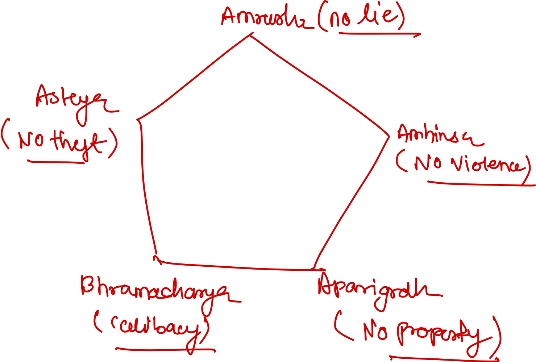
- 24 personalities known as Tirthankars
- 1st Tirthankar was Adinath (Rishabhdev) (associated symbol - ox/bull)
- 23rd was Parsvanath (associated symbol - snake/serpent)
- 24th was Vardhaman Mahavir (associated symbol - lion)
- Principles of triratna (Right faith, Right Knowledge, Right conduct) (draw tringle)
- Five pledges - Amrusha, Ahimsa, Asteya, Aparigraha, Brahmacharya
- Chandragupta Maurya under the influence of Jain monk Bhadrabahu accepted Jainism.
- 1st Jain Council Patliputra in 299 BC, Bindusar, presided by Jain monk Sthulabhadra. (PBS)
- Compilation of the teachings of the Tirthankars in 14 books known as Purva.
- Bhadrabahu (wrote kalpasutra) <> Sthulabhadra (Digambar (orthodox) <> Shwetambar)
- Kalpasutra mentions the life histories of 24 Tirthankaras
- 2nd Jain Council, 512 AD, Valabhi in Gujarat, Chalukyas, Devardhi Kshem Shramana.(VCD)
- compilation of Jain literature in the Prakrit language - Anga, Upanga, Prakirna, Chedabsutra, Mulsutra, and Bhagwatisutra.
- Important subsects of Jainism
- Bispanthi (बिस्पंथी)
- Mulapanthi (मूलपंथी)
- Therapanthi (थेरपंथी)
- Gumanapanthi (गुमानपंथी)
- Sthanakvasi (स्तंकवाशी)
-
Hinduism
-
The 12 Jyotirlingas are :-
- BMK-STRONG
-
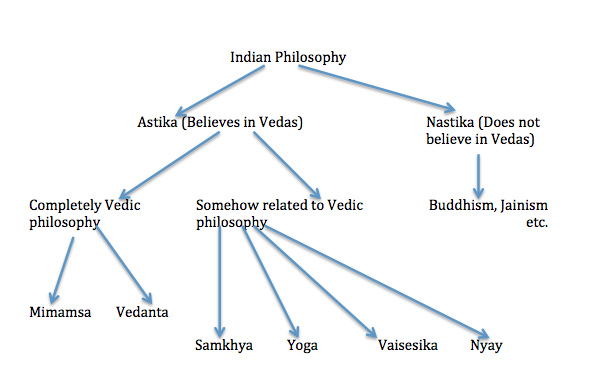
Philosophies
-
Orthodoxy - accepted Vedas
- Samkhya
- Kapil Muni
- Dvaitvada.(द्वैतवाद)
- Yoga
- Patanjali
- Believed Ashtanga yoga leads to salvation
- Nyaya
- Akshapada Guatam (अक्षपाद गौतम).
- logic and reason -> knowledge -> salvation
- Vaiseshikha (वैसेशिखा)
- Kanad
- Nyaya and Viaseshikha are considered as a Yugma.
- It is considered as the beginning of the school of Physics in India.
- universe is atomic in nature
- Mimamsa (मीमांसा)
- Mimansa means reflection
- Jaimini (जैमिनि)
- performance of Vedic rituals to attain salvation
- Emphasized the importance of the priestly class
- Vedanta (वेदांत)
- It is also known as Uttar - Mimansa.
- Bhdrayana (भद्रायण)
- Advaitvad (अद्वैतवाद - only one reality)
- Shankaracharya
- “Aham Brahmashmi” (अहं ब्रह्मास्मि) meaning “The God is within oneself”
- Vishista Adavaitvada (विषिस्थ अद्वैतवाद)
- Ramanujacharya.
- It believes that Bhakti Marg will lead to Salvation.
- Samkhya
-
Heterodox
- Jainism, Buddhism
- Ajivikas
- Makhaliputra Gosala
- Niyativada (Theory of destiny)
- Determinism - there is no free will and whatever that has happened, is happening, and will happen, one can not change it.
- theory of salvation as a fallacy
- Carvaka.(चार्वाक)
- materialistic school of philosophy also known as Lokayata (which means very popular among the masses).
- “Pratyaksha” is the only means of knowledge.
- “Prthyksham kin Pramanam” (प्रत्यक्षम किम प्रमाणम)
- “Yavat Jivet Sukhan Jivet, Rhinam Kritva gritam pibet” (यावज्जीवेत्सुखं जीवेत् ऋणं कृत्वा घृतं पिबेत्)
- maximization of pleasure and happiness
-
Conclusion
- Sramana tradition has a significant positive influence on the socio-cultural life of the people as well as it led to reforms in Hinduism.
- They led to establishing ideas of equality, justice and morality. They were revolutionary ideas of the time.
-
Lion
- Associated with royalty and power
- Lauriya Nandangarh Pillar
- Vehicle of deities
- Durga
- Embody heroic qualities
- Narsimha
- Buddha’s teachings
- Lion Capital at Sarnath
- Portray valour and nobility
- lion imagery in the Panchatantra and Jataka tales
- Title of singhparakram
- Associated with royalty and power
-
Bull
- symbolize agrarian prosperity and fertility - essential for ploughing and farming
- Vehicle of deities
- Nandi the bull is vahana of Lord Shiva
- symbolizing strength, determination, endurance
- Bulls are integral to the rural economy, used in agriculture, transportation, and trade.
- Bulls are celebrated and decorated during festivals
- Govardhan puja
- Example: The festival of Pongal in Tamil Nadu
- Religious sacrifice
- bull sacrifices in ancient Vedic ritual
-
Role of Indian Philosophy and Tradition in Shaping Monuments and Their Art:
- Vaastu Shastra guide the construction of temples
- Conceptualization of Stupa - represent the path to enlightenment and life events of Buddha
- Rock cut architecture - Chaitras and Viharas for hosting Monks
- Temples embody religious philosophies spiritual teachings
- Bhakti movement - highlight bond between deities and devotees
VEDIC SOCIETY
- Main Features of Vedic Society
- Varna System:
- Gotra exogamy started
- Gurukul System:
- Example: The Upanishads describe the relationship between guru and shishya
- Joint Family System:
- Patriarchal Society
- Example: Manusmriti outlines the duties and roles of men and women.
- Agrarian Economy:
- Polytheism: Worship of multiple deities with rituals and sacrifices
- Example: Rigveda hymns for gods like Agni, Indra, Soma
- Religious beliefs
- Nature worshippers
- Ritualistic Practices:
- Example: The Ashvamedha Yajna by King
- Decentralized governance
- Sabha, Samiti, Vidhata in various Mahajanapadas
- Philosophical thoughts and meditative practices
- Vedas and Upanishads
- Varna System:
LITERATURE
-
Introduction
- Indian literature has vast expanse of over 3500 years evolved from Brahmi (ब्राह्मी) and Kharoshthi (खरोष्ठी) scripts in diverse fields like religion, poetry, science etc.
-
Conclusion
- Literature of every age is regarded as a ‘Mirror of the society’.
-
Abugida system of writing
-
Classical Sanskrit Literature
- Introduction
- Sanskrit is argued to be most ancient language, with oldest literary heritage of mankind embodied in the Rig Veda.
- Introduction
-
Vedas, Brahmanas, Aranyakas, Upanishads, Puranas (stories e.g. Vishnu, Shiv)
- Rigveda - description of nature, prayers and mantras, Hotra (होत्र)
- Samaveda - hymns sung, last part - Gandharva Veda (grammar of music), Udgatar (उदगातर)
- Yajurveda - rituals and Yajnas, Adhvaryu (अधवारयु)
- Atharvaveda - diseases, mathematical knowledge, astronomy, astrology, book of spells and charms.
-
Books written
- Ashvaghosha (अश्व घोष) - Buddhacharita (बुद्धचरित) (Kanishka’s Court)
- Vishakhadutta (विशाखा दत्त) -
- Mudrarakshasha (मुद्रा राक्षस) (Chandragupta Maurya <> Dhanananda)
- Devichandraguptam (देवीचंदगुप्तम) - biography of Chandragupta II
-
Kalidasa
- Abhigyan Shakuntalam (अभिज्ञान शकुन्तलम) - (Dushyant and Shakuntala)
- Malvikagnimitra (मालविकाग्निमित्र) - (Malvika of Vidisha and Agnimitra Shunga)
- Vikramourvashi (विक्रमूर्वशी) - (Pururava and Urvashi)
- Kumar Sambhavam (कुमार शम्भवम) - Kartikeya (son of Lord Shiva)
- Raghuvamsam (रघुवमसम)
- Meghadootam (मेघदूतम)
- Ritusamhara (रितुसमघारा)
-
Shudraka (शुद्रक) - Mrichchhakatikam (मृच्छकटिकम्)
-
Banabhatta (बांड भट्ट) - Harshacharita (हर्श्चरित)
-
Harshvardhan - रत्नावली, प्रियदर्शनिका, नागनंदा
-
Sanskrit grammar
- Panini (पडिनी) - Ashtadhyayi (अष्टाध्याय)
- Patanjali - Mahabhashya (महाभास्या)
- Amarsimha (अमरसिंघ) - Amarkosha (अमरकोश) (gupta period)
-
Scientific test
- Varah Mihir - Surya Siddhanta
- Aryabhatta - Aryabhatiya
- Brahma Gupta - Brahma Sputa Siddhantika (भ्रम स्पुत सिधांतिका) (Book has the mention of zero)
- Nagarjuna - Rasaratnakar (रसरत्नआगर) - metallurgy
- Charaka - Charaksamhita (Ayurveda) (1st-2nd centuries AD)
- Bhrigu - Bhrigusamhita (Ayurveda)
- Sushruta - Sushrutsamhita (Surgery) (c. 4th century AD)
-
Conclusion
- Sanskrit is perhaps the only language that transcended the barriers of regions and boundaries and created integrated ‘Indian subcontinent culture’.
-
Ancient Buddhist Literature
- Canonical literature:
- Written only in Pali
- Tripitaka (त्रिपितक़) - Suttapitaka (सुत्तापिटक) (original teachings of Buddha), Vinaypitaka (विनयपिटक) (rules to be followed by the monks in Sangha), Abhidhammapitaka (अविधम्मपिटक) (philosophical interpretation of Buddha’s teaching).
- Khuddaka Nikaya (खुद्दक निकाय) of Suttapitaka (सुत्तापिटक) mentions Jataka kathas.
- Non-canonical literature:
- Pali books
- Mahavastu (महावस्तु) - Holy text of Theravada
- Mahavamsa (महावाम्सा) and Dipavamsa (दीपवाम्सा) - Sri Lankan chronicles of Buddhism
- Therigatha (थेरी गाथा) (women’s experience of renunciation)
- Sanskrit books
- Buddhacharita by Ashvaghosha
- Lalitvistara - Holy text of Mahayana Buddhism
- Pali books
- Canonical literature:
-
Ancient Jainism Literature
- Written in Prakrit Language (some are found in Sanskrit too)
- Anga; Upanga; Prakirna; Mulsutra; Chedabsutra and Bhagwati sutra
- Kalpasutra written by Bhadrabahu
- Writings of Bhaskaracharya - contributed towards development of mathematics
-
Early Dravidian Literature (e.g. Sangam Period)
-
Introduction
- Sangam literature is the earliest known literature of South India. Recent ASI’s report placed Sangam age between (800 BCE and 300 CE)
-
2nd assembly - Tolkappiyam (तोलकापीयम) (Tamil Grammar) written by Tolkappiyar (तोलकप्पियर)
-
3rd Sangam assembly
- Melkanakku (मलकानक्कु) (18 major texts) - political exploits of Pandya rulers
- Ethuthogai (ईतूटोगाई) (8 Prose)
- Ppattuppattu (प्पत्तु पट्टू) (10 Anthologies of poems)
- Kilkanakku (किलकानकु) (18 Minor texts) - Ethics, Morality and benevolence
- Thirukural (तिरुकुरल) written by Thiruvalluvar (तिरुवल्लुवर)
- Palamoli (by Munrurai Araiyar)
- Acharakkovai
- Melkanakku (मलकानक्कु) (18 major texts) - political exploits of Pandya rulers
-
Post Sangam period Tamil Epics - 200 to 600 CE
- The poems are of two types—aham (love poems) and puram (heroic poems).
- Silapatthikaram (सिलापाथिकारम) - Ilango Adigal (इलाँगो अदिगल) - 6th AD - post sangam period
- Mannimekalai (मनी मेकलाई) - Chattanar (सत्तनार). (Buddhism)
- Jivaka Chintamani
- Valaiyapati
- Kundalakesi.
-
Tirumurai - Writing of Shaivite saints - 12th AD
-
Limitations
- Fragmentary Nature: focus on individual experience and emotions rather then a coherent historical account
- Lack of Chronology: absence of dated records complicate construction of historical timeline
- Selective representation: Focus on specific region and kingdoms leading to fragmented and biased view
- Example: Poems often glorify Pandyas, Cholas and Cheras
-
Portray social conditions
- Social hierarchy: provide detailed descriptions of the caste system
- describe the activities of daily life
- Provide account of religious rituals and customs
- Role of women
- Provides accounts of various festivals, ceremonies
-
Portray economic conditions
- Agriculture and Land Use: describes agricultural practices, crop patterns, land and water management practices
- Example: Poems detail the cultivation of rice, sugarcane and millets
- Trade and Commerce: describing the bustling markets and trade routes.
- Example: Sangam poems mention trade with Romans and Southeast Asia
- Depict various occupations and crafts: like blacksmiths, weavers, fishermen, and traders
- Details of patronage extended by kings to poets and artisans
- Agriculture and Land Use: describes agricultural practices, crop patterns, land and water management practices
-
Conclusion
- Sangam writings are possibly unique in ancient India due to their multi-disciplinary approach. It reflects that toleration and acceptance are culturally imbedded in indian ethos.
-
Medieval Literature
- Persian literary sources reflect the spirit of the age
- Document political narratives like reigns of rulers, military campaign
- Example: “Tarikh-i-Firuz Shahi” by Ziauddin Barani
- Shows blend of Indian and Persian culture
- Example: The “Ain-i-Akbari” by Abu’l-Fazl, part of the “Akbarnama,” illustrates religious tolerance
- Show scientific and intellectual works
- Francois Bernier (1656-1668) - wrote ‘travels in mogul empire’
- Give insight into administration and governance
- Ibn-Batuta (1304-69) - Kitab-ul-rihla
- Describe social norms and daily lives
- Al-Biruni (973-1050) - Kitab-ul-Hind
- Reflect influence of Sufiism and Bhakti Saints
- Amir Khusrao (1253-1325) - Ijaz-e-khusravi
- Descriptions of architectural marvels and artistic achievements
- Example: Persian accounts of the construction of the Taj Mahal by Shah Jahan
- Document political narratives like reigns of rulers, military campaign
- Persian literary sources reflect the spirit of the age
-
Krishnadeva Raya as a Patron of Learning and Literature
- Ashtadiggajas: established a distinguished assembly of eight poets
- Example: Prominent poets like Allasani Peddana and Tenali Ramakrishna
- Patronized the translation and composition of classical texts
- Supported diverse literary genres, including poetry, drama, satire
- Patronage to scholars from different languages including Telegu, Kannada, Sanskrit, Tamil
- Construction of Educational Institutions: established schools, libraries, and universities
- Encouragement of Art and Architecture: literary themes often depicted in temple sculptures and paintings
- Gave numerous endowment to religious and cultural institutions:
- Example: The renovation and expansion of the Tirupati Temple
- Ashtadiggajas: established a distinguished assembly of eight poets
-
Trends in Medieval Literature
-
Modern Indian Literature
- Kozhikode: UNESCO ‘City of Literature’
ARCHITECTURE
-
Harappan Architecture
- Introduction - Harrapan Civilization was discovered by Dayaram Sahni in 1921. It is believed to be the oldest known advanced urban settlement in the world.
-
Features of townships
- Grid-Patterned Layout
- Underground Drainage System:
- consisting of covered drains and brick-lined sewers.
- Standardized bricks of uniform size and moisture content
- Granaries and Warehouses
- Trade Networks with Mesopotamian Civilisations
-
IVC seals - made up of soft river stones ‘Steatite’.
- Pasupathi seal, Pipal leaf, unicorn seal
-
Terracotta toy carts, animals etc represent day-to-day life.
-
Conclusion - The civilization’s sense of life, skills and artistic sensibilities reflects vivid imagination of the people, we can take inspiration from them in urban planning in modern india.
-
Mauryan Architecture
-
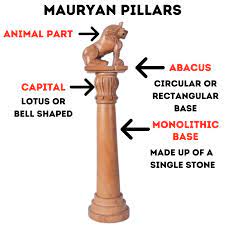
Pillars
- monolith and created from a single stone.
- It included a shaft, a bell capital, and an abacus sometimes with Ashoka chakra.
- Lauriya Nandangarh - Lion, Rampurva pillar - Bull, Sarnath Pillar, Sankissa pillar - Elephant
-
Sarnath pillar
- Lion represent - power and enlightenment
- Overall 4 lion, PPCC - Power, Pride, Courage, Confidence
- 4 Animals - Bull, Lion, Elephant, Horse
- Dhamma chakra
- State emblem of india Act, 2005 (Central government can make changes in design)
- State Emblem usage Rule, 2007
-
Stupa
- Stupa is a Sanskrit word that means a heap of sand.
- The early nine stupas were created by Ashoka.
- Significance
- Buddhist Pilgrimage Site
- Marks spread of Buddhism and its commitment to teaching Dharma
- Example: Ashoka’s inscriptions
- Promoting Enlightenment: guiding followers on their spiritual path
- Encouraging ethical conduct and righteous living
- Ashokan Edicts
- Fostering devotion and sense of community and collective worship
- Convey Buddhist philosophy in accessible and comprehensible manner
- Highlight development of Buddhist architectural form
- Example: The intricate carvings on the gateways depicting Jataka kathas
- Hub for cultural and religious exchanges
- Centre for Buddhist learning
- Was major monastic center
-
-
Architectural significance
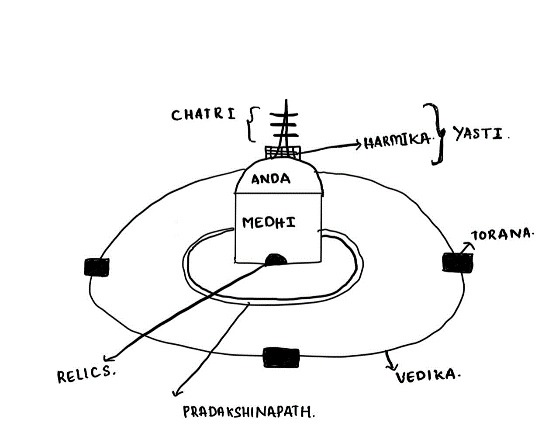
- Hemispherical dome (anda) represent the universe
- Three chatris signify the three jewels of Buddhism - Buddha, Dharma, and Sangha.
- Toranas depict scenes from Buddha’s life and Jataka tales.
- Vedika indicating a transition in architectural materials.
- From wooden to stone balustrade.
- pradakshina patha reflect the Buddhist practice of reverence.
-
-
How it expounded Buddhist ideals
- Jataka Tales: stories from Buddha’s life teaching moral lessons
- Vessantara Jataka on Toranas of Sanchi Stupa
- Bodhi Tree and Lotus Motifs: symbolized purity and enlightenment
- Relief carvings at Bharhut Stupa
- Yakshas and Yakshini’s: representing nature and fertility
- Shalbhanjika Yakshini at gateways of Sanchi Stupa
- Animals and nature: highlighting interconnectedness of all life forms
- Carvings of lion, elephant, bull, etc
- Symbolic representation: Dharmachakra, footprints of Buddha, and stupa itself convey Buddhist teachings
- Jataka Tales: stories from Buddha’s life teaching moral lessons
-
Influence on Future Architecture in India
- influenced early temple architecture during Gupta period
- development of rock-cut cave architecture
- The chaitya halls at Ajanta
- Influenced layout and design of monastic complexes
- continued to influence religious architecture
-
Post-Mauryan Period Gupta Period
- Introduction - Gupta Period in the 4th century A.D. marks the beginning of another era as expressed by Fa-Hien. Art, science and literature and technology flourished greatly during their time.
-
Caves
- Apsidal vault cave with Pillars - Ajanta
- Apsidal vault cave without pillars - Thana Nadsur
- Quadrangular Hall Flat Roof Cave - Mahakali
- Chaitya - Worship
- Vihara - Shelter
-
Stupas
- The wooden Vedika of the Previous period was now replaced with stone balustrade
- Upper Pradhakshinapath - emphasised the Mahayana path of Buddhism
- Manushi Buddha
- Chhatris started to increase in odd numbers
-
Cave Architecture
- Mauryan caves - first man-made cave
- semi-circular façade, intricate reticular design, Elephant images, meant for shelter for Ajivika Monks
- The majority of these caves were created by Ashoka and his grandson Dashrath
- Lomas rishi caves and Sudama caves of Gaya Bihar, Dhauli caves of Odisha
- Gupta Period Caves
- Ajanta caves - Aurangabad
- 29 caves- 25 Viharas and 4 Chaitya
- Steep side of the hill, As such it didn’t have any courtyards
- Fresco - Padmapani (Boddhisattva holding the Lotus), Vajrapani (Bodhisattva holding the vajra (thunderbolt)), Maitreya (Future Buddha), Manjushri (Buddha of wisdom), Flying apsara and Dying Princess.
- Ellora Caves
- 34 caves-17 are Hindu, 12 Buddhist and 5 Jain
- slope side of the hill because it had courtyards in Ellora
- Premise 16 - Kailashanatha temple - monolithic temple
- Rashtrakuta ruler - Krishna I
- Fresco - Lord Vishnu riding on garuda
- Elephanta caves
- Buddhist tradition -> Hindu Tradition
- Trimurti sculpture of Mahesh, Uma, and Bhairav.
- Nasik Caves
- viharas and belong to the Hinayana tradition of Buddhism.
- Bagh Cave - MP, sandstone, Rang Mahal-beautiful frescos based on Buddhism.
- Ajanta caves - Aurangabad
- Jaina Caves
- Udayigiri-Khandgiri Caves
- Odisha
- Jain king Kharvela
- Udayigiri-Khandgiri Caves
- Mauryan caves - first man-made cave
-
Rock Cut Architecture - consisting of temples, monasteries, and caves
- Significance
- Historical Chronology: help in establishing timeline of developments
- Insights into religious and cultural practice
- Example: The Ajanta Caves depict the life and teachings of Buddha
- Show intricate sculptures, frescoes, and carvings highlighting craftsmanship of artisans
- Example: The Barabar Caves
- Reveal advancements in engineering and construction
- Example: The Kailasa Temple at Ellora, carved out of a single rock
- Provide insights into the socio-economic conditions
- Provide valuable information about historical events, rulers, and religious practices.
- Helped in preserving ancient texts, teachings, and traditions
- Example: The Ajanta murals
- Significance
-
Temple Architecture
- Introduction - Temple architecture evolved over the centuries from simple rock-cut or flat roof structures to massive and ornate temples which spread across the Indian sub-continent.
- E.g. Brihadeshwar temple of Tanjore
- ‘Golden age’
- Introduction - Temple architecture evolved over the centuries from simple rock-cut or flat roof structures to massive and ornate temples which spread across the Indian sub-continent.
-
Gupta period - Deogarh temple, Sanchi temples
-
Nagara Style
- Evolution
- First Stage
- Temple No. 17 at Sanchi
- Second Stage
- Parvati Temple in Nachna Kuthara
- Third Stage
- Dashavatar Temple Deogarh, Jhansi
- First Stage
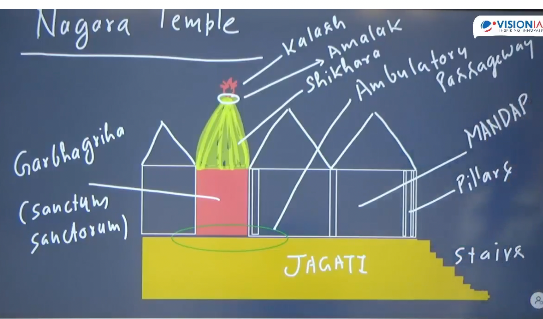
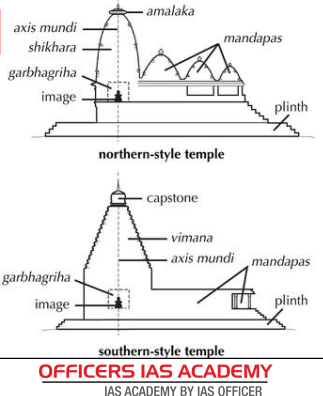
- Features
- crucified ground plan
- Do not have boundary walls
- water tank is absent
- Curvilinear tower Shikhara.
- created facing east direction
- Panchayatan style
- Evolution
-
Khajuraho
- Chandelas
- Exterior and interior walls - lavishly decorated
- Lakshmana temple
- Multiple Shikhar - impression of a mountain range
- Kandariya Mahadev
- sculptures inspired by Kamasutra written by Vatsayana (वात्स्यायन)
- circular temple was also created in many places
- Chaunsath yogini temples of Khajuraho
- Hindu and Jain temples
- Parshvanath temple.
-
Orissa
- Ganga dynasty
- boundary wall is present
- exterior wall - lavishly decorated
- interior walls - plain
- Sun temple of Konark
- Deul (देउल) Shikhara
- Lingaraja temple of Bhubaneshwar
- Voga Mandira, Nartya Mandira
- In some of the temples of Odissa, the image of the deity is created from wood.
- Jagannathpuri temple
-
Solanki
- lavish intricate ‘interior’ decoration
- presence of water tanks in some temples
- Modhera sun temple of Gujarat. Jain temple: Dilwara Jain temple of Mt. Abu.
-
Dravida Style
- Developed in south India under Pallavas
- 4 stages - R-PK-V
- Mahendravarman stage - rock-cut temples of Siyamangalam
- Narsimhavarman stage - Pandav Rath, Mahabalipuram
- Rajsimhavarman stage - Kailashnath temple of Kanchi, Shore temple of Rameswaram
- Nandi Varman stage - Vaikunth Perumal temple of Kanchipuram
- 4 stages - R-PK-V
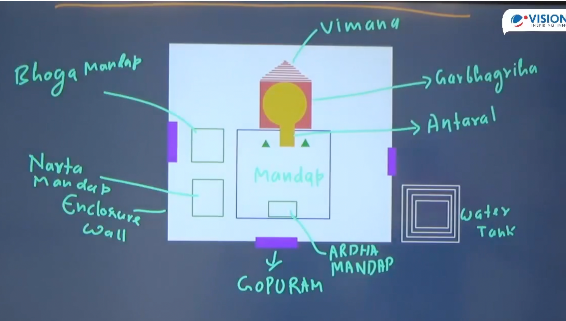
- Vimanas created on gopuram as well.
- Water Tank is a necessary feature of Dravida style, so are the enclosure walls.
- The finial in this style is known as Cupola.
- Kuta (square), Shala (rectangular), Vritta (circular) and Gaja-Pristha (elliptical), ashtasra (octagonal) are subdivisions.
- Developed in south India under Pallavas
-
Chola temple - Brihadeshwar Temple Thanjavur - Rajaraja 1
- interlocking pattern were used
- vimana is 8 ton, height of tower is 60 m
-
Vijayanagar Temple - Krishnadevaraya
- Amman shrine (2nd garbh graha)
- Kalyana mandapam
- Raya Gopurams
- Examples: Virupeksha Temple of Hampi, Veerbhadra temple of Lepakshi.
-
Nayaka Temple - Madhurai
- created many Gopurams with very high vimanas on them.
- presence of huge corridors known as “Parakram”.
- water tank inside temple - Pushkaram
- Examples: Sri Ranganath Swamy temple of Srirangam, Meenakshi sundereshwar temple of Prakram.
-
Vesara Style
- ‘Cradle of Temple Architecture’.
- Chalukya rulers of Badami
- Sanskrit word Vishra meaning taking a long path
- Mixture
- Panchayatan style
- Pyramidical Shikhara on the Garbhagriha
- They also incorporated a Buddhist-style semi-circular chaitya hall.
- Examples: Durga temple of Aihole, lad khan temple of Aihole.
-
Hoysala Style (10-14 Century) -
- stellate or star-shaped ground plan.
- Pyramidical vimana
- lavish decoration was created on both sides of the wall
- Hindu mythology was engraved i.e. the Mahabharat and the Ramayana on walls
- Examples: Hoysaleshwara temple of Halebid, Channa Keshava temple of Belur.
-
Significant features of Dravida Temples
- Monumental Scale: expensive complex and towering vimanas
- Ranganath Swamy Temple, Srirangam
- Advanced engineering skills
- Interlocking pattern Brihadeshwar Temple
- Intricate Sculpture and rich iconographic tradition: depicting gods, goddesses, mythological scenes
- Meenakshi-Sundereshwar temple
- Built according to Vastu Shastra: ensuring harmonious alignment with cosmic principles.
- Integration of Art and Architecture:
- Virupeksha temple of Hampi
- Temple complexes that served as social, economic, and cultural hubs
- Hoysaleshwara temple of Halebid
- Monumental Scale: expensive complex and towering vimanas
-
Conclusion - Evolution in the vivid imagination and magnificence of temple architecture can be seen when we compare flat roof temples at Sanchi with Khajuraho’s temple.
- The Kakatiya architecture made the temples of deccan as the brightest star in the galaxy of temples as said by macro polo.
-
Medieval and Indo-Islamic Architecture
- Introduction - Indo-Islamic Architecture emerged from the amalgamation of Indigenous and Islamic features with arrival of Islam in the subcontinent.
-
-
Features of Indo-Islamic Architecture
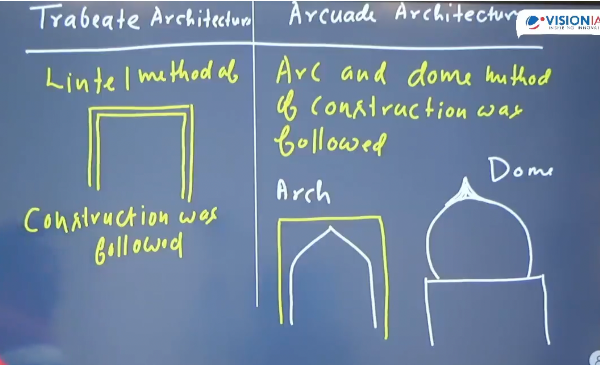
- arch and dome method
- red sandstone, grey sandstone, and white marble in construction.
- geometrical designs
- Iconography
- angularised Persian script - kufi
- Arabesque (अरबेसक्यू) method of decoration
- Ornamentation
- intricate jali work
- Pietra-dura in which coloured stones, marbles, semi-precious stones were pasted on the walls in a particular design.
- Chahar bagh (Char Bagh)
- Water bodies
-
Imperial Style Delhi Sultanate
- Slave
- Hindu and Jain premises were converted to Islamic premise
- E.g. Qutub Minar - Sufi saint Qutub-ud-din Bakhtiyar Kaki
- E.g.: Arhai din ka Jhopra (Ajmer); Quwwat ul Islam Mosque- Delhi
- Khilji period
- Red colour sandstone
- Tughlaq period
- started using Grey sandstone instead of Red sandstone
- battar method of construction
- For example- Tughlaqabad fort; Firoz shah Kotla fort; Jahapanah fort
- Lodhi period
- Double dome structure
- incorporated the Indian concept of Verandah in their buildings
- started planting gardens
- Ex- Lodhi Garden and Lodhi tomb
- Slave
-
Provincial Style
- Bengal - Brick and Black colour stone, terracotta tiles, Sloping Bangla Roof
- Ex: Kadam Rasool Mosque, Pandua
- Jaunpur - Sharqui style, Propylon Gateways
- For Example - Atalla Masjid Of Jaunpur
- Malwa - Mandu, Well proportion staircases, Large windows, middle of water bodies
- E.g.- Jahaj Mahal; Ashrafi Mahal; Mandu Fort; Rani Rupmati Pavillion; Hindola mahal, etc
- Bijapur - Adil Shahi dynasty of Bijapur (Karnataka)
- Three Facade Arch
- Spherical domes
- E.g.- Gol Gumbaj; Adil Shah Mosque; Jama Masjid (means place for Friday prayer) of Bijapur
- Bengal - Brick and Black colour stone, terracotta tiles, Sloping Bangla Roof
-
Mughal Style
- Humayun’s tomb at Delhi
- Akbar
- Red Fort at Agra
- Fatehpur Sikri
- Buland Darwaza in which Tudor Arch was created, Panch Mahal (Trabeate Rajput style)
- Salim Chisti’s Tomb
- Jodha Palace, Birbal Palace, Jahangir Mahal, Ibadatkhana
- Jahangir
- Naturalist
- Portrait painting
- Itmad-ud-Daulah tomb Agra
- Shahjahan constructed the City of Shahjahanabad and following buildings in Shahjahanabad -
- Red Fort, Delhi
- Jama Masjid, Delhi
- Fatehpuri Masjid, Delhi
- Chandni Chowk, Delhi
- Meena Bazar, Delhi
- Aurangzeb
- Badshahi Mosque at Lahore
- Biwi ka Maqbara at Aurangabad
-
Sikh Style of Architecture
- fluted dome.
- stepped water tanks
- Examples: Golden Temple of Amritsar, Huzur Sahib in Nanded Maharashtra, Patna Sahib in Patna.
- fluted dome.
-
Rajput Architecture
- one of the finest fort makers of the World.
- Examples: Amer Fort, Jai sing Fort, Nahargarh Fort, Mehrangarh, Ranthambhor Fort, Jaisalmer Fort, Gwalior Fort, Bhangarh Fort.
- modified the dome structure in a concave shape.
- hanging balconies of carved cornice of half bowed sides.
- Raja Jai Singh - Jantar Mantar
- Examples: The Hawa Mahal, Udai Vilas Palace, Umed Bhawan, City palace of Jaipur, Jantar Mantar of Jaipur.
-
Conclusion - Indo-Islamic architecture is a remarkable amalgamation of Persian, Turkic and Indian architecture known for its symmetry and decorations.
-
Colonial Architecture & Modern Architecture
-
European Influence
- Indo-Gothic style -
- steel and iron rod in construction.
- poured concrete in construction
- pointed arches
- large windows
- Victorian deco-art
- St. Fort George in Madras and St. fort William in Kolkata
- Victoria Memorial are examples of Kolkata. Church gate, CST, gateway of india in Mumbai
- Neo Roman style
- Began after 1911
- Edwin Lutyens and Herbert Baker
- pink sandstone
- double dome structure
- good number of green belts
- Examples - old parliament building, Rashtrapati Bhawan, old supreme court
- Indo-Gothic style -
-
Indo-Saracenic Architecture
-
Post-Independence Period
-
Contribution of Buddhism & Jainism to the Development of Indian Architecture

INDIAN ART FORMS
Gandhara Art Influences
-
Central Asian influence in Gandhara Art - IC-ROMA
- Clothing: Buddha’s depiction with headgear and boots
- Grooming: use of Mustache in sculptures
- Stupa architecture: development of Persian style decorative motifs
- Ornamentation: depiction of weapons
- Material: terracotta and stucco was inspired from Central Asian practices.
-
Greco-Bactrian elements in Gandhara Art
- Artistic Styles: naturalistic representation, idealized forms
- Anatomical accuracy and idealistic body proportion
- Greek intricate drapery
- Narrative reliefs
- Sculptural techniques: use of perspective, depth and realistic portrayal
- Materials: like schist stone in sculptures prevalent in Greek art adapted by Gandhara artists.
-
Roman influence
- Realistic Portraiture: unshaven face and curly hairs
- Roman architectural features: Corinthian columns in monasteries and stupas
- Imperial Imagery: standing posture and use of halo
- Coins: artistic styles of coins with realistic portraits and inscriptions
- E.g. coins from Kushana Empire featuring Greek gods
-
Gandhara art is a remarkable example of cultural blending reflecting the rich and interconnected history of the region.
INDIAN PAINTINGS
-
Introduction -
- Painting is art form giving expression to human thoughts and feelings through the media of line and colour.
- …. Formed the spinal column of different school of Indian …. Art.
-
Paleolithic
- Petroglyph
-
Mesolithic
- Microlith, Red colour (blood of animals)
- Reflection of Cultural Life:
- Depiction of Daily Activities: hunting, gathering, animal riding, group dance, sexual union (primitive institution of marriage)
- Example: The Bhimbetka rock shelters
- Use of Tools and Weapons: illustrations of tools, weapons, and animals
- Example: Depictions of stone tools and spears
- Social and Religious Practices
- Rituals and social gatherings
- Environmental Interaction: reflects a deep connection with the natural environment
- Depiction of Daily Activities: hunting, gathering, animal riding, group dance, sexual union (primitive institution of marriage)
Example: The diversity of animal figures, including deer, bison, and elephants, at Bhimbetka
-
Aesthetic Sense Comparable to Modern Painting:
- Use of natural colour and pigments
- Example: The red and white pigments used in the Bhimbetka paintings
- Artistic Techniques: like engraving, stencilling
- reflect an advancement
- Symbolism: abstract symbols and motifs were painted
- Example: Geometric patterns
- Expressive Quality: in scene of movement and dance
- parallels modern artistic expressions of motion and emotion
- Use of natural colour and pigments
-
Critical analysis
- Function: primary function of Mesolithic art was education and rituals rather then aesthetics
- Cultural context: they were group painting and cannot be attributed to individuals
- Different material and paints
- Evolution of artistic styles: modern art encompass multiple painting styles
-
Political features
- Portraits of kings
- the Jahangir’s painting depicts Jahangir standing on a lion
- Nationalism
- E.g., Bharat Mata by Abanindranath Tagore
- Portraits of kings
-
Fresco Mural Paintings
- mixture of clay, cow dung, and rice husk
- lime plaster is coated on Mixture
- Colours
- Examples -
- North
- Ajanta caves - Padmapani (Boddhisattva holding the Lotus), Vajrapani (Bodhisattva holding the vajra (thunderbolt)), Maitreya (Future Buddha), Manjushri (Buddha of wisdom), Flying apsara and Dying Princess.
- Ellora painting -
- Badami Mural - Manglesh Chalukya - Vaishnavite Tradition
- Bagh caves (Gwalior) - Gupta period
- South
- Sittanvasal Mural - Pandyas - Jainism
- Chola Mural - Hindu Gods and Goddess and also the images of Chola rulers
- Lepakshi Mural or Vijayanagar Mural - secular in nature
- Kerela Mural - Travancore rulers - Ramayan Mahabharat and Puranas
- Nayak Mural - Madurai, Hindu Mythology and the Life of Vardhman Mahavira.
- North
-
Miniature Paintings
- Pala rulers
- Palm leaves
- Buddhist tradition
-
Mughal
- Mir sayyid Ali, Abdus Samad
- Safavid style of miniature
- Akbar - Realism
- Razmanama (Mahabharat), Tutinama was painted
- Jahangir
- Naturalist
- Portrait painting
-
Rajput
- Lord Krishna, Jayadeva geet govinda
- Mewar - ragmala painting - Maru Ragini - Sahibdin
- Kota Bundi - local vegetation
- Kishangarh - nihal chand - bani thani
-
Pahari Paintings
- Kangra - charles metcalfe - hindu god and goddess
- Guler - jammu - love themes
- Thang-ka painting - ladakh - buddhist - mandala art
-
Patna kalam - East India Company
- Men of Bihar - subaltern approach - hardship of poor
-
Conclusion - Paintings reflects the social practices, values and traditions of the time.
DANCES IN INDIA
-
-
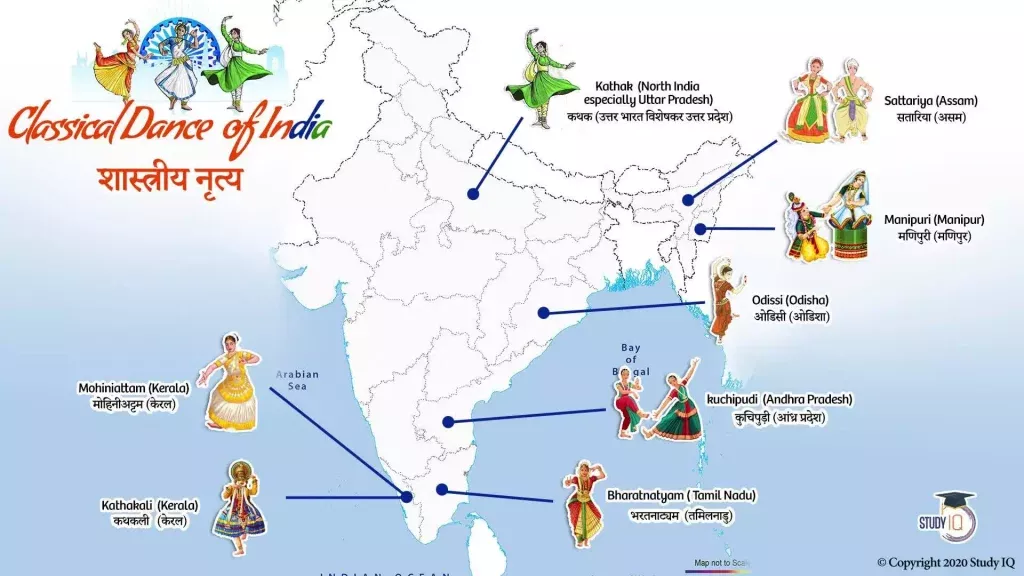
Classical Dance Forms
- The Earliest treatise on Dance, Drama and Music is Bharatmuni’s Natyashastra
- As such Following elements were incorporated
- Pathya (पथ्य) (Words) - were taken from Rig Veda.
- Abhinaya (अभिनय) (Expression) - From Yajurveda
- Geet (गीत) (Music)- From samveda
- Rasa (रस) (Emotions)- From Atharveda
- Samaveda - 16000 Raga and Ragini, later part Gandharva Veda which is a rule book or grammar of music.
- 2 aspects of Dance
- Lasya (लस्या)
- Tandav (तांडव)
- Aggression, determination, strength, fast movement.
- Shivas tandava
- Bhairav (भैरव) tandava - destruction
- Ananda (आनंद) Tandava is a Dance of reconstruction.
-
3 ELEMENTS OF DANCE
- Nritta (नृत्ता) (Pure dance movement)
- Natya (नाट्य) (dramatic expression)
- Nritya (नृत्य) (Expression with dance movement)
-
Bharatnatyam - Devdasi System of Tamil Nadu
- Fire, Carnatic music
- Katak Mukha Hasta - symolise OM.
-
Kuchipudi - Andhra Pradesh - Male Brahmins (Bhagwathalus)
- Earth, शृंगार रस, Carnatic music
- Themes - भामाकल्पम
- Popular elements - मंडूक शब्दम, जल चित्र नाट्यम, तरंगम
- Patronized by rulers of Vijaynagar.
-
Kathakali - Kerela
- From theatres of Kerela like Krishnattam (कृष्णत्तम), Ramanathan (रामंत्तम).
- Sky, Ballad of the east, Ramayana and Mahabharata, Sopan Music
-
Mohiniattam
- Dance of Enchantress
- Lasya, Air, Carnatic music
-
Odissi -
- Odra Nritya - mentioned in Bharatmuni’s Natya Shastra
- गोतीपुआ - young boys doing धामे
- Themes - Geet Govind Of Jaidev and Vichitra Ramayan of Vishwanath Kunthia
- Hindustani Classical Music
- Tribhanga, Chowk
-
Manipuri
- Fusion of Lai Haroba and Thang Ta.
- Sankirtana, Ras Leela
- सर्वांग अभिनय
- NagBandha Mudra
-
Sattariya - Assam
- Shankar Deva introduced Devdasi folk dance
-
Kathak - UP
- Kathakar tradition of North
- Costume - अंगरखा (male), अनारकली (female)
- Full foot contact (unlike bent position in other classical dances) is of utmost importance
- Jugal bandi
-
Folk Dance Forms
-
Modern Dance
MUSIC
-
Bharatmuni’s Natya shastra
-
Classical Music
- Dhrupad
- Oldest
- Temples of North, devotional
- Alaap->Jod->Sthayi->Antara-> Sanchari->Aabhog
- Baiju Bawra, Gopal Das, Tansen
- Khayal
- Amir Khusrau
- Romantic, Use of Taan
- Carnatic
- Annamacharya - Sankirtana - lord Venkateshwara
- Sangitsara (संगीतसार) of Vidyaranya (विध्यारण्या)
- Venkatamukhi (वेंकटमुखी) wrote Chaturdandi Prakashika (चतुरदंडी प्रकाशिका)
- Melakarta (मेलाकर्ता) Raga System
- Vishnu Narayan Bhatkhande (विष्णु नारायण भातखंडे) - Popularised
- Ragam (Alaapana) -> Tanam -> Pallavi (set melody to taal)
- Dhrupad
-
Semi Classical
- Thumri
- Bhakti saints
- Purbi & Punjabi
- Dhamar (धामर)
- Braj Area - Holi
- Tarana
- Tappa
- Camel riders of North West
- Qawwali
- Amir Khusrao, Festival of URS
- Ghazal
- Persian influence
- Sufi elements
- Thumri
-
Folk Music
PUPPETRY
- String Puppets
- Shadow Puppets
- Rod Puppets
- Glove puppets
- Modern Puppetry
- Tribal Puppetry
POTTERY
-
Introduction
- Pottery is process of forming durable objects and vessels from ceramic materials by heating at high temperatures. It plays important role in understanding culture and reconstructing past.
-
Black and Red Ware (BRW)
- IVC
- Chalcolithic period
-
Ochre (गेरुवा) Coloured Pottery (OCP)
- Later IVC - chalcolithic sites
-
Painted Grey Ware (PGW)
- Vedic era
-
Northern Black Polished Ware (NBPW)
- Mauryan pottery
- Created on a speedy running wheel - glossy and shiny - only found with the elites
- Mauryan pottery
-
Glazed and Unglazed Pottery
-
Contemporary relevance - tribal pottery
-
Conclusion
- Pottery helps validate the associations between different civilisation.
DRAMA/THEATRE
-
Are plays or dramatic presentation that reflects social, cultural and religious aspects of life.
-
Classical Sanskrit Theatre
-
Regional Theatre
-
Modern Theatre
-
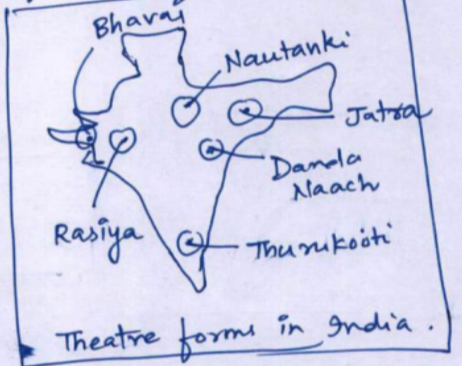
Traditional Theatres
- Yakshagana
- Jatra
- Dashavatar
- Ras Leela
- Ram Leela
- Swang
- Mudiyettu
-
-
Significance
- embodying values of dharma (righteousness) and karma (action).
- Ram Leela
- emphasizing virtues like bravery and sacrifice.
- Yakshagana on bravery of Abhimanyu
- Express collective emotions like love, grief, and social justice.
- Jatra
- Reflect common man’s challenges and societal norms.
- Nautanki
- critiques social evils
- Bhavai addresses dowry practices
- emphasizing virtues like honesty and loyalty
- Dashavatar
- Commentary on social issues often with a humorous undertone.
- Tamasha
- Individual’s responsibility towards family and kingdom
- Example: Pandavas fighting for justice in the Mahabharat
- Show individual’s devotion and service
- Example: Hanuman’s unwavering dedication to Lord Rama.
- Reflect individual’s role in social reforms
- Example: Female protagonists fighting against patriarchal oppression.
- Reflect the virtues expected of individuals in society
- embodying values of dharma (righteousness) and karma (action).
-
Thus, theatre play a crucial role in preserving cultural heritage and societal values.
MARTIAL ARTS
- Thang Ta - Manipur
- Gatka - Punjab
- Kalaripayattu - Kerela
- Mallakhamb -
- Silambam- Tamilnadu
- Other Important Martial Arts
VISUAL ART (SCULPTURES)
-
Introduction
- Sculptures serve as a visual record of the social life and culture.
-
What does it represent
- Values, beliefs, social life, activities, social stratification etc
-
Sculptures of Harappan Civilization
- Stone sculptures were created with soft river stone steatite.
- Bearded priest
- The terracotta sculpture is made from clay and baked on fire.
- mother goddess
- Bronze (Tin + copper) sculpture.
- Lost wax techniques were used for creating bronze sculptures.
- Dancing girl from Mohenjdaro.
- Stone sculptures were created with soft river stone steatite.
-
Sculptures of the Mauryan Age
- Yaksha and Yakshini
- Shalbhanjika Yakshini, Didarganj Yakshini
- Yaksha of Sanchi Stupa
- Yaksha and Yakshini
VISUAL ART
Introduction
- Sculptures serve as a visual record of the social life and culture.
What does it represent
- Values, beliefs, social life, activities, social stratification etc
Sculptures of Harappan Civilization
- Stone sculptures: were created with soft river stone steatite.
- Bearded priest
- The terracotta sculpture: is made from clay and baked on fire.
- mother goddess
- Bronze (Tin + copper) sculpture:
- Lost wax techniques were used for creating bronze sculptures.
- Dancing girl from MOHENJDARO.
Sculptures of the Mauryan Age
- Yaksha and Yakshini
- SHALBHANJIKA YAKSHINI, DIDARGANJ YAKSHINI
- YAKSHA OF SANCHI STUPA
Post-Mauryan Period
Introduction - which developed during KUSHANA and SUNGA period and reached it’s climax during the GUPTA’S.
| Basis of classification | Gandhara | Mathura | Amravati |
|---|---|---|---|
| Area | Northwest frontier province | Mathura | Lowe Krishna Godavari valley ⭐ (Should likely be ‘Lower’) |
| Material | Grey color sandstone | Red color sandstone | White marble |
| Influence | Greco-Roman and Bactrian influence. | No outside influence | |
| Religions associated | Buddhism | Buddhism, Jainism and Hinduism | Buddhism. |
| patronization | KUSHANA | KUSHANA | SATVAHAN and IKSHAVAKU. ⭐ (Common spelling is ‘Satavahana’) |
| Features | |||
| Images | Spiritual images of the buddha. Wavey hair, unshaven face, half-closed eyes, fewer ornaments, optimal clothing, lean body, etc. | Delighted images of Buddha. Combed hair, shaven face, fully open eyes, more ornaments, maximum cloth, round body. | |
| Influence | 1. The grace of Gandhara sculpture as inspired by Greek god APOLLO and ZEUS 2. masculinity of image was inspired from Greek characters ATLAS and HERCULES 3. Roman features. Large forehead, large earlobe, broad shoulders and chest, tall body, and realism in depiction. 4. Bactrian features (central Asia)-Image with headgear, mustaches, and depiction of weapons. | 1. Jaina sculpture. Sculptures of 24 TIRTHANKARAS were depicted and images of VARDHMAN MAHAVIR were often depicted in the naked form in natural surroundings. 2. Hinduism- a sculpture of Lord VISHNU was created and he was depicted with his Ayudh (arms with weapons). Lord SHIVA was also created in the form of SHIVALINGA and MUKHALINGA. | In Amaravati instead of creating a single dominating image, they preferred panel sculpture. Panel Sculpture were based on JATAKA KATHA (folk narratives). It tells the previous life story of Buddha. |
- Thus, MATHURA & GANDHARA Art cross-fertilized in due course of time, The result of this synthesis refined and purified the Buddha image that later became model for sculpture development in south-east Asia.
- Central
Jain Sculptures
- images depicting Tirthankars (RISHABHDEV, PARSHVANATH, MAHAVIR)
- AKOTA BRONZE of Gujarat
- CHAUSA BRONZE of Bihar
- MATHURA SCHOOL
Buddhist Sculpture
Gupta Sculpture
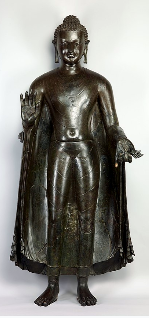
- Seated buddha emerged during Gupta period from SARNATH school of art.
- Sultanganj Buddha
Medieval School of Sculpture
- Chola - NATRAJ STATUE
Modern Indian Sculpture
Represent social life of those days
- Depict economic activities like agricultural practices, market scene, trading
- Festivals and Rituals are shown
- Religious ceremonies, and processions were vividly portrayed
- Example: The MEENAKSHI TEMPLE in Madurai portraying CHITHIRAI festival.
- provide details on contemporary clothing and ornaments
- Features musical and dance traditions
- Role of women
- Depict social hierarchies
- Centrality and powers of king
Conclusion
- The style of sculpture developed under the GUPTAS is often referred by scholars as “the International Style.” , cosmopolitan
NUMISMATICS
Gupta period demonstrated level of excellence
- Artistic excellence: detailed engravings, aesthetic appeal
- Example: The gold dinars of CHANDRAGUPTA II
- Standards and uniformity in coinage: highlight advance minting technology
- Example: The consistency in weight, size, and purity of GUPTA gold coins is unmatched
- Features cultural and religious symbols
- Example: The depiction of the goddess LAKSHMI on GUPTA coins
Decline in later period
-
Shift in priorities: less on artistic detail and more on mass production
-
Change in material: greater use of less precious metals like copper
-
Political instability
-
Economic constraints
-
However, this is a generalization and there would be certainly examples of exceptional coinage being produced even after the GUPTA era.